The alpha, twice a week
That was 3 min.
Get the best new moments in your inbox every Wednesday and Saturday. It's free.
Check your inbox
We sent a link to your address. Click it to finish signing up. Not there in a minute? Look in spam.
or
Decoder · 3 min · Nov 19, 2026
Incumbents should acknowledge hardship instead of citing statistics
 Jon Favreau
's campaign lesson from Obama's 2012 reelection: acknowledge that people are still struggling instead of reciting improving statistics.
In this episode
Full analysis- 11:13Data center backlash reflects a loss of local control4 min
- 25:05Creators need multiple platforms to reduce distribution riskPro pick 3 min
- 4:50Incumbents should acknowledge hardship instead of citing statistics3 min
- 28:33Partisan media faces a narrower pool of major advertisers3 min
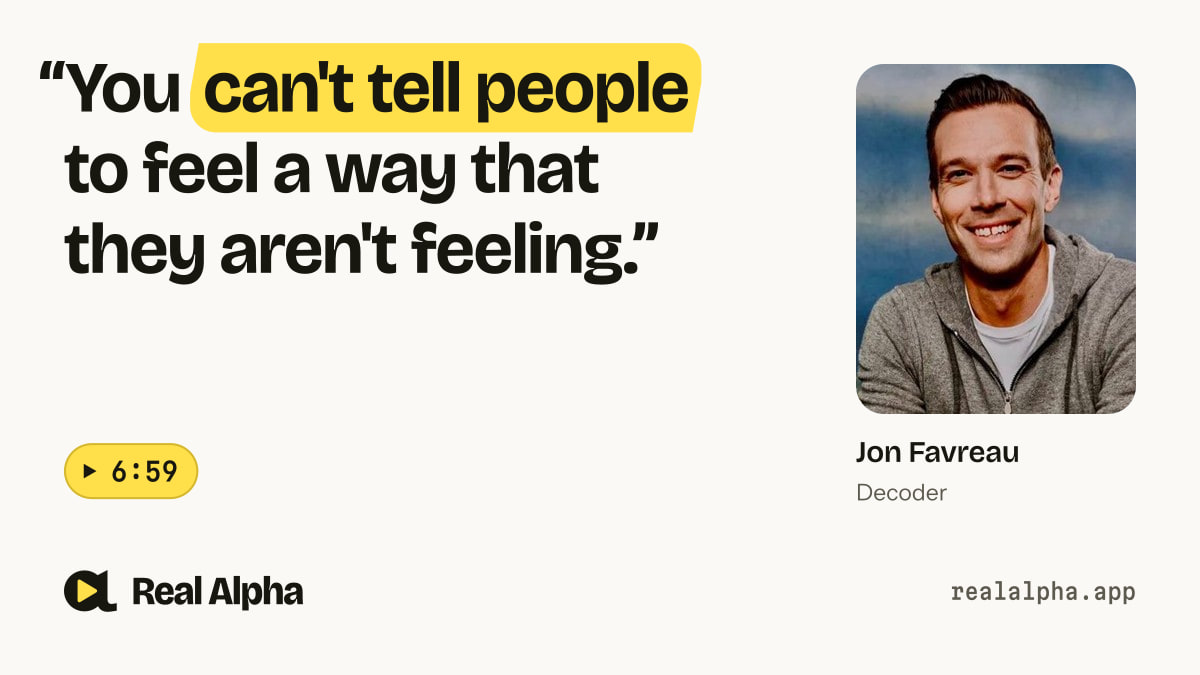
“You can't tell people to feel a way that they aren't feeling.”
 Jon Favreauat 6:59 · Decoder
Takeaways
- Admit when households still feel economic pressure.
- Frame the election as a choice without claiming conditions are already good.
- Do not tell voters that less important issues should matter more.
About this segment
Jon Favreau's campaign lesson from Obama's 2012 reelection: acknowledge that people are still struggling instead of reciting improving statistics. Voters notice when claims contradict their daily experience.

Jon Favreau is a political commentator and cofounder of Crooked Media.

Nilay Patel, Host · Editor-in-chief, The Verge
Helped start The Verge in 2011 and has hosted Decoder since 2020.
From “How Silicon Valley lost the public (w/Crooked Media’s Jon Favreau)”, Nov 19, 2026. Watch the full episode
Thanks. We'll look at and fix what's off.
Transcript
Transcribed by machine (Whisper) from the episode’s audio, so a word may be off here and there.
- 5:02
And so this is the same was true with Joe Biden, is Joe Biden can go out there and say, well, we passed this bill, we gave the checks out and things are getting better and we're just recovering from COVID and you're just you haven't felt it yet, but it's getting better. And look at the economic statistics and people are just like, no, I don't I don't feel that yet. And so I'm going to maybe, you know, give Donald Trump another try, even though I think he's a shitty guy and don't like him very much.
- 5:29
But maybe they remember the economy of the first term being good. I mean, we dealt with this, you know, when Obama ran and became president in 2009, they thought, okay, well, financial crisis, can't stand Bush anymore, going to try Obama, and then Obama gets into office, and first two years, the financial crisis is over, but the recession is still there. people are still out of work. And so they're like, Oh, I know you passed healthcare and I know you passed the recovery act, but I still can't find a job. The economy just still doesn't feel great to me. So it doesn't matter what you say you did or how great your messaging is. I don't feel it.
- 6:03
And so I'm going to, you know, vote in a Republican Congress. And it's been like that for as long as I've been in politics now. Is there some reason the incumbent party does not realize that saying something that sounds like the fundamentals of the economy are strong kills you because you you're describing a pattern that repeats and it's it's that phrase almost exactly yes i mean that's why we understood it once 2012 rolled around because people were still not satisfied with the economy when obama was running for re-election and we did everything we could to make that election a choice and we acknowledged that people were still struggling and people were still in pain, we totally avoided the like long, you know, list of statistics about how wonderful the economy was getting and how everyone had recovered and all that kind of stuff.
- 6:50
And we just said, look, it's a, things are still, things are still rough out there, but it's a choice. And this is the kind of vision Mitt Romney has for the economy. And this is the vision we have for the economy. And so you get to pick one. So like, I think there's a way if you are the incumbent party in power to still keep people on your side, but you've got at least a have to acknowledge and be honest about how people are feeling. You can't tell people to feel a way that they aren't feeling. And you can't tell people that a whole bunch of issues are important that aren't the issues that matter most to them in their lives, or at least to most people, which is like, do I feel economically secure? And do I actually feel safe? That's why people care about crime and they care about safety in their communities. And then they also care