The alpha, twice a week
That was 3 min.
Get the best new moments in your inbox every Wednesday and Saturday. It's free.
Check your inbox
We sent a link to your address. Click it to finish signing up. Not there in a minute? Look in spam.
or
20VC · 3 min · Oct 24, 2026
Inference could become a $10 trillion market
 Naveen Rao
 argues inference demand can grow as AI absorbs labor and cheaper tokens enable new uses.
The episode’s best minutes
Full analysis- 56:34Inference could become a $10 trillion market3 min
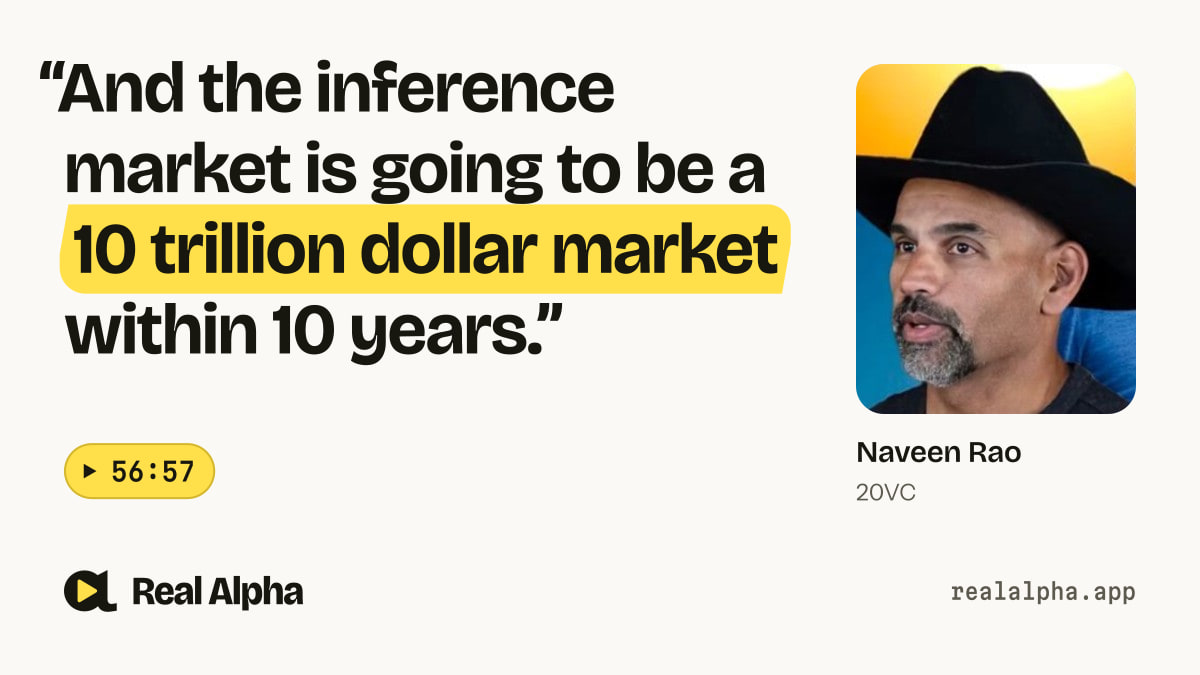
“And the inference market is going to be a 10 trillion dollar market within 10 years.”
 Naveen Raoat 56:57 · 20VC
Takeaways
- Rao forecasts a $10 trillion inference market within a decade.
- A tenfold efficiency gain can expand the range of useful applications.
- He expects robotics to outsize coding agents.
About this segment
Naveen Rao argues inference demand can grow as AI absorbs labor and cheaper tokens enable new uses. He expects robotics to be even larger than coding agents because intelligence will reach physical problem-solving.

Naveen Rao is founder and CEO of Unconventional AI.
Co-founder and CEO of Unconventional AI; founded and sold Nervana Systems to Intel and MosaicML to Databricks.

Harry Stebbings, Host · Founder, 20VC
Built a venture firm on his podcast; its third fund closed at $400M.
From “Inference Will Be $10TRN Market: What No One Sees | Software Investors are F***ed | Naveen Rao”, Oct 24, 2026. Watch the full episode
Answers “What will AI look like in the next few years?” See all 395 answers
Thanks. We'll look at and fix what's off.
Transcript
Transcribed by machine (Whisper) from the episode’s audio, so a word may be off here and there.
- 56:47
market. What do I know now that I wish I'd known 24 months ago? That the inference market was just like unbounded. It's unbounded. It's multi trillions. Like if you asked me 10 years ago, you know, what were trillion dollar markets? It's basic needs. It's housing, food, transportation, right? You would never have thought something in tech would be a trillion dollar market. And I think just AI models themselves will be a trillion dollar market in the next few years.
- 57:09
And the inference market is going to be a 10 trillion dollar market within 10 years. So this is insane to think about, right? And to your point, we're moving some of that labor market and part of the value generation stack to technology. So that's where we're getting these giant TAMs. So the way I look at like unconventional, the reason that I think it's a fantastic market to be in is that if we knock off a zero, one order magnitude of efficiency on delivery of a token, that effectively 10Xs the market in some ways.
- 57:38
So if something was a trillion dollar market, now all of a sudden you have way more applicability. The base of potential uses just increases more than 10x. This is Jevin's paradox. So I think we're in this place where we can build these exponentials and just unlocks massive value and market. So I actually think robotics is going to be 100 times larger than agentic coding. Well, that is slightly disagreeing with me, Naveen.
- 58:00
Can we just like, before we do a quick fire, can we just unpack that? Because I don't want to be completely moronic. Why do you say that? I think we're still scratching the surface of how to see the output of intelligence. So the physical world is something we've just not been in at all for intelligence. Like I would argue robotics to date, like industrial robotics, are not really intelligent. They're rote.
- 58:21
We're imbuing them with intelligence that we have, like how to do a task, and we're just doing it rote. That's not really novel problem solving. We will be in the realm of physical problem solving in a not distant future. Like imagine a world where I have billions of robots roaming around and they actually solve problems dynamically. That's a problem. That thing just broke. I'm going to go clean it up.
- 58:40
I'm going to I'm going to replace it. Like the cost of delivery of cleaning everything up in our world, building new buildings, you know, solving physical problems will not drop to zero. I hate those drop to zero kind of statements. It will greatly reduce. So I think that market will be enormous. And that's why I think it's just going to be much bigger than what we see today in the virtual world.