The alpha, twice a week
That was 3 min.
Get the best new moments in your inbox every Wednesday and Saturday. It's free.
Check your inbox
We sent a link to your address. Click it to finish signing up. Not there in a minute? Look in spam.
or
Bloomberg Daybreak: US Edition · 3 min · Oct 30, 2026
Inflation is suppressing hiring despite strong profits
 Anna Wong
 says firms are absorbing higher input costs by improving efficiency instead of hiring.
The episode’s best minutes
Full analysis- 2:48Inflation is suppressing hiring despite strong profits3 min
- 18:24The BOE may hike as insurance against renewed energy inflation3 min
- 28:28AI investment may keep Australian inflation pressure highPro pick 7 min
- 3 more moments in the full episode
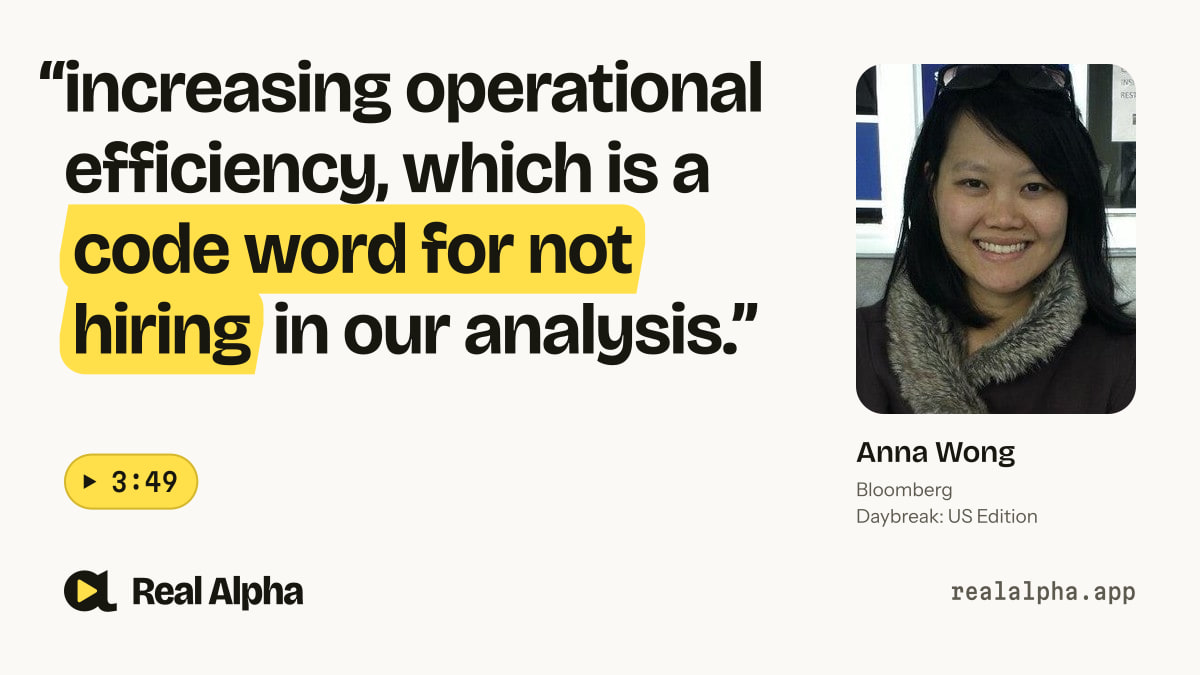
“increasing operational efficiency, which is a code word for not hiring in our analysis.”
 Anna Wongat 3:49 · Bloomberg Daybreak: US Edition
Takeaways
- Bloomberg Economics forecasts 26,000 new jobs in October.
- About 50,000 jobs are needed to keep unemployment steady.
- Demand-driven disinflation could bring more layoffs, not more hiring.
About this segment
Anna Wong says firms are absorbing higher input costs by improving efficiency instead of hiring. If inflation falls because demand weakens, she warns, unemployment could rise further.

Chief US economist, Bloomberg
Leads Bloomberg Economics' US analysis after roles at the Fed, White House Council of Economic Advisers and Treasury.
- NH
Nathan Hager, Host · Host, Bloomberg
From “Daybreak Weekend: US Jobs, BOE Meeting, RBA Decision | Bloomberg Daybreak: US Edition”, Oct 30, 2026. Watch the full episode
Thanks. We'll look at and fix what's off.
Transcript
From the transcript Bloomberg Daybreak: US Edition publishes with the episode.
- 2:50
just that price pressures have been as elevated as they've been all this time? That is a great observation, Nathan. And I wish more people would have made that observation you made, because there is actually a connection to firms hiring versus the cost that they're dealing with. So one way that firms have been handling these higher raw material costs and Input costs, higher health care premium costs is by not hiring as much as they would. We saw this in earning calls.
- 3:24
And the interesting irony is that we are seeing spectacular earning growth, right? In the last quarter and so far, this quarter in the earning season, the firms are still reporting very strong BITs. And so how is it that firms are not hiring? Well, it's because exactly that they're also all reporting very strong input cost growth and firms are handling that via operational efficiency, increasing operational efficiency, which is a code word for not hiring in our analysis.
- 3:59
So I think this low hiring, low firing environment is not necessarily. A stable environment, either going forward, inflation eases, then firms will even have more spectacular earnings and they will hire more because profits have increased. But that is conditional on the assumption that this inflation that we're seeing is purely supply driven. And however, if what happens today, in the future is that inflation eases because the fed hikes interest rate credit spreads widen generating demand destruction. That is not conducive to increasing hiring and that kind of inflation decrease would actually lead to more firing and worsened trajectory for labor market. In fact, when we look at forward-looking forecasting models, such as the one that the Fed used as its workhorse model. The term premium increase that we have seen
- 5:05
in the 10-year yields since March of this year is consistent with credit spread widening in the Q4 and going into next year. And in the case where the Fed is not accommodating this credit spread widening, they're actually holding rates constant, or even worse, hiking, The models would actually suggest that unemployment rate should be ticking up by 0.1 percentage point this quarter and rising by another 0.4 percentage point next year. So I think along our current trajectory, our view is that this low-firing, low-hiring mode will not be a stable one. We might see more firing going into the new year at the end of the year.