The alpha, twice a week
That was 8 min.
Get the best new moments in your inbox every Wednesday and Saturday. It's free.
Check your inbox
We sent a link to your address. Click it to finish signing up. Not there in a minute? Look in spam.
or
This Past Weekend w/ Theo Von · 8 min · Nov 3, 2026
Instacart tested how much shoppers would pay for groceries
 Lindsay Owens
 describes tests showing Instacart varied prices for identical groceries, while ticketing and delivery apps varied fees.
The episode’s best minutes
Full analysis- 24:22Instacart tested how much shoppers would pay for groceries8 min
- 1:07:01Retailers use personal data to vary prices and monetize loyaltyPro pick 7 min
- 1:29:06AI shopping assistants can ignore requests for the cheapest option7 min
- 5 more moments in the full episode
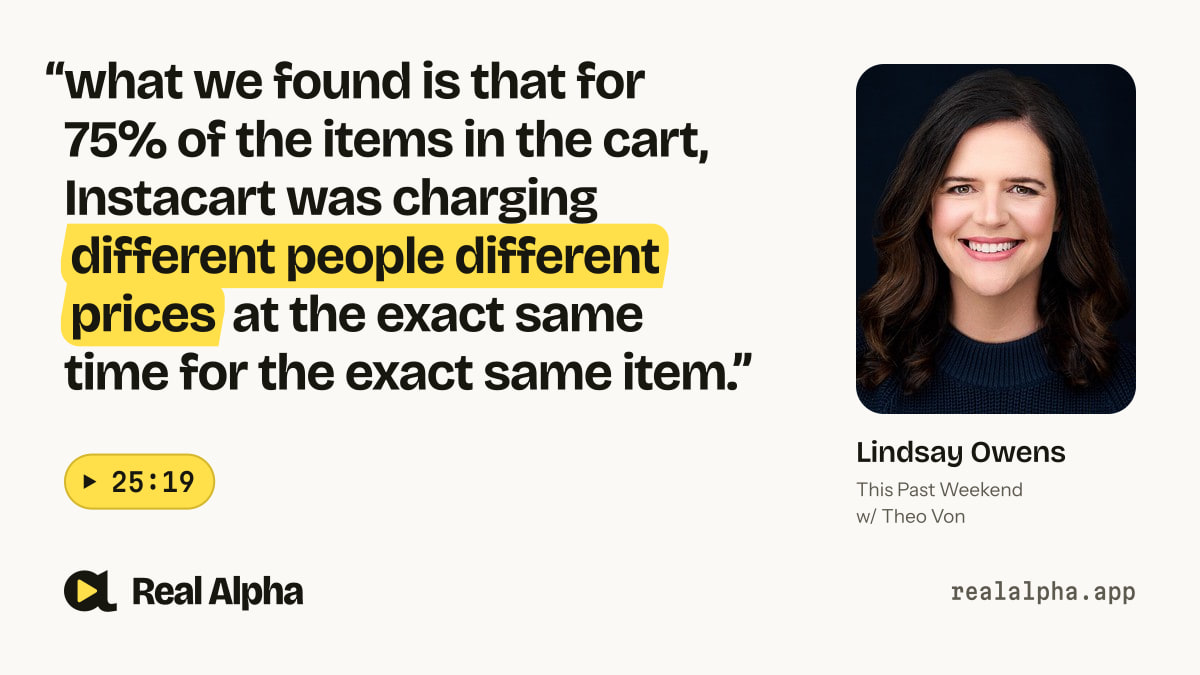
“what we found is that for 75% of the items in the cart, Instacart was charging different people different prices at the exact same time for the exact same item.”
 Lindsay Owensat 25:19 · This Past Weekend w/ Theo Von
Takeaways
- 75% of tested grocery items had different prices for different shoppers.
- Some identical items differed in price by as much as 23%.
- DoorDash withdrew a patent linking user behavior to promotions.
About this segment
Lindsay Owens describes tests showing Instacart varied prices for identical groceries, while ticketing and delivery apps varied fees. Public exposure led Instacart to end its pricing experiment.

Lindsay Owens is a consumer protection expert and author of Gouged.
Exposed corporate pricing power and profiteering, shaping debate on inflation, affordability and consumer protection.

Theo Von, Host · Host, This Past Weekend w/ Theo Von
From “Corporate Watchdog: You’re Being Experimented On Every Time You Shop | Lindsay Owens #693”, Nov 3, 2026. Watch the full episode
Thanks. We'll look at and fix what's off.
Transcript
Transcribed by machine (Whisper) from the episode’s audio, so a word may be off here and there.
- 24:27
So we, yeah. So we like hired these, like we got these volunteer secret shoppers and we said, all right, like fire up the Instacart app, set your pickup location, like, you know, a Kroger in Nashville, Tennessee, for example, buy these 23 grocery items. Like get the same items. Yeah, exact same items. Like, get a dozen Lucerne eggs, get a 16-ounce box of Frosty Flakes, right? Like, the store brand Frosted Flakes, right?
- 24:52
Yeah. It was normal stuff, like breakfast, lunch, dinner, deli meat, apples. Cheez-Its. I think we did, like, Tostitos. Yeah. That's good. Like the normal stuff that you would buy, or maybe it was ruffles. Okay. Okay, so it's 23 items. We said, put it in your cart, and then just take a picture. Like, take a picture of your— Of the cart. Of a cart, so that we know, like, what your cart total was and how much you were going to get charged for every item in your cart.
- 25:17
And then we took all those screenshots, and we had the team enter them into a spreadsheet, and we just crunched the numbers. And what we found is that for 75% of the items in the cart, Instacart was charging different people different prices at the exact same time for the exact same item. How were they basing the pricing on? Was it just on where you lived? Well, by the way, the price differences, as much as 23%.
- 25:41
Wow. So this wasn't like a nickel or a penny. Like you could be charged 23% more for a dozen eggs than me, which could be like a buck 50 for a dozen eggs, which is just insane. Eggs are already so expensive right now. Well, it's just not fair. It's like, what is the price of it? Right. Like it used to be that if you and I went to the grocery store together and we stood in line and we both bought a gallon of milk, we would get charged the same amount. Right. And if we didn't, like you and I would look at each other and we'd like pull out our receipts and we'd be like, one of us, you made a mistake. Like one of us got charged the wrong amount. Right. And now it's like, no, that's not a mistake. Like that's the whole ball game. And what was it based on? It was based on your location.
- 26:15
So we held all of that constant. So same location, same store. What we learned is that Instacart, They basically admitted this in their response to us when we released the investigation. They were just running experiments to see how much they could charge us for every item in the cart. And so they were just testing the outer bounds of like, you know, how much they could get away with charging for eggs, how much for milk.
- 26:40
Like, you know, if you were making a sandwich, they were trying to test how much they could get you to fork over for every single item in the sandwich. Like the deli meat, the mustard, the lettuce, the tomato, the bread, right? And actually, like, they admitted it. They said, oh, yeah, this is just like our typical A-B testing that we do to, like, make life more affordable for Americans who are shopping on Instacart.
- 27:03
But they were letting people pay the higher prices. They weren't just having it be, wow, that's not. Yeah, of course. Like, they were definitely charging the prices in the experiment. And were they getting people's consent to do that? Do they have to have people's consent? No, you definitely didn't consent to this. And in fact, part of the reason that we knew that Instacart was doing this, like we designed our experiment expecting to be able to expose their experiment is because they had purchased an AI company called Everett.
- 27:30
Eversight. And Eversight's entire reason for existence was that they built software to help companies run experiments on you without your knowledge. Like that's the whole ballgame. Eversight is an AI-powered pricing and trade promotion optimization company. Eversight was acquired by Instacart in September 2022 to enhance its grocery pricing and trade promotion technology. Instacart faced regulatory scrutiny and public backlash regarding dynamic and inconsistent It's an ad pricing test through Eversight, leading Instacart to wind down in the Eversight AI pricing tool.
- 28:04
Wow, did you guys' findings help lead to that? And wow, congrats. Yeah, thanks. Yeah, two weeks after the study was released, they folded and like right before Christmas, like December 22nd, they put up a little blog post that was like, you know, maybe we got this one wrong. Like from now on, like two people who are shopping at the same store at the same time will pay the same price. Wow. Yeah. But look, this is like whack-a-mole because there are so many other companies that are doing the exact same thing that Instacart is doing.
- 28:32
Like we just did a couple of weeks ago an experiment with the Today Show where we had everyone buy Harry Styles tickets at Madison Square Garden on StubHub. Okay. And the underlying ticket price was identical. Like, you know, we all bought the same seat, right? Like row M, seat four, whatever. And the underlying ticket price was the same, right? Like the resellers were not playing games with prices.
- 28:55
Like they had a fixed price. But StubHub was experimenting on how much they could charge in fees to different concert goers. And some of the fee differences in this experiment were $60 difference. So, like, you could be charged $60 more for the, like, delivery fee, whatever that is. Like, they send you the QR code. I don't know what, like, they're delivering. But, like, you could be charged $60 more than me for the delivery fee.
- 29:20
We have seen this when we have run experiments on Uber Eats and DoorDash where we, like, sit in the conference room. I mean, this is like what you do at a think tank. You like, you know, do research. So we like order lunch, right? And we're like, what's going on with Uber Eats? And we'll all order the same item from McDonald's, for example. And what you'll see is that Uber Eats and DoorDash are running experiments on those delivery fees and service fees and things like that, charging some of us more than others for the, like, to deliver the exact same product to the exact same location.
- 29:49
How are they determining that it's more to you or that you will pay more? Like, how do they determine that I'll pay more for McFish or whatever than somebody else would pay? Well, this is a great question. So over the summer, I testified for Josh Hawley in Congress. H-A-W-L-E-Y? Yeah. He's one of the guys I see investigating this type of stuff the most. He's a senator. Yeah, absolutely. I mean, he really has no fear when it comes to holding corporations to account.
- 30:18
And during the hearing, we talked about a patent that DoorDash had filed for what they called their agitation index. Okay. And the agitation index was made up of 16 different factors, but it included how quickly you scroll in the DoorDash app, how jerkily you scroll in the DoorDash app, which I imagine was like, I don't know, like your blood sugar or something. You're really hungry or hangry and you're just like, you know.
- 30:44
Oh, if you're just like, oh, I need a damn McMuffin. Like right now. Yeah. By the way, your phone battery was one of the variables because I guess if your phone battery is about to die, like you've got to get the order in, right? Oh, really? yeah like even if they know your screen like your brightness is set really low like this guy has 40 seconds to get a 10-piece mcnugget right so like he'll probably pay 40 for it right so price up yeah so all of this went into their agitation index and they filed a patent that was going to allow them to connect the agitation index to um the types of promotions that different um users got right so whether or not you'd get a discount or something detecting user agitation application interaction and this is on uh patents dot uh justia um well so interestingly justice i guess
- 31:35
we what does it mean maybe it's latin i don't know just yeah a method includes retrieving by the user device from a database on the user device historical data and real-time client device data the method includes determining an agitation score based on the real-time client device data and the historical data and then performing an action based on the agitation score. So that is what the patent is for. Yep. Wow. Interestingly, I will say, you know, when, when, you know, Josh Hawley and I talked about this in Congress and, you know, it's like on the record a couple of days later, DoorDash quietly withdrew the patent. Really? Yeah. Yeah. So all some of this stuff, it's just, it's just shining a light on it. Absolutely. Right. Absolutely. Like In the book, I tell this crazy story.
- 32:22
In the 1990s, the CEO of Coke was down in Brazil, like probably thought no one was paying attention. It's like the 90s in Brazil. Yeah.