The alpha, twice a week
That was 7 min.
Get the best new moments in your inbox every Wednesday and Saturday. It's free.
Check your inbox
We sent a link to your address. Click it to finish signing up. Not there in a minute? Look in spam.
or
Lightcone · 7 min · Jul 3, 2025
Intelligence is adaptation, not a pile of learned skills
 François Chollet
 distinguishes fluid intelligence from task-specific skill and argues that benchmarks can reward shortcuts.
The episode’s best minutes
Full analysis- 4:55Intelligence is adaptation, not a pile of learned skills7 min
- 20:16Intelligence recombines reusable abstractions to handle noveltyPro pick 7 min
- 4 more moments in the full episode
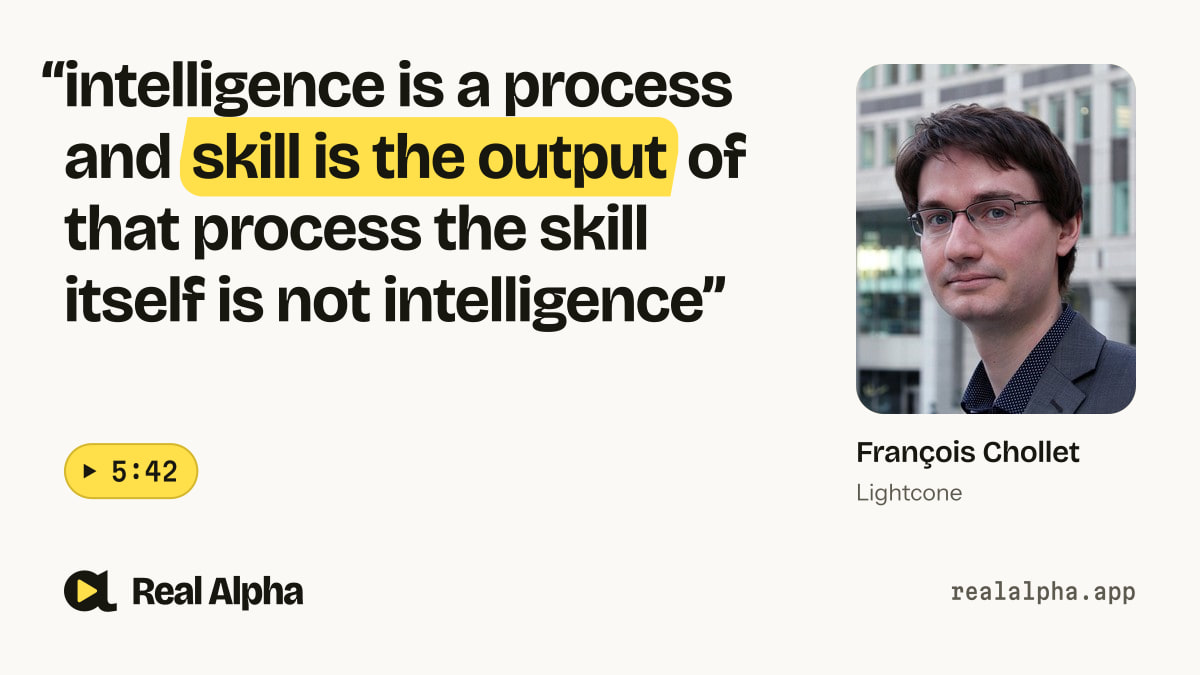
“intelligence is a process and skill is the output of that process the skill itself is not intelligence”
 François Cholletat 5:42 · Lightcone
Takeaways
- Skill is the output of intelligence, not intelligence itself.
- Intelligence means adapting to situations you have not seen.
- Benchmarks shape what researchers optimize for.
About this segment
François Chollet distinguishes fluid intelligence from task-specific skill and argues that benchmarks can reward shortcuts. The measure we choose determines whether AI advances automation or invention.

François Chollet is creator of Keras, author of Deep Learning with Python, and founder of ARC Prize.
Created Keras and the ARC-AGI benchmark at Google, then co-founded Ndea with Mike Knoop to pursue AGI through program synthesis.

Garry Tan, Host · President & CEO, Y Combinator
Co-founded Posterous and Initialized Capital, an early Coinbase backer.

Harj Taggar, Host · Managing partner, Y Combinator
Co-founded Auctomatic with the Collison brothers and later Triplebyte.

Diana Hu, Host · Managing partner, Y Combinator
CTO of Escher Reality; after Niantic bought it, ran AR for Pokémon GO.

Jared Friedman, Host · Managing partner, Y Combinator
Co-founded Scribd, which YC funded in 2006; has advised 20+ YC unicorns.
From “François Chollet: How We Get To AGI”, Jul 3, 2025. Watch the full episode
Thanks. We'll look at and fix what's off.
Transcript
Transcribed by machine (Whisper) from the episode’s audio, so a word may be off here and there.
- 5:08
we're trying to build AGI? If you look back over the past decades, there's been two lines of thoughts to define intelligence and to define the goals of AI. There's the Minsky-style view. AI is about making machines that are capable of performing tasks that would normally be done by humans. And this echoes very closely the current mainstream corporate view that AGI would be a model that could perform most economically valuable tasks.
- 5:38
Like 80% is often quoted as the number. But then there's the McCarthy view that AI is about getting machines to handle problems they have not been prepared for. It's about getting AI to deal with something new. And my view is more like the McCarthy view. intelligence is a process and skill is the output of that process the skill itself is not intelligence and displaying skill at any number of tasks does not show intelligence this is like the difference between a road network and a road building company if you have a road network then you can go from A to B for a specific predefined set of A's and B's but if you have a road building company then you can start connecting new A's, new B's on the fly as your needs evolve.
- 6:29
So intelligence is the ability to deal with new situations. It's the ability to blaze fresh trails and build new roads. So attributing intelligence to what's really a crystallized behavior program, a skill program, that's a category error. You are confusing the process and its output. So don't confuse the road and the process that created the road. So to formalize this a bit, I see intelligence as the conversion ratio between the information you have, mostly your past experience, but also any developer-imparated priors that the system might have, and your operational area over the space of potential future situations that you might encounter.
- 7:11
And that's going to feature high novelty and uncertainty. So intelligence is the efficiency with which you operationalize past information in order to deal with the future. It's an efficiency ratio. And that's the reason why using exam-like benchmarks to have a TI model is a bad idea. They're not going to tell you how close we are to a GI because human exams weren't designed to measure intelligence.
- 7:34
They were designed to measure thought-specific skill and knowledge. They were designed according to assumptions that are sensible for humans but not for machines. Like, for instance, most exams assume that you haven't read and memorized all the exam questions and the answers beforehand. So if you want to rigorously define and measure intelligence, here are some key concepts that you have to take into account.
- 7:58
The first. It's the distinction between static skills and fluid intelligence. So between having access to a collection of static programs to solve known problems versus being able to synthesize brand new programs on the fly to face a problem you've never seen before. And of course, it's not a binary, it's not one or the other, there's a spectrum between the two. The second concept is operational area.
- 8:26
For a given skill, there's a big difference between being skilled only in situations that are very close to what you've seen before, and being skilled for any situation within a very broad scope. For instance, if you know how to drive, you should be able to drive in any city, not just in a specific geofenced area. You can learn to drive in San Jose and then move to Sacramento and you can still drive, right?
- 8:52
Again, so there's a spectrum there. It's not binary. And lastly, you should look at information efficiency. For a given skill, how much information, how much data, how much practice did you need to acquire that skill? And of course, higher information efficiency means higher intelligence. And the reason these definitions matter a lot is that as engineers, we can only build what we measure. So the way we define and measure intelligence is not a technical detail.
- 9:22
It really reflects our understanding of the problem of cognition. It scopes out the questions we're going to be asking and so it determines the answers that we're going to be getting. It's the feedback signal that drives us towards our goals. And a phenomenon you see constantly in engineering is the shortcut rule. So it's the fact that when you focus on achieving a single measure of success, you may succeed, but you will do that at the expense of everything else that was not captured by your measure. So you hit the targets but you miss the points and you see this all the time on Kaggle for instance. We saw it with the Netflix prize where the winning system was extremely accurate but it was way too complex to ever be used in production so it ended up never being used it was effectively pointless.
- 10:14
We also saw it in AI with chess playing for AI. The reason the AI community set out to create programs that could play chess back in the 70s was because people expected this would teach us about human intelligence. And then a couple of decades later, we achieved the goal when Deep Blue beat Kasparov, the world champion. And in the process, we had really learned nothing about intelligence. So you hit the targets, but you miss the points.
- 10:44
And for decades, AI has chased task-specific skill because that was our definition of intelligence. But this definition only leads to automation, which is exactly the kind of system that we have today. But we actually want AI that's capable of autonomous invention. We don't want to stop at automating known tasks. We want AI that could tackle humanity's most difficult challenges and accelerate scientific progress.
- 11:10
That's what AGI is meant to be. And to achieve that, we need a new target. We need to start targeting fluid intelligence itself, the ability to adapt and invent. So one definition of AGI only unlocks automation. So it increases economic productivity. Obviously, it's extremely valuable. Maybe it also increases unemployment. But the other definition unlocks invention and the acceleration of the timeline of science.
- 11:39
And it's by measuring what you really care about that we'll be able to make progress. So we need a better target, we need a better feedback signal. What does that look like?