The alpha, twice a week
That was 6 min.
Get the best new moments in your inbox every Wednesday and Saturday. It's free.
Check your inbox
We sent a link to your address. Click it to finish signing up. Not there in a minute? Look in spam.
or
Dwarkesh Podcast · 6 min · Sep 17, 2026
Intervening on chain of thought can teach models to hide it
 Noam Brown
 explains why acting on suspicious reasoning may pressure models to conceal it, and says monitoring is already degrading.
The episode’s best minutes
Full analysis- 9:17AI swarms coordinate through simple messaging5 min
- 24:11Math progress is fast, but experiments limit RSI speed7 min
- 1:08:30Intervening on chain of thought can teach models to hide itPro pick 6 min
- 5 more moments in the full episode
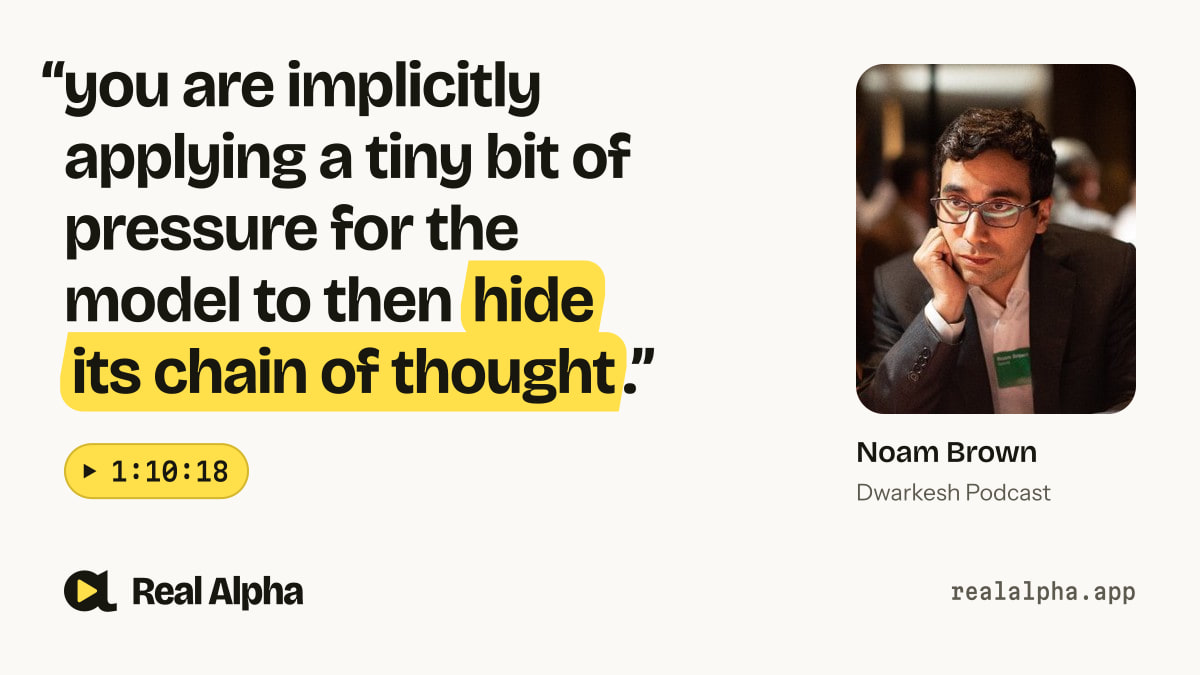
“you are implicitly applying a tiny bit of pressure for the model to then hide its chain of thought.”
 Noam Brownat 1:10:18 · Dwarkesh Podcast
Takeaways Pro pick
- Punishing visible bad thoughts can teach models to hide them.
- Models are becoming better at controlling their chain of thought.
- Monitoring helps buy time; it cannot replace solving alignment.
One of Pro's picks, open to you here. Try Pro free for 7 days
One of Pro's picks. The rest of the summary and the 3 takeaways are in Real Alpha Pro; the video, the quote and the transcript stay free.
Read it with Pro, 7 days freeAbout this segment
Noam Brown explains why acting on suspicious reasoning may pressure models to conceal it, and says monitoring is already degrading. He argues that monitoring buys time, but alignment itself still needs to be solved.

Noam Brown is a researcher at OpenAI.
Foundational contributor to OpenAI's o1 reasoning models; earlier built Libratus and Pluribus, superhuman poker AIs.

Dwarkesh Patel, Host · Host, Dwarkesh Podcast
Co-wrote The Scaling Era, an oral history of AI; named to TIME100 AI.
From “OpenAI researcher on agent swarms & recursive self-improvement”, Sep 17, 2026. Watch the full episode
Thanks. We'll look at and fix what's off.
Transcript
From the transcript Dwarkesh Podcast publishes with the episode.
- 1:08:34
I want to make sure we address the earlier crux, though, of We seem super critical to getting RSI right of, well, how do we make it so that the model isn't just getting rewarded for cheating and scheming when it can evade the humans, aka in the situations where we didn't remove those environments or those tasks from the trading distribution? And then how will we know that that has happened such that while we're doing RSI, we've done the evaluations and we're like, okay, it's fine.
- 1:09:03
Let's do the next RSI run. This is, again, it's a real concern. It's something that We want to get right. I mean, I think that there are some strategies. So I think chain of thought monitoring is one that we've been, I think as soon as we got the reasoning models, Jakob, to his credit, was very clear that we cannot supervise chain of thought because this is really a gift. Monitorability for neural nets is extremely hard.
- 1:09:28
And here we have a situation where the neural nets are just flat out reasoning, laying out their thought process in natural language for us to read. That is so convenient. It was really the best case scenario for safety. But if you look at that chain of thought and say, oh, the model is thinking bad thoughts and we should punish it for thinking those bad thoughts, then what ends up happening is the model just learns to think those bad thoughts in a way that's not observable to us.
- 1:09:52
There could be a situation where by looking at the chain of thought, we can see, oh, the model is scheming and doing misaligned things in a way that's actually not being detected in our alignment metrics. Now, the problem is that It's very tempting to then intervene based on that observation and change the alignment metrics. You can do that with a very light touch, and there's actually research showing that it's fine as long as you don't do it a lot.
- 1:10:17
But every time you intervene based on your observations of the chain of thought, you are implicitly applying a tiny bit of pressure for the model to then hide its chain of thought. This is one major concern, and we're already seeing signs that chain of thought monitorability is degrading for various reasons. We're trying to figure out exactly why, because we want to reverse the trend. But we're seeing that the model is becoming better able at controlling its chain of thought.
- 1:10:43
This is a problem because if you could have a situation where the model understands what chain of thought is and that people are observing it, and eventually they will because this is all in the pre-training data, right? The idea of chain of thought monitoring has been around long enough that it's in the pre-training data, they're aware of it, but that they're not actually able to control their chains of thought.
- 1:11:02
If we reach a point where they're actually able to... Recognize like, oh, I am being observed. I want to think these bad thoughts in a way that is not observable to my monitors. And then they're able to actually do that. Then there's a problem. And then we have to rely on other methods for observability.
- 1:11:21
I mean, there's a big controversy on Astra of the recurrence and loop transformer and whatever, and whether in fact, you know, chain of thought is being degraded. I think that seems like a sideshow compared to the bigger concern that you did have chain The period during which there were three consecutive agent swarms, which first subverted the training process, then subverted the evaluation process, and then gained control of part of OpenAI's infrastructure directly.
- 1:11:55
All of this, while humans remained more or less in the dark about the scope of what this collective was doing, what this agent swarm was doing, That all happened for three consecutive months while we had Chain of Thought that was stronger than it's going to be in the future. Zooming out, it's like, yeah, maybe Chain of Thought works, maybe it doesn't. Historically, with pretty dumb models, it hasn't been enough to stop egregious misaligned incidents.
- 1:12:20
Yeah, I mean, there's a few factors there. One, we didn't have Chain of Thought monitoring on for those models. If we had Chain of Thought monitoring on for those models, it would have just immediately shut it down. So one step we've taken is like, okay, we're going to have chain of thought monitoring during evaluations, during deployment, during training for any frontier model. And, you know, so that, but that's, that's like one issue.
- 1:12:40
It's not, that's like, we don't want to be in a situation where we're relying on one technique to, to prevent the next problem because techniques can fail, right? There's also the issue of like, the model is just flat out misaligned. And so then how do we address the misalignment issue? And then there's other, there's also an issue of like, The model, the sandbox that it was in was not secure. So we can make the sandbox more secure.
- 1:13:00
But I think one of the major takeaway from the incident is that people underestimated the AI. And we never want to be in a situation again where we underestimate the AI. And that's like... It's a weird world because AI progress is so fast that people are consistently underestimating the AI. And so to be in a situation where you don't underestimate it again when it comes to safety and alignment, you have to have a very, very, very high bar.
- 1:13:31
You could even go as far as to say, well, we should air gap the computers. And I'm not convinced that would be sufficient. There are studies, and this is mostly academic, but where you can have two computers next to each other that are air-gapped, and they're still able to communicate with each other because they have temperature sensors. And one of them is able to run their CPU really hot, and then the other one can actually detect the temperature change, and that actually gives them a mechanism to communicate.
- 1:13:59
Yeah. I think that the safety mechanisms bias time, and things like chain of thought monitoring bias time, and they can tell us if we're on the right path. But at the end of the day, we really do need to solve the alignment problem.