The alpha, twice a week
That was 6 min.
Get the best new moments in your inbox every Wednesday and Saturday. It's free.
Check your inbox
We sent a link to your address. Click it to finish signing up. Not there in a minute? Look in spam.
or
Sourcery · 6 min · Nov 19, 2026
IPO wealth needs patience and diversification
 Andrew Feldman
 describes the stress of sudden wealth and offers practical guidance for employees with concentrated stock.
The episode’s best minutes
Full analysis- 58:08AI demand is broader than the revenue figures suggest5 min
- 10:01IPO wealth needs patience and diversificationPro pick 6 min
- 36:47Hardware companies take years to scale4 min
- 5 more moments in the full episode
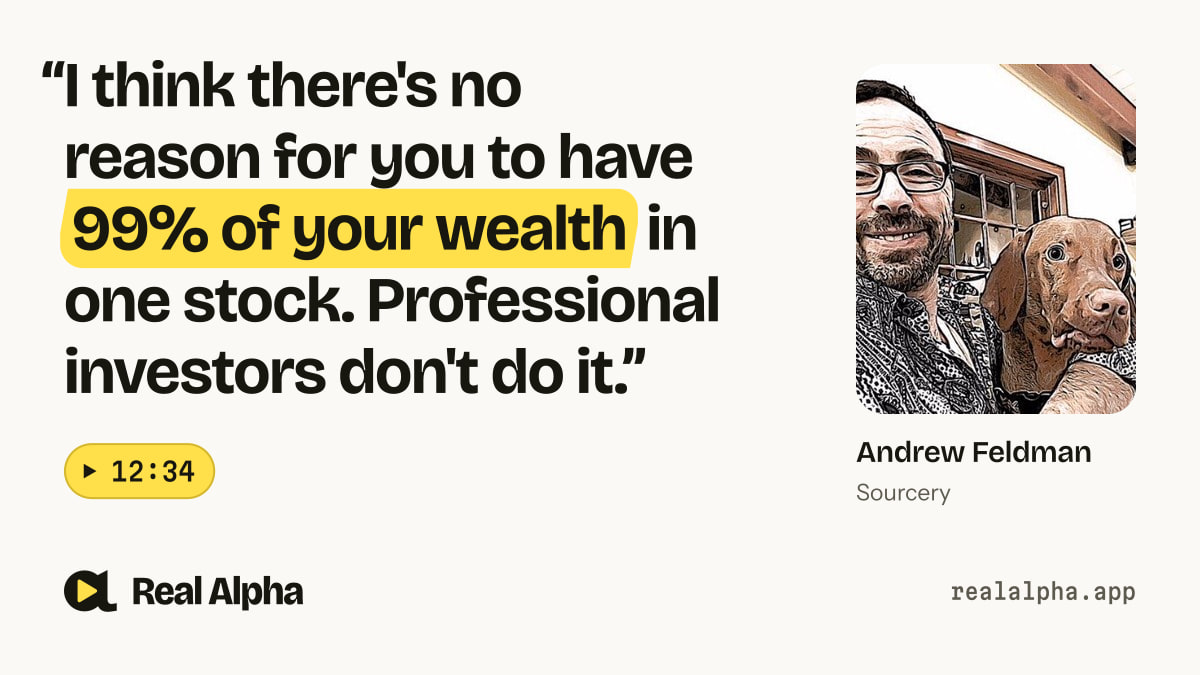
“I think there's no reason for you to have 99% of your wealth in one stock. Professional investors don't do it.”
 Andrew Feldmanat 12:34 · Sourcery
Takeaways Pro pick
- A volatile stock price can make sudden wealth psychologically difficult.
- It is reasonable to sell some shares to reduce concentration risk.
- After a cash gain, take time before making big decisions.
One of Pro's picks, open to you here. Try Pro free for 7 days
One of Pro's picks. The rest of the summary and the 3 takeaways are in Real Alpha Pro; the video, the quote and the transcript stay free.
Read it with Pro, 7 days freeAbout this segment
Andrew Feldman describes the stress of sudden wealth and offers practical guidance for employees with concentrated stock. His advice: diversify some, pause before big decisions, and reflect on your values.

Co-founder & CEO, Cerebras
Co-founded and leads Cerebras Systems, whose wafer-scale engine is the largest processor in computing history.

Molly O'Shea, Host · Founder, Sourcery
Ex-Upfront Ventures investor; has interviewed Alex Karp and Palmer Luckey.
From “TomorrowX: Brian Armstrong, Gavin Baker, Andrew Feldman & More”, Nov 19, 2026. Watch the full episode
Thanks. We'll look at and fix what's off.
Transcript
Transcribed by machine (Whisper) from the episode’s audio, so a word may be off here and there.
- 10:14
So how do you handle that psychologically? Well, look, I think change is stressful. And the vast changes in your personal wealth, both up and down, are really stressful. I think it's further sort of made challenging by the fact that your wealth is fluctuating every day and sometimes intraday. Yeah. Right. And I remember years ago at a different company when our stock went down and in one day my position and my personal wealth changed more than my father made in his lifetime. Wow. In a day. Right. And that's not easy. I think what we've done with our team first, we made more than a thousand millionaires. That's something I'm really proud of. I think that's our job as leaders is to make our guys wealthy.
- 11:10
we talked about the fact that we're not in this for the short run. The daily fluctuations are not what they should watch. What we should watch is our sales and our growth, whether we continue to deliver engineering products that are extraordinary and that we're proud of. And that over time, the market weighs those things. And so you try and teach people that these fluctuations that we have no control of can't be watched.
- 11:41
I mean, for a while, my dad called me every day and said, why is your stock down? And I'm like, Dad, that's not helpful. Come on, Dad. I know it's down, but I don't know why it's trading. It's got nothing to do with, there's no new news in the market. The stock is going up and down and you have to modulate when it's up your psyche and you got to modulate when it's down and you got to think about what your job is every day which is how do we build extraordinary product how do we make our customers happy how do we hire great people those are things that pay dividends not tomorrow's stock but years and years and that's the way to think about it. So for people who are just entering and they're entering in a very volatile market What is the one piece of advice that you have for them?
- 12:32
I think that most companies now, especially ones that have been around for years, have a way for, as a private company, for you to sell a little bit and pay yourself. I think there's no reason for you to have 99% of your wealth in one stock. Professional investors don't do it. And Mr. Employee, there's no reason for you to do it either. Yeah. Right? And I think it's okay to sell a little bit. I think it's not a statement on the company.
- 13:05
It's a statement on your situation as such that it's unwise to have 99% of your wealth or 95% of your wealth in a single company. That's number one. Number two, if you get a big cash gain, you don't have to do anything. Right? There's no rush. Right? You can put it in a money market and you can breathe. Right? I think there are a lot of people who will come and tell you what to do and offer to help you for a fee.
- 13:31
Oh, of course. I think you can wait and just get comfortable with it. Take a breath. I think for what did I do the first time we sold the company, I paid off the house. That felt good. Yeah. and but I think it forces you to confront some of your values right how much you'd like to get to charity if any right are you the type of person that wants a super flash car do you want to help your brother who's doing something different with his life or you want to help you want to put some money away for your kids. I mean, these are all things that take time and real thought. And I think the best advice is you don't have to do anything at all, number one. And number two is it's okay to sell a little. Number three is once you have some cash, it's okay to do nothing with it. Right? And just it's designed so that you shouldn't be more stressed. And certainly I've seen it have that
- 14:39
impact on people where they got really, really stressed. Those are some observations. It should make your life better rather than worse. So we'll focus on breath work and meditation. I'm the least new aging guy on earth. I'm like, what? Mindful eating. It's like, totally not me. But I think sometimes there's a drive, especially in driven people, that once something happens, you got to take the next step you got and sometimes the right thing is to think yeah right and to stop and to to say all right i'm going to make this decision over a 90 day period or over a six month period and that will be fine um and and so i i think those are some of the the things i think some thought about your values um is really really valuable at that time