The alpha, twice a week
That was 5 min.
Get the best new moments in your inbox every Wednesday and Saturday. It's free.
Check your inbox
We sent a link to your address. Click it to finish signing up. Not there in a minute? Look in spam.
or
Big Take · 5 min · Oct 25, 2026
Iran chose Pakistan to keep Israel out of the room
 Suhasini Haidar
 explains how the Iran war strained India’s ties and put millions of Gulf-based Indians at risk.
The episode’s best minutes
Full analysis- 12:55India’s protest crackdown is testing a generation and the press5 min
- 18:24Iran chose Pakistan to keep Israel out of the room5 min
- 3 more moments in the full episode
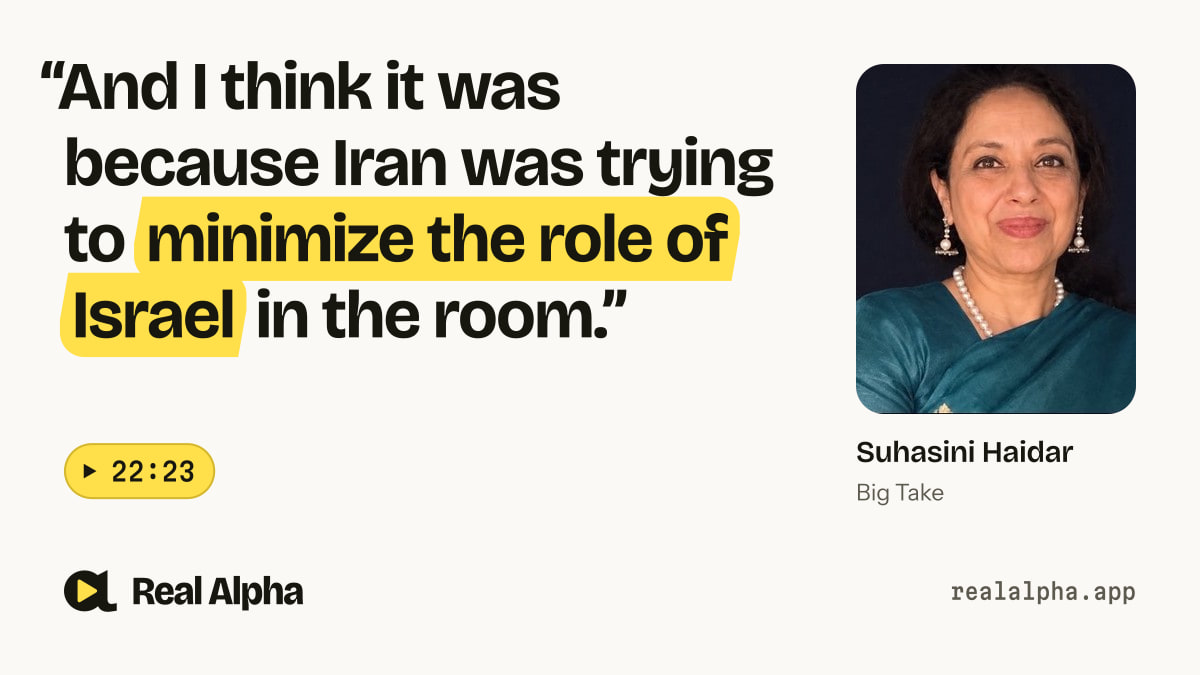
“And I think it was because Iran was trying to minimize the role of Israel in the room.”
 Suhasini Haidarat 22:23 · Big Take
Takeaways
- Ten million Indians in the Gulf faced risks to safety and livelihoods.
- Pakistan’s mediation role caused reputational damage for India.
- Iran wanted negotiations with the US to minimize Israel’s role.
About this segment
Suhasini Haidar explains how the Iran war strained India’s ties and put millions of Gulf-based Indians at risk. Pakistan’s mediation stung New Delhi, but Iran had a specific reason to choose it.

Suhasini Haidar is a diplomatic editor for The Hindu.
Covered foreign policy and conflicts across regions including Pakistan, Sri Lanka, Libya, Lebanon and Syria.

Mishal Husain, Host · Host, The Mishal Husain Show
From “Weekend Listen: Suhasini Haidar on Modi’s Challenges Trump Abroad and Gen Z at Home | Big Take”, Oct 25, 2026. Watch the full episode
Thanks. We'll look at and fix what's off.
Transcript
From the transcript Big Take publishes with the episode.
- 18:26
Can we dig further into the impact of the Iran war, both politically in terms of relationships and economically? Do you discern an economic impact? Is India suffering inflation or is there an energy impact?
- 18:44
I think people are definitely feeling the pinch. Fuel has gone up. and the rupee has plummeted. So those two things itself have taken the prices of a lot up. Recovering from COVID was hard enough. And then the Russian invasion of Ukraine meant a new clap down on food and fuel and fertilizer prices that everyone in rural India faced. And of course, most of India lives in rural India.
- 19:09
So Prime Minister Modi was there in Israel right before the war began at the end of February. Do you think he was told that Israel was about to attack Iran with the U.S. I mean, there is no way that he did not
- 19:23
realize that there was some kind of a conflict coming because he says it in the Knesset. He actually said that whatever comes, India will stand shoulder to shoulder with Israel now and in the future. Did he know that it was going to come two days after he flew out of Tel Aviv? I doubt that, but there's no way of knowing. The government has always denied that it had any idea. What actually made it a little more shocking was the immediate reaction of the Indian government to the conflict itself, that it took four or five days for the government to react to the killing of Iran's supreme leader, Ali Khamenei, and even more to react to the killing of 168 at that school in Minab. That sort of was a little more surprising. It seemed to denote that there was a real shift in Indian policy.
- 20:18
But like all things, and that's why I say the strategic autonomy aspect of what we're seeing in Indian foreign policy seems to reassert itself because you realize that then the government decided that this was not going to be the policy that actually India would begin to condemn. Violence on all sides. And of course, by then, Iran had begun to hit back. So India was also condemning the violence on Gulf countries. And remember, in the Gulf, India has 10 million citizens because they don't get citizenship there.
- 20:50
They're just there to work. 10 million citizens are in the crossfire. And they all affected their livelihoods. Absolutely. Their safety.
- 20:59
Travel, safety, trade. Energy imports, remittances, you know, India gets maybe $ 150 billion, $ 40 billion in remittances. It's the highest remittance earner in the world.
- 21:12
And then the country that it sees being a very visible part of the effort to bring the war to an end is Pakistan. Correct. Which hurts, troubles.
- 21:23
It clearly hurt the government because we heard the external affairs minister not saying on the record, of course, it was a closed door parliamentary committee meeting. But he used the term Dalal and said India is not that, which means a middleman or a fixer or even. It's like a derogatory term. And his point was we are not that. So I think the government felt it took reputational damage amongst its own supporters because here was Pakistan being feted by the world.
- 21:51
And the president of the United States in particular. And to be fair, Pakistan actually did quite a comprehensive job in terms of bringing all the players to Islamabad in terms of having a text that eventually did produce some kind of a ceasefire for a little while. But I think people forget that that it wasn't just about why Pakistan took that role or whether India could have played that role or not. The real question was why was Pakistan picked by Iran as the mediator because there were others in the world. And I think it was because Iran was trying to minimize the role of Israel in the room. It wanted to keep that negotiation between Iran and the United States. Pakistan does not have any relations with Israel.
- 22:40
Doesn't recognize Israel. So there was no question that India could not have played that role. But yet there was a sense over here of grievance, of foreign policy commentary, really saying this is something India should have been at the forefront of, even suggesting now when India is playing a slightly more important role when it comes to conveying messages between Moscow and Kiev that India is playing catch up in a sense.
- 23:04
I don't agree with that, but yes, it was a concern. So in terms of India and the United States, is the feeling that this administration, the next two years of this administration will likely be difficult, but then India will