The alpha, twice a week
That was 4 min.
Get the best new moments in your inbox every Wednesday and Saturday. It's free.
Check your inbox
We sent a link to your address. Click it to finish signing up. Not there in a minute? Look in spam.
or
Bloomberg Daybreak: Europe Edition · 4 min · Oct 28, 2026
Israel's Arab parties could decide who forms a government
 Stuart Livingstone-Wallace
Stuart Livingston-Wallace explains why neither bloc can yet form a majority and how Arab parties may shape coalition talks.
The episode’s best minutes
Full analysis- 12:01Israel's Arab parties could decide who forms a government4 min
- 16:46The UK budget is likely to defer its hardest choices5 min
- 22:03The UK has less fiscal headroom but may gain room in 2027Pro pick 3 min
- 2 more moments in the full episode
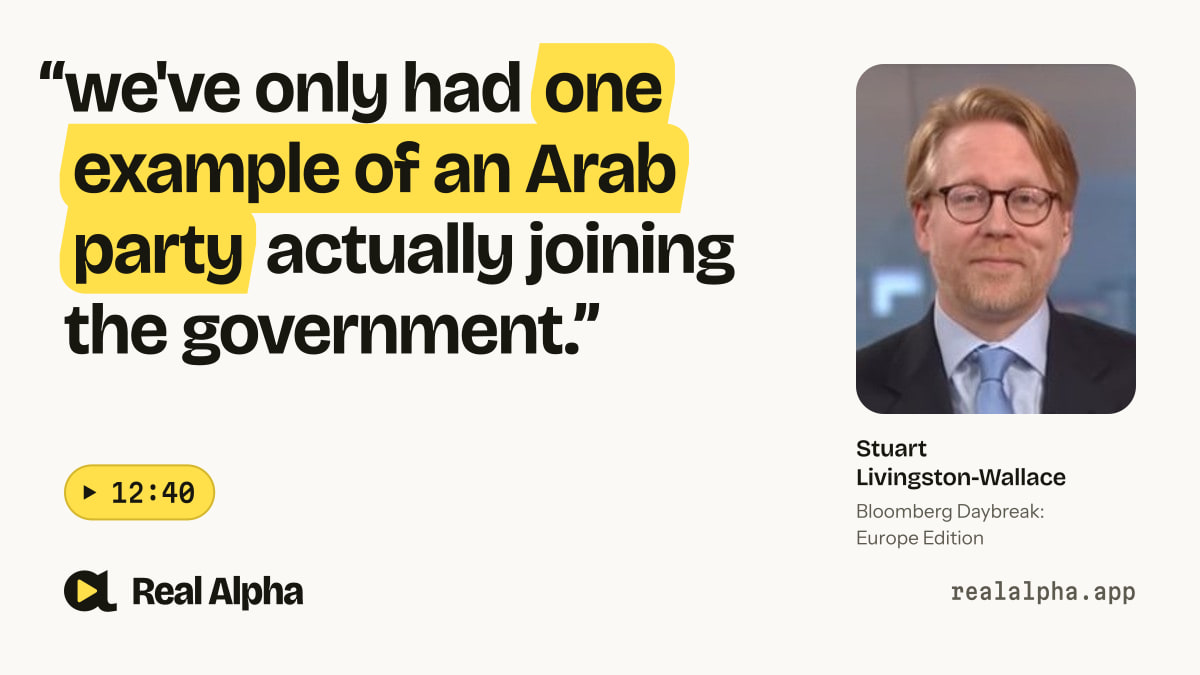
“we've only had one example of an Arab party actually joining the government.”
 Stuart Livingston-Wallaceat 12:40 · Bloomberg Daybreak: Europe Edition
Takeaways
- Arab parties could hold about 16 seats and become kingmakers.
- Coalition talks may take weeks or months, or lead to another election.
- Eisenkot could reject regime change by force while still backing military action to stop Iran getting a nuclear weapon.
About this segment
Stuart Livingston-Wallace explains why neither bloc can yet form a majority and how Arab parties may shape coalition talks. He also outlines what an election change could mean for Israel's Iran policy.

Head of Middle East & North Africa, Bloomberg
Led Bloomberg's energy and commodities coverage before taking charge of its Middle East and North Africa team.
From “Israel Vote Too Close to Call, Bolsonaro Flees Brazil, UK's 'Mañana Budget' | Bloomberg...”, Oct 28, 2026. Watch the full episode
Thanks. We'll look at and fix what's off.
Transcript
From the transcript Bloomberg Daybreak: Europe Edition publishes with the episode.
- 12:04
two main parties neck and neck. Will the smaller Israeli Arab parties be kingmakers here? What happens next?
- 12:12
Yeah, good morning. So, I mean, it's been a rapidly evolving situation through the night. I mean, as of about five minutes ago, they were about 52% of the way through the vote counts. The numbers for each block have been changing substantially, you know, and certainly in the last six hours or so, it looks like Netanyahu's block is inching ahead, but... it's way too early to call it. And as you say, maybe the Arab parties who look, at least as of now, they look like they're going to get about 16 seats. They could well be the kingmaker here. Quite what that's going to look like is difficult because we've only had one example of an Arab party actually joining the government. So, We may be in a situation where certainly Eisenkot is going to have to make a decision about which of those particular parties could
- 12:54
be part of government. Would the other Arab parties with seats then have some sort of informal agreement? Would that be enough for him to form a coalition? Really hard to tell at this stage. But we may end up in a situation where, you know, it continues to be a dead heat. And we've had multiple exams of this in recent years where, you know, potentially it's going to be weeks, if not months, to try and form a coalition.
- 13:16
That may not happen at all. And they have to rerun the election. That's not a prediction. That's just sort of a reminder that Israeli politics is always complicated. Yeah. And so it's a difficult question.
- 13:27
But how might Israel's security and foreign policy priorities change maybe? Yeah.
- 13:32
Well, so if the Netanyahu bloc comes out of this on top, is able to form a governable coalition, then presumably one would assume no change from the policy we've seen in the last several years. If, on the other hand, Eisenkot's bloc manages to succeed and form that winning coalition, then it's not going to be a radical change of policy, but you will see nuances there, and I think important nuances, the most important of which potentially is that he has said publicly he doesn't think regime change in Iran is achievable through military means. On the other hand, it's not like he's, you know, saying we need to hold off entirely.
- 14:10
You know, he's also very clearly focused on stopping any development of a nuclear weapon and perfectly willing to do that through military means. So it wouldn't be a radical change, but there are slight differences there that may change the calculus in terms of the regional conflict. Okay.
- 14:26
One other point. The Wall Street Journal reporting that the U.S. Has told several Gulf nations to prepare for an intense military campaign, a short one after the U.S. Midterms. No decision seems to have been made reportedly. So, how likely is that?
- 14:43
So I think you have to look at several factors. So you start with the movement of military personnel. So we know there's a strike carry group, a third one coming into the region. Still not clear if it's here as an addition or as a replacement. Two reports of military personnel being moved off U.S. bases, which, you know, was what we saw prior to the action in February and March. Also, non-essential diplomats and their families being moved around the region. Again, that's something of a sign. You've seen this somewhat unusual movement amongst the Gulf powers, plus Turkey, plus Pakistan, to try and engage in more serious diplomacy.
- 15:23
And you have other actors like Qatar in there as well. Plus, of course, the rhetoric coming out of the White House. Trump has been very explicit about this being a very serious option on the table after the midterms, quite whether that's the pivot point is a different matter. So all of that adds up certainly to an escalating situation on top of what is already now a pretty lively front between the Houthis and Saudi Arabia and continuing fighting in Hormuz itself against shipping. All of that adds up to quite an inflammatory situation quite how that ends up hard to hard to make that prediction but you know the next couple of weeks seem key in terms of getting some sort of resolution to which direction this will go.
- 16:01
Yeah absolutely okay Stuart thank you so much for being with us that is Bloomberg Stuart Livingston-Wallace who leads our team covering the Middle East and North Africa stay