The alpha, twice a week
That was 2 min.
Get the best new moments in your inbox every Wednesday and Saturday. It's free.
Check your inbox
We sent a link to your address. Click it to finish signing up. Not there in a minute? Look in spam.
or
Training Data · 2 min · Jul 9, 2026
Kalshi prioritized regulation before broad adoption
 Tarek Mansour
 says Kalshi rejected an offshore, move-fast approach because financial markets need compliance and trust.
In this episode
Full analysis- 42:48Kalshi sued its regulator because the upside outweighed the risk5 min
- 20:36Founders should own the company’s biggest problem3 min
- 35:16Marketing works best when it meets the moment3 min
- 51:35Kalshi uses account limits to reduce risky trading8 min
- 16:46Kalshi shifts its focus as customer demand changes3 min
- 24:37Kalshi prioritized regulation before broad adoption2 min
- 28:29Decide whether the idea is worth the opportunity cost3 min
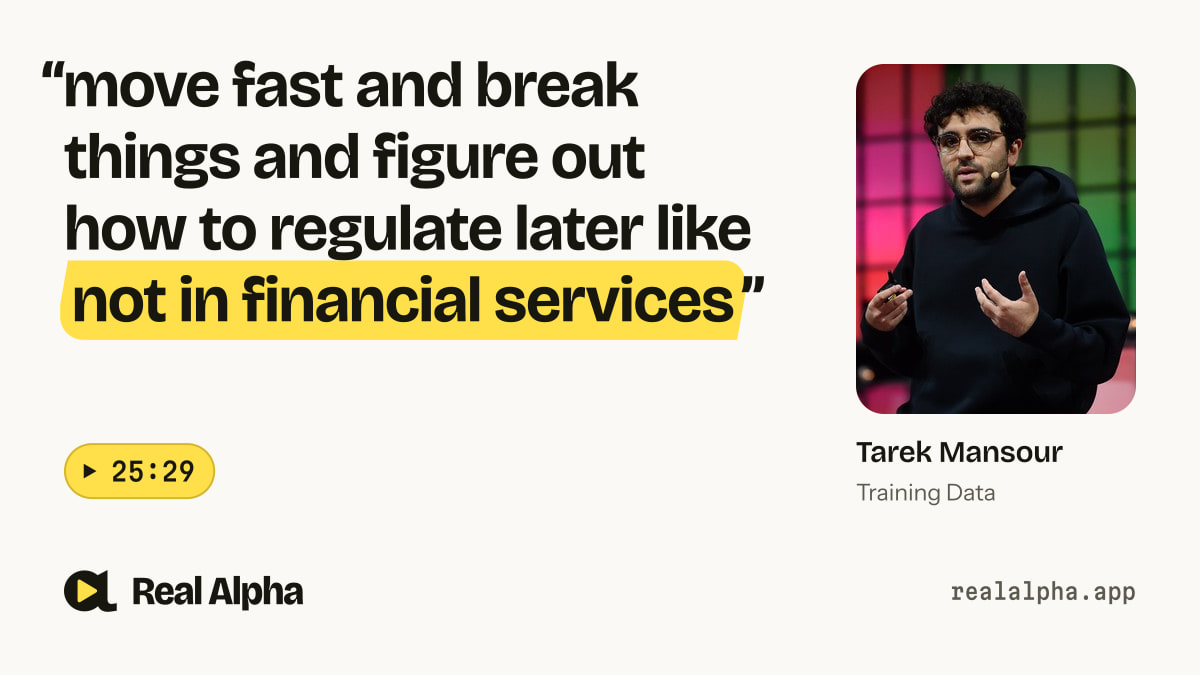
“move fast and break things and figure out how to regulate later like not in financial services”
 Tarek Mansourat 25:29 · Training Data
Takeaways
- Financial services failures can carry high costs, so shortcuts have different stakes.
- Kalshi built product and regulatory infrastructure before broad launch.
- Mansour says growth accelerated after the company got approval.
About this segment
Tarek Mansour says Kalshi rejected an offshore, move-fast approach because financial markets need compliance and trust. He credits that foundation, alongside product and growth execution, with helping adoption compound after approval.

Tarek Mansour is cofounder of Kalshi.
Built Kalshi, the federally regulated exchange for event contracts, with co-founder Luana Lopes Lara.

Sonya Huang, Host · Partner, Sequoia Capital
Works with OpenAI and Anthropic; co-wrote Sequoia's essay on generative AI.

Pat Grady, Host · Co-steward, Sequoia Capital
Joined Sequoia in 2007; backed Snowflake, Zoom, ServiceNow and OpenAI.
From “Kalshi's Tarek Mansour: Chaos by Design”, Jul 9, 2026. Watch the full episode
Thanks. We'll look at and fix what's off.
Transcript
Transcribed by machine (Whisper) from the episode’s audio, so a word may be off here and there.
- 24:39
And from what I can tell, you passed them a lot of it in sports, like really crushing that. We're bigger than across. i mean we're like in the us 95 market share now okay so across the board how'd you do it i mean i think it's like you were way behind you know it's interesting we were way behind in the headlines like okay maybe but like so we started coming in 2018 it's been a long On time. Yeah, I want to get into that.
- 25:01
It's been eight years, right? But we didn't really launch the general public until end of 22. And I think our proper launch was end of 24 when we're allowed to do the markets that people really want, which is the election and other markets. And they launched in 2019, a year later, or started the company, and then they launched immediately without a license. So they were the brand that sort of did it.
- 25:18
But we were very dogmatic in our approach, which was we're going to do it the right way. Why? I think there's two reasons. One that is practical, which I think in financial services and healthcare, I don't think you can cut too many corners. I see. i don't really believe in that like i know in silicon valley it's like move fast and break things and figure out how to regulate later like not in financial services i think financial services inevitably things go wrong and when they go wrong they go wrong bad uh and so i if you want to build true mainstream adoption and true like institutional adoption and like all that these people will care like how are you doing things are you regulated what like so they will care and i think so that was one number two is honestly like it's a bit it's a bit more philosophical i was
- 25:53
excited about changing the system fundamentally like building the next generation new york stock changed from within like change the system no matter how hard it is then going offshore and building something on the side and you know like that was just not exciting to me i i didn't feel like i'm pumped about doing that so and we were we stayed dogmatic about that approach but what we were doing is building an incredibly great product and great infrastructure and and great regulatory infrastructure that like like the word trust like i think people trust us more like when they put their money there they feel good about putting money with us they feel good there's not to be Put some money on the Red Sox last night and they beat the Yankees.
- 26:27
Oh, nice. Great. But I think there was that. I think when we did get regulated and we got approved, our trajectory just went really parabolic. And I think it's a mix of that sort of foundation lane that we've done for a while, which I really believe in. I think if you believe that you're going towards a good market, building a solid foundation, even if you're not growing, is okay. And then I think we just have superior execution on product and growth.
- 26:48
We compound at a much, much faster rate. And given enough time, the results start showing. While you were there, it's 2018 to start the company.