The alpha, twice a week
That was 3 min.
Get the best new moments in your inbox every Wednesday and Saturday. It's free.
Check your inbox
We sent a link to your address. Click it to finish signing up. Not there in a minute? Look in spam.
or
Minus One · 3 min · May 21, 2025
Ken Liu distinguishes a thematic parallel from a prediction
 Ken Liu
 recalls a story linking knot-based language to protein folding.
In this episode
Full episode- 20:40Science fiction gets mythology right more often than details5 min
- 13:27Investors find more alpha by looking beyond the current AI wave3 min
- 1:07:19AI may absorb emotional work pushed out of social life3 min
- 10:20Joscha Bach says AI advanced through scale, not a master algorithm3 min
- 40:14Neal Stephenson does his best writing in the first two hours4 min
- 57:16Cyan Banister looks for outlier founders to spot new themes4 min
- 4:20Nuclear knowledge diffused because its discovery hit a narrow window6 min
- 28:08Ken Liu distinguishes a thematic parallel from a prediction3 min
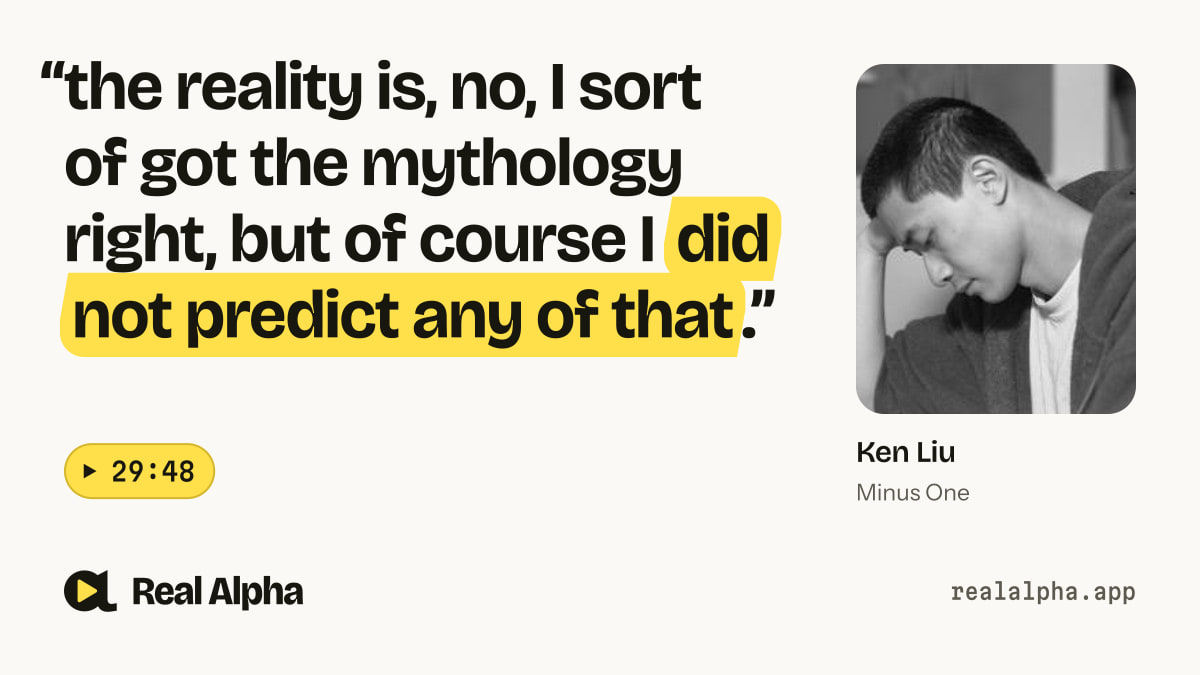
“the reality is, no, I sort of got the mythology right, but of course I did not predict any of that.”
 Ken Liuat 29:48 · Minus One
Takeaways
- His story used knot-tying as a way to think about protein shapes.
- He refuses to claim he predicted later protein-folding breakthroughs.
- He sees the resemblance as shared inspiration, not prophecy.
About this segment
Ken Liu recalls a story linking knot-based language to protein folding. He says its resemblance to later research was a thematic rhyme, not a forecast.

Author
Created the Dandelion Dynasty and “The Paper Menagerie,” the first fiction work to win Hugo, Nebula and World Fantasy Awards.

Aditya Agarwal, Host · General partner, South Park Commons
One of Facebook's first engineers, he helped build its first search engine; later CTO of Dropbox.
From “AGI, Sci-Fi, & Storytelling | Neal Stephenson, Ken Liu, Cyan Banister, & Joscha Bach”, May 21, 2025. Watch the full episode
Thanks. We'll look at and fix what's off.
Transcript
Transcribed by machine (Whisper) from the episode’s audio, so a word may be off here and there.
- 28:12
Well, actually, this is a perfect segue because one of the motivators for this panel was that I worked at Google and I was part of a team called Primer, named after the book in the Diamond Age, and currently I'm working on something eerily similar to uploaded intelligence from your stories, Ken. So I literally, in my lived actual professional life, the boundary between sci-fi and reality is blurring. And so I guess the question is more for the authors, but everybody who's written anything, what does it feel like when something that you've written about becomes true or starts taking effect in the real world? I mean, I like to say that I can, you know, feel great and take credit for it, but oftentimes it doesn't actually quite feel like that. So I'll give you a concrete example, Right. So many, many years ago, I wrote a story called Tying Knots, which envisioned the eventual solving of the protein folding problem by leveraging the linguistic skills of a particular tribe of people whose language is in the form of knots that they tie into a rope.
- 29:16
And the idea was that because of this particular form of writing required you to predict the shape of the final rope and to know how a shape would form based on localized tension forces, that this technique, this human intuition, if somehow adapted into a computer algorithm, would solve the problem of protein folding. Now, if you squint a little bit, I'm essentially arguing that linguistic techniques are useful for solving the protein folding problem.
- 29:47
So if I were unscrupulous, I could go out there and claim myself to be a visionary. But the reality is, no, I sort of got the mythology right, but of course I did not predict any of that. This is nonsense. I could not possibly claim it. Now, there are some sci-fi authors who would go around and claim themselves to be prophets largely on this sort of thing, and you can imagine what I think of them.
- 30:11
My view is this. Oftentimes you do something and you read something in the news that sort of rhymes with what you predicted. I think what I would feel in that case is the zeitgeist is right. I got the mythology right. I got the foundational collective unconscious yearning that made a thing possible right. But I wouldn't call myself a profiting in any sense of the word. You know, there are lots of us making these predictions all the time.
- 30:40
Once in a while, we get them right. And it's more luck than anything else. But if you got the basic mythology right, then, yeah, that is pretty cool. Because you might have written something that summarizes a very foundational aspect of human nature. That's pretty cool.