The alpha, twice a week
That was 2 min.
Get the best new moments in your inbox every Wednesday and Saturday. It's free.
Check your inbox
We sent a link to your address. Click it to finish signing up. Not there in a minute? Look in spam.
or
Bloomberg Business of Sports · 2 min · Nov 20, 2026
Ki MMA will use a global tournament to crown a yearly champion
 Scott Coker
 explains why Ki MMA is built around a global, bracketed tournament.
The episode’s best minutes
Full analysis- 26:17Ki MMA will use a global tournament to crown a yearly champion2 min
- 32:33Ki MMA plans to build stars through scouting and tournament exposurePro pick 3 min
- 4 more moments in the full episode
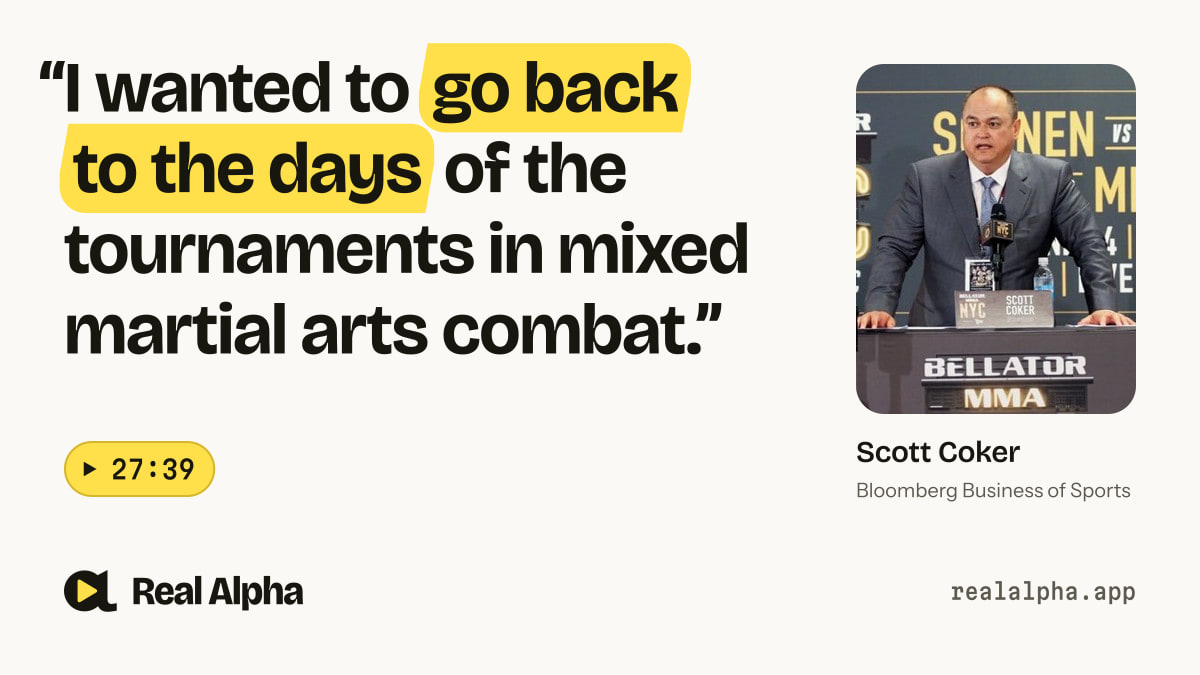
“I wanted to go back to the days of the tournaments in mixed martial arts combat.”
 Scott Cokerat 27:39 · Bloomberg Business of Sports
Takeaways
- The plan is a 32-fighter tournament with continental brackets.
- Fighters from different continents will compete against one another.
- The tournament is designed to crown a yearly weight-class champion.
About this segment
Scott Coker explains why Ki MMA is built around a global, bracketed tournament. The format aims to identify the best fighter in a weight class each year.

Co-Founder, Ki MMA
Founded Strikeforce and led Bellator before launching Ki MMA's global tournament-based promotion.
- VP
Vanessa Perdomo, Host
- RW
Randall Williams, Host
From “Ki MMA Co-Founders Peter Levin and Scott Coker | Bloomberg Business of Sports”, Nov 20, 2026. Watch the full episode
Thanks. We'll look at and fix what's off.
Transcript
From the transcript Bloomberg Business of Sports publishes with the episode.
- 26:20
Scott, thanks so much for joining the Bloomberg Business of Sports. We're really excited to have you on. And to talk more about Key MMA, you know, we recently caught up with Peter and he gave us a little bit of the groundwork of how it all came together. But, you know, from your vision and from how you saw this from the start, can you give us a little bit of that, your background into it and what from your eyes it's going.
- 26:46
To look like? Yeah, I mean, I've been in combat sports for decades now. And, you know, I created a mixed martial arts league and found a mixed martial arts league called Strike Force back in the early 2000s. And we had a great run there, sold to the UFC in 2012. I was on a three-year non-compete. And then I decided to take a position with Viacom to help them run their brand called Bellatorc. Eventually, that sold as well. I took about a year off and started thinking about what is it that I feel is missing in the sport and in the combat space right now. I started putting a plan together, hired a business development team, started putting some numbers to maybe the vision.
- 27:33
It took about maybe another eight months, almost a year. Actually, it's probably over a year. Really, what we came out with was I wanted to go back to the days of the tournaments in mixed martial arts combat. And there was a league called Pride back in the day that was a tournament. K-1 was a tournament back in the day. UFC started as a tournament. When you compete as a child in martial arts, it's all tournament-based. You go to jiu-jitsu tournaments today, it's other jiu-jitsu matches, it's all tournaments.
- 28:04
So You know, I wanted to go back to the tournament format and create a, let's say like a NCAA bracketed format, but make it global and something like a World Cup and have the best fighters from each continent compete against each other and really see who is the best fighter in a particular weight class for the year that we're going to host a tournament.