The alpha, twice a week
That was 2 min.
Get the best new moments in your inbox every Wednesday and Saturday. It's free.
Check your inbox
We sent a link to your address. Click it to finish signing up. Not there in a minute? Look in spam.
or
Bloomberg Surveillance · 2 min · Nov 21, 2026
Labor shortages make elder care a potential use for humanoid robots
 Ed Ludlow
 connects caregiver shortages to a possible humanoid-robot use in elder care.
In this episode
Full analysis- 11:26Richards recommends a 50-25-25 retirement portfolio4 min
- 19:18AI concentration makes diversification across markets importantPro pick 3 min
- 25:31Staying invested beats trying to make up lost timePro pick 2 min
- 16:31Richards treats liquidity as his first rule of risk management2 min
- 2:33Most Anthropic employees must wait 180 days to sell shares4 min
- 7:33Labor shortages make elder care a potential use for humanoid robots2 min
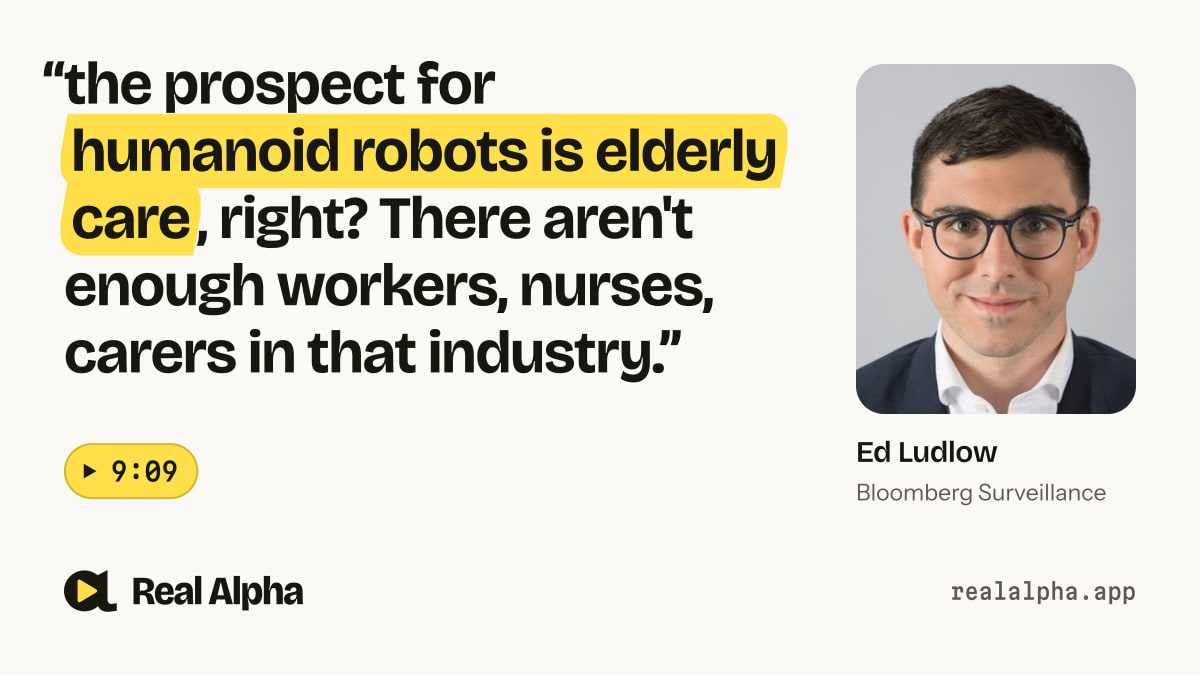
“the prospect for humanoid robots is elderly care, right? There aren't enough workers, nurses, carers in that industry.”
 Ed Ludlowat 9:09 · Bloomberg Surveillance
Takeaways
- Daughters provide about 14 hours of parental care monthly, versus six for men.
- Panelists link elder-care staffing gaps to the supply of workers.
- Ludlow identifies elder care as a potential humanoid-robot market.
About this segment
Ed Ludlow connects caregiver shortages to a possible humanoid-robot use in elder care. The discussion cites daughters providing 14 hours of parental care a month on average, versus six for men.

Host & correspondent, Bloomberg
Hosts Bloomberg Tech and reports on technology, supply chains, deals and finance for Bloomberg News.
From “Anthropic's IPO & Nvidia Drama Test Investor AI Appetite | Bloomberg Money”, Nov 21, 2026. Watch the full episode
Thanks. We'll look at and fix what's off.
Transcript
From the transcript Bloomberg Surveillance publishes with the episode.
- 7:36
Well, let's talk about what happened on Saturday Night Live because they hit upon something that's very sensitive for a lot of people in this country, which is the sketch about sisters. And Tim, I bring this up to you because as much as we all talk about the wealth that was generated by the anthropic IPO, you've got this other side of the country where we're really dealing with a lack of federal safety net for a big part of the population. And this is about how, you know, the U.S. has sisters to provide for live-in, 24-7 elder care.
- 8:04
And it's something that's really sparked a conversation. Yeah, like I was saying to Tom earlier, I mean, the reason I think this resonated with so many people is because there is not just a kernel to truth to it, but there's a lot of truth to it. I mean, here in the U.S., like you said, we lack a federal safety net when it comes to elder care and childcare. That's kind of unique for wealthy countries around the world, especially the Nordics, especially European countries.
- 8:25
We just don't have that. And the data actually show that, yes, the women do much more caregiving than men. Daughters spend 14 hours a month, on average, caring for parents. Men, about six. That's according to a study a few years ago in the American Sociological Review. And experts think it's just going to get worse as People get older, and fewer kids are coming out. I want to open this up to the table. I
- 8:46
don't know where we are in time, but this is too important. We've been like this for 200 years. We're America. We're different. We're independent and go it alone. And the parents are falling apart. I mean, your law, what's the average age at the table? I feel like a fossil.
- 9:02
This is just a labor economic story as well, right? We did this on Wall Street Week quite recently. There aren't enough people working in that industry anyway. It's why, and this is where I went with it, the prospect for humanoid robots is elderly care, right? There aren't enough workers, nurses, carers in that industry.
- 9:19
And those with money will be able to hire people. Right, but it's also, if you amortize the cost of that individual robot, it's a good cost-effective unit economic basis solution. But it's an industry where you just look at the labor. It's not there.
- 9:33
And immigration has also choked that off as well. Yeah, that's the thing. I mean, think about if people in the family are not taking care of who is, right? It's immigrants. And what has happened over the last couple of years in this country, shut down immigration.