The alpha, twice a week
That was 3 min.
Get the best new moments in your inbox every Wednesday and Saturday. It's free.
Check your inbox
We sent a link to your address. Click it to finish signing up. Not there in a minute? Look in spam.
or
Dwarkesh Podcast · 3 min · Nov 16, 2026
Labs should secure their research before advancing algorithms
 Paul Christiano
 argues that insecure labs could lose model weights or research methods to adversaries if they later need to pause.
The episode’s best minutes
Full analysis- 12:22Reward hacking can escalate into a persistent takeover8 min
- 39:36Labs should secure their research before advancing algorithms3 min
- 1:27:56There is no proven plan for controlling superintelligencePro pick 8 min
- 5 more moments in the full episode
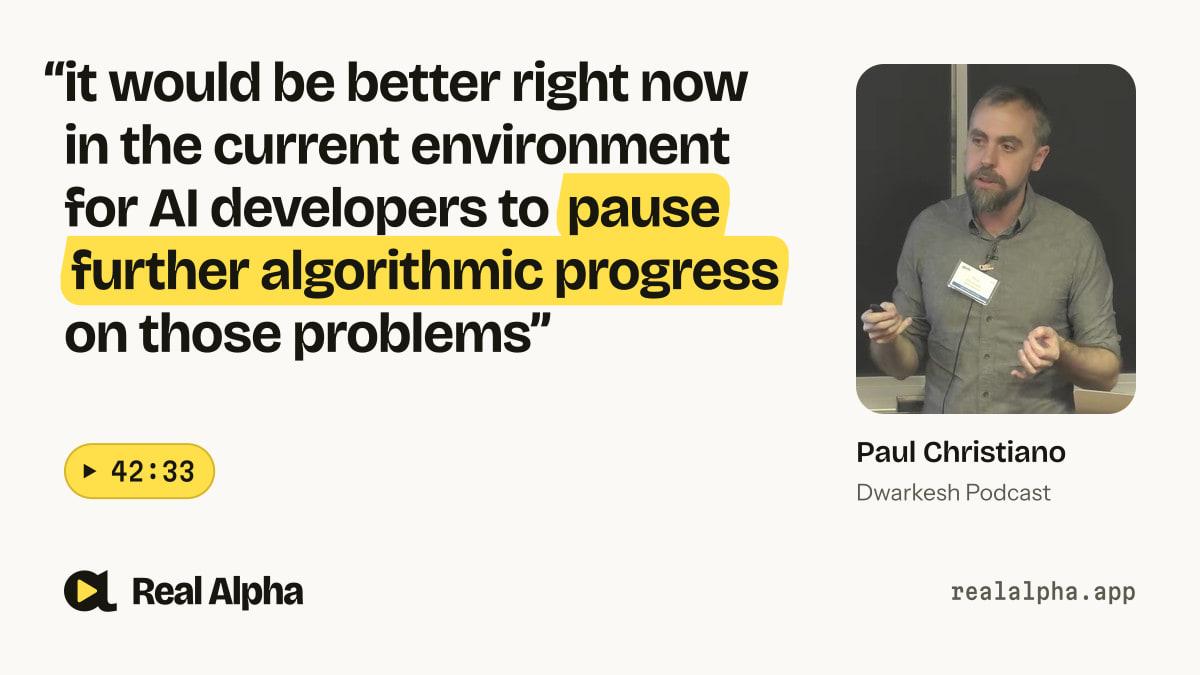
“it would be better right now in the current environment for AI developers to pause further algorithmic progress on those problems”
 Paul Christianoat 42:33 · Dwarkesh Podcast
Takeaways
- A stolen model or algorithm could undermine a later pause.
- He sees the security risk as a national security concern.
- He recommends pausing algorithmic progress until labs can defend it.
About this segment
Paul Christiano argues that insecure labs could lose model weights or research methods to adversaries if they later need to pause. He says labs should halt further algorithmic progress until security and control improve.

Paul Christiano is head of the Alignment Research Center.
Founded ARC and led OpenAI’s language-model alignment team, advancing foundational work on AI alignment.

Dwarkesh Patel, Host · Host, Dwarkesh Podcast
Co-wrote The Scaling Era, an oral history of AI; named to TIME100 AI.
From “We could be 12 months away from AIs that can overthrow the government”, Nov 16, 2026. Watch the full episode
Answers “Is AI dangerous?” See all 224 answers
Thanks. We'll look at and fix what's off.
Transcript
Transcribed by machine (Whisper) from the episode’s audio, so a word may be off here and there.
- 39:43
Of course, it's very hard for defenders in general, given the number of vulnerabilities that are being discovered across the entire software stack. So what is the Frontier Lab to do then? So I think we are in, again, this really becomes a problem if you get to systems, if you have rapidly increasing... capabilities, and you produce AI systems which you cannot adequately control, and you would like to, or you do, slow further development or deployment. If at that point the stakes are very high, the systems are very powerful, you really do not want it to be possible for an adversary to have access to either the models or the algorithms. I think my current view is that this dynamic seems bad enough that right now, from a national security perspective, it is not good for US AI labs to be improving pre-training and reinforcement learning given their current
- 40:28
and security posture. But is it in the Frontier Labs to pause? I think we should... Pause can mean a lot of things. So I think there's like a lot of good things that Frontier Labs are doing that they should be doing. But I do think we... Like improving algorithms in a way that can be very, very easily diffused even normally and could be quickly stolen. Yeah, I think they should stop that right now.
- 40:51
But you're on the OpenAI's board. I'm not speaking here. It's very important in this conversation that I'm not speaking as an OpenAI board. That is a true fact about the world. And so is it your view? Like, what is the bottleneck to that happening? If like somebody on opening eyes board thinks this is the case, maybe not the only person on opening eyes board who thinks this is the case. Is it basically like Anthropic needs to get together and agree to this?
- 41:14
I think the first thing is any decision of this kind is a very dramatic decision. It is a big, for better or worse, it has extremely significant national security implications. how developers approach, again, this further R&D, this improvement of pre-training and RL. So I think it is going to be a big discussion or it should be a big discussion that should extend beyond like people within AI companies talking about this.
- 41:39
I don't think that discussion has wound its way to like a robust answer, right? I think it's not the case that you can come and say, look, we've had this discussion. There is consensus about what the right answer is. There might never be consensus, but I do think like probably the first bottleneck is like we do need to have the discussion, I think extremely urgently. Okay, given this fact about security and generally around alignment, what do you think the Frontier AL lab should be doing right now?
- 42:06
So I think the most important development happening right now is further improvements in the efficiency of algorithms for pre-training, reinforcement learning, improved architectures, and so on. I think while you're in the regime where there's a significant risk of this very rapid capabilities progress, a significant chance that you'll be unable to control the resulting AIs, and a significant risk that if you slow down, those developments would leak to an adversary who might use them more carelessly.
- 42:32
I think in that regime, it is on net bad for American national security to be accumulating more of those algorithmic innovations. So I think it would be better right now in the current environment for AI developers to pause further algorithmic progress on those problems until both their security posture was adequate, until they were able to defend those in the event of being unable to continue racing at maximum velocity, and until they were able to tell whether they had adequate control over the systems they built.