The alpha, twice a week
That was 4 min.
Get the best new moments in your inbox every Wednesday and Saturday. It's free.
Check your inbox
We sent a link to your address. Click it to finish signing up. Not there in a minute? Look in spam.
or
Relentless · 4 min · Nov 8, 2026
Lean teams can grow output without growing headcount
 Adam Bry
 says Skydio overhired when capital was easy, then flattened headcount as its business matured.
The episode’s best minutes
Full analysis- 7:04China's sanctions forced Skydio to rebuild its supply chain5 min
- 42:34Skydio made irreversible bets before the technology was proven3 min
- 56:01Lean teams can grow output without growing headcount4 min
- 5 more moments in the full episode
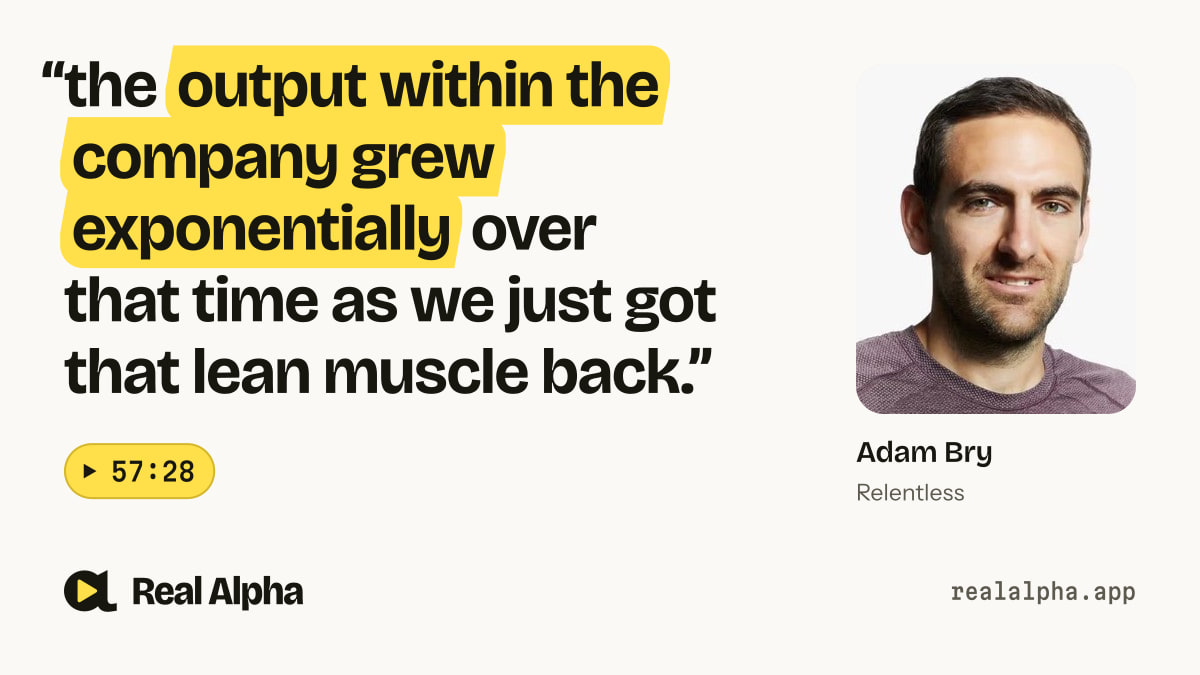
“the output within the company grew exponentially over that time as we just got that lean muscle back.”
 Adam Bryat 57:28 · Relentless
Takeaways
- Easy fundraising led Skydio to overhire.
- Headcount stayed flat or fell while output grew exponentially.
- The company will scale teams only as fast as needed.
About this segment
Adam Bry says Skydio overhired when capital was easy, then flattened headcount as its business matured. That leaner team grew output and became a constraint the company intends to keep.

Adam Bry is cofounder and CEO of Skydio.
Co-founded Skydio, building autonomous drones from research pioneered at MIT and Google’s Project Wing.

Ti Morse, Host · Host, Relentless
Interviews hard-tech founders on Relentless; guests include Sam Altman, Brian Armstrong and Hadrian's Chris Power.
From “The Drone Startup That's Outcompeting China | Adam Bry, Skydio”, Nov 8, 2026. Watch the full episode
Thanks. We'll look at and fix what's off.
Transcript
Transcribed by machine (Whisper) from the episode’s audio, so a word may be off here and there.
- 56:05
on whatever their particular mission is. When you think about building a company and the lifeblood is venture capital and you have to survive because you don't have cash flow, I think it's a slightly different operating philosophy than when you have some sort of cash engine because some product is working in a huge way. How do the bets change as that switch happens like are you willing to take more bets at the same time it's an interesting question so the for a long so we've been through different cycles as a company like when we started scrappy early stage company my co-founders and i didn't come you know this wasn't our second or third company where we could just like snap our fingers and raise 100 million bucks or whatever and also you know the silicon valley environment at the time was very different so
- 56:48
by necessity in the early days we were very scrappy with very small teams uh where prioritization was kind of everything and we started to expand enterprise and government customers in 2020 um money sort of became free you could raise a ton of money i think like a lot of companies we got ahead of ourselves there and kind of overhired and lost that kind of like lean scrappy muscle and then you know it took us longer for that business to really work it took a long time for doc to really mature uh and then we'd like you know we had very limited ability to raise money and we had our backs against the wall. And by necessity, we had to get lean. And we basically had headcount flat or slightly down over a multi-year period. But the output within the company grew exponentially over that time as we just got that lean muscle back. So now,
- 57:41
we're not constrained by capital, but that lean muscle, I think, is really core to identity as a company. And if you look at the size of our team and the revenue scale that we're at, it's remarkable. I mean, if you can look at like comps that I look at on the public markets that build hardware software products, we're literally like a half to a quarter of the headcount with products that I think are like an order of magnitude more complex in their technical sophistication.
- 58:08
So even though we could like, you know, raise as much money as we needed, grow the team as much as we wanted to, we're just not going to do it. Like the, the constraint that we will not shy away from is like truly exceptional teams operating in an efficient, like high velocity way. And I've learned the hard way you, you can't, you can't like keep doubling year over year in terms of the size of the company and maintain that. And so like, you know, you can go on like LinkedIn and look at companies where they've like doubled year over year over year. And I just, and especially the ones that are building hardware like i i just know with like a hundred percent certainty that there's like no way there it's just it's like not how the world works that they're operating like efficiently and effectively internally um and having been on the wrong side of that like we
- 58:51
we won't do that uh ourselves and so that's really the constraint is like having exceptional teams with awesome people that are uh aligned and and doing great work uh and and we'll scale that as quickly as we can but but no faster and that affords us the capacity to do a certain set of things which is way less than the opportunity we're exposed to and so then it's just the prioritization game and I think that that's healthy like there's there's a bunch of things where it's like very obvious if we built a product to do this we would unlock a bunch of value and we're not doing those things because we don't have the capacity to do it so we have to be really thoughtful about what we do and I think that's actually like having been on all sides of it I I think that's like the right healthy place to be.