The alpha, twice a week
That was 4 min.
Get the best new moments in your inbox every Wednesday and Saturday. It's free.
Check your inbox
We sent a link to your address. Click it to finish signing up. Not there in a minute? Look in spam.
or
Uncapped · 4 min · Mar 12, 2026
Legora expects executives to scale as the company changes
 Max Junestrand
 says executives must keep scaling as Legora changes, and teams should optimize for the company over their function.
In this episode
Full analysis- 14:01Focusing on three use cases helped Legora double revenue4 min
- 22:52Legora uses customer evals to decide when a legal task is solvedPro pick 5 min
- 29:04Legora won pilots by letting customers keep what they built3 min
- 18:03Legora expects executives to scale as the company changes4 min
- 33:54Legora proved US demand from Stockholm before opening locally6 min
- 6:27One law firm's AI advantage can push its peers to adopt3 min
- 10:41Legora kept engineers at the center of product development3 min
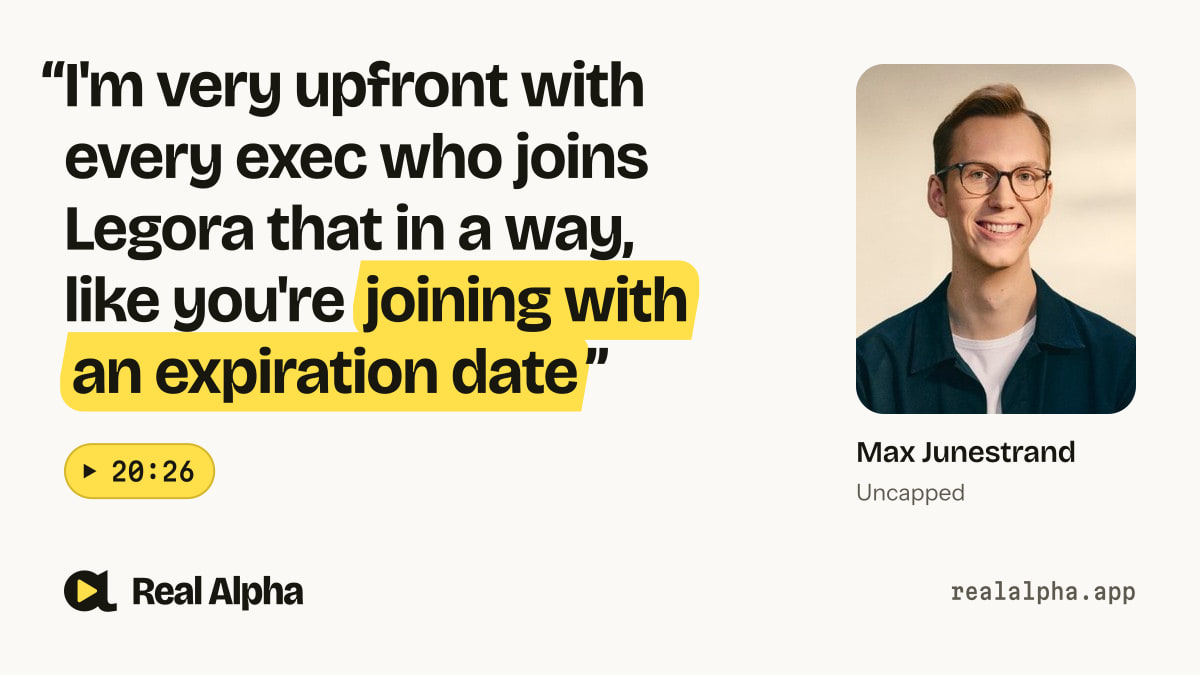
“I'm very upfront with every exec who joins Legora that in a way, like you're joining with an expiration date”
 Max Junestrandat 20:26 · Uncapped
Takeaways
- Optimize for the company, not a function’s scope.
- Executives must keep scaling as the company changes.
- AI lets a 50-person engineering team ship what once needed 500.
About this segment
Max Junestrand says executives must keep scaling as Legora changes, and teams should optimize for the company over their function. He contrasts a 50-person engineering team with the 500 people once needed.

Max Junestrand is cofounder and CEO of Legora.
Co-founded and leads Legora, an AI workspace for lawyers, after stints at McKinsey and Ericsson.

Jack Altman, Host · General partner, Benchmark
Co-founded Lattice and ran it until 2023, then started his fund, Alt Capital.
From “Building an AI-Native Software Company With Legora CEO Max Junestrand | Ep. 44”, Mar 12, 2026. Watch the full episode
Answers “Which jobs will AI replace, and which are safe?” See all 132 answers
Answers “Will AI replace software engineers?” See all 40 answers
Thanks. We'll look at and fix what's off.
Transcript
Transcribed by machine (Whisper) from the episode’s audio, so a word may be off here and there.
- 18:15
those features at all. Chase made a cool point to me recently, which is that because you, we were talking about how, you know, companies that are pre-AI and companies that are just fully AI native just have to be built differently in various ways. And the fact that you didn't build a pre-AI company, I think gives you sort of like, you know, this unshackled mind to like, you're not even trying to think about some past alternative.
- 18:40
You're just like, given what's in front of me, what should a company look like? And, you know, you talked about how like having YC founders inside the company has been helpful and I'm sure there's like a lot there but I'm curious about like what are like the main tenants that you've observed you know because now you've probably hired a lot of people who did you know work and built companies pre-AI what do you think are like the main tenants ideas cultural concepts that have been important to you just to like make it work in like a fully AI native world yeah so I think this idea that Chetan brought up around like you have to be willing to like kill the stuff that you've done in the past is very important because I think in more traditional software, you had to build the foundations and then you build the stuff on top of it and you sort of kept building the stack.
- 19:24
And in that world, it was also very good to have like a technical architecture where one feature would rely on the same microservices as like other features. But the problem is in AI, like maybe that feature now needs to scale really, really quickly. And the cost of writing software is so low that it's basically better to build your own stack for like each thing and now that we hire you know finance professionals or even like lawyers internally to lagora or we just hired our first like tax person i think they come with a set of ideas of like oh this is how i used to do it in my old company and Everybody's forced to relearn, I think, and also question what their value is on top of the general model capabilities in a way, which is like very painful.
- 20:12
Totally. Brett Taylor talked about this on this podcast too, basically that like people are going to build something and six months later, we might just kill that thing and everybody needs to be comfortable with that, which I think historically would be a lot of painful internal conversations. Like, do you have to change? Is that like a different culture for people? I think it's a different culture completely.
- 20:29
I mean, I think the culture is you don't maximize for your function, like you maximize for the company always. And I'm very upfront with every exec who joins Legora that in a way, like you're joining with an expiration date and you have to continuously prove that you like scale out of that in a way, because the company is scaling so exponentially. And I don't know if it was Mark Zuckerberg or somebody talked about like, let's hire people with high Y slopes and not like high Y intercepts, I think about that a lot, mostly because I've had to do that, right?
- 21:06
Like I did not join or start Legora with a lot of experience, but I've proven that at every new point in time, I've scaled with the business. And so other people in Legora needs to do the same. And I think that goes for every function. And, you know, I think an engineering team that's shipping the amount that we do previously had to be like 500 people. And now we can get away with being 50. And I think there's even a question of like, do we need to be more than 100 engineers?
- 21:36
Or is the bottleneck here really knowing what to build and building it in the right way and designing an experience that works for, you know, hundreds of thousands of people that we now have on the platform? I think the paradigm is like shifting all the time. What's nice about our work is that engineering is sort of a, a roadmap of what's going to happen in other industries too like i think the general models