The alpha, twice a week
That was 3 min.
Get the best new moments in your inbox every Wednesday and Saturday. It's free.
Check your inbox
We sent a link to your address. Click it to finish signing up. Not there in a minute? Look in spam.
or
Latent Space · 3 min · Nov 2, 2026
Legora tests agents in simulated legal workspaces
 Jacob Lauritzen
Legora tests tasks in simulated legal data rooms and tracks performance by practice area.
The episode’s best minutes
Full episode- 8:39Legora tests agents in simulated legal workspacesPro pick 3 min
- 26:13Client confidentiality forces Legora to infer product failures3 min
- 34:25Tabular Review lets lawyers test a workflow on ten rows firstPro pick 4 min
- 5 more moments in the full episode
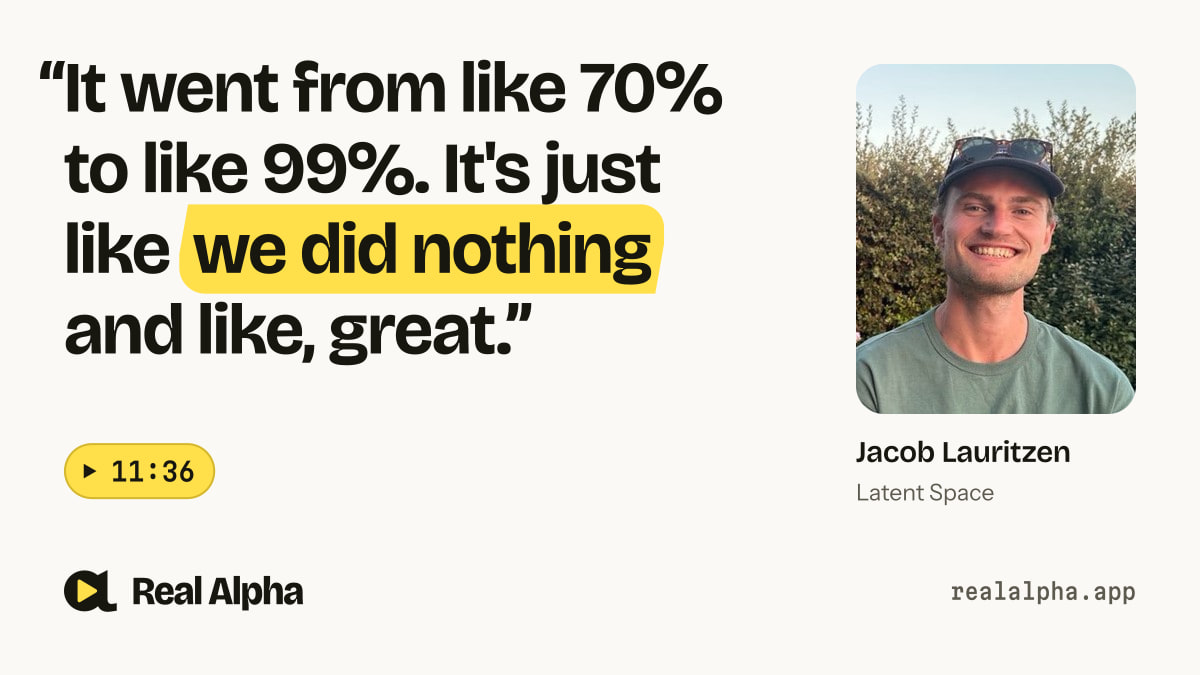
“It went from like 70% to like 99%. It's just like we did nothing and like, great.”
 Jacob Lauritzenat 11:36 · Latent Space
Takeaways Pro pick
- Build test environments around realistic legal tasks.
- Track model performance across practice areas and tasks.
- Model releases can fix failures without product changes.
One of Pro's picks, open to you here. Try Pro free for 7 days
One of Pro's picks. The rest of the summary and the 3 takeaways are in Real Alpha Pro; the video, the quote and the transcript stay free.
Read it with Pro, 7 days freeAbout this segment
Legora tests tasks in simulated legal data rooms and tracks performance by practice area. A new model release once lifted citation accuracy from 70% to 99% without any product changes.

Jacob Lauritzen is CTO of Legora.
Leads engineering at Legora, building legal AI agents for research, contract review and drafting.

Shawn Wang (swyx), Host · Co-founder, AI Engineer
Wrote “The Rise of the AI Engineer” and founded Smol AI, maker of AI News.
- BC
Basil Chatha, Host · Forward Deployed
From “Building Legal Agents When You Can't See the Data — Jacob Lauritzen, CTO of Legora”, Nov 2, 2026. Watch the full episode
Thanks. We'll look at and fix what's off.
Transcript
Transcribed by machine (Whisper) from the episode’s audio, so a word may be off here and there.
- 8:44
Sub-agent delegation was one of them that we've gotten working really well now for fan-out type retrieval queries. It works extremely well for us now. That was difficult before. We basically track, so we have a team that's just doing evals, and so we track all of the model's performance in different practice areas, which is like subgroups of legal, and different tasks across all of those. So we basically have a big heat map, and we're like, and then we can see them move and it's like, usually they improve most stuff, but there's actually a lot of model releases where they improve some and regress in others.
- 9:15
Okay. And that actually happens a lot more than you'd think. Like, what are some of those tasks, like, are you familiar with how you guys are running a lot of the evals? Like, what are those different sub-segments, I guess, that you look at? So, like, there's different just, like, framing stuff. So, we have different basically, like, worlds, like, RL environments, essentially, which is, like, here's a because Laura's working projects always more or less.
- 9:36
So it's like, here's 10,000 file data room. You're doing a due diligence. In the end, a grid report looks like this. Like it contains all these red flags and like it doesn't contain whatever weird stuff. And like we want it to be concise, et cetera, et cetera. That's kind of how we've built it. So there's different tasks, which is like part of it is drafting a report. Like does the draft look good?
- 9:56
Does it contain all the right stuff? Is the wording sound, the analysis sound? There's also the part of finding the red flags, like the analysis before that. So you can kind of like self-divide it a little bit. And that's how we run the evals. Interesting. What does your evals team look like? Do you hire lawyers to do that? So yes, it's a mix. We have engineers and then we have lawyers. And it's one team.
- 10:17
So there's like three engineers and like three lawyers right now. And then we have a pool of what we call legal engineers, which is people that have worked in big law for like three or four years. Typically, maybe they have a CS degree and like they're very tech forward. and then they come to us because they want to help change the industry. Are they IT in big law? No, they're lawyers in big law. They're lawyers in big law.
- 10:39
With CS degrees. Yes. Oh my God. It's a Venn diagram. Yeah, exactly. That's like our hardest person to hire for. But they're also such a force multiplier because we can pull on them for the eval stuff and for the product development, which is like you have a pool of 100 experts that use the product every day and go and talk to clients every day. And also like they live this and have lived this. And we just pull on them to do evals and help us shape the product and it's such an advantage.
- 11:03
And curious, when did you guys start that team? Evals grew out of the assistant agent team at some point. I think there was a point up until recently where it was like, honestly, just not really worth it. Because all models just got better. So it was like, do we want to spend a lot of our time doing really complex evals or do we just want to build? Because there was so much to be gained from building a better harness and just sort of leaning into everything's going to improve and everything kind of just improved.
- 11:29
Yeah, like every two, three months, you get an infrastructure model. Yeah, exactly. Just pass it through, right? Exactly. I mean, we had one problem where it wouldn't site properly, and so it would be difficult to follow. And it was like, next model release solved. It went from like 70% to like 99%. It's just like we did nothing and like, great. Yeah. Maybe the real work is keeping all the data private,