The alpha, twice a week
That was 6 min.
Get the best new moments in your inbox every Wednesday and Saturday. It's free.
Check your inbox
We sent a link to your address. Click it to finish signing up. Not there in a minute? Look in spam.
or
Latent Space · 6 min · Nov 19, 2026
Linear tests AI pricing before charging customers
 Cristina Cordova
 says outcome-based pricing is hard when the value varies by company, so Linear often charges for AI features based on serving costs.
The episode’s best minutes
Full analysis- 12:08Linear proved it could win growth companies before going enterprise4 min
- 19:56Agents create half of Linear issues, but the app still mattersPro pick 3 min
- 50:08Linear tests AI pricing before charging customers6 min
- 5 more moments in the full episode
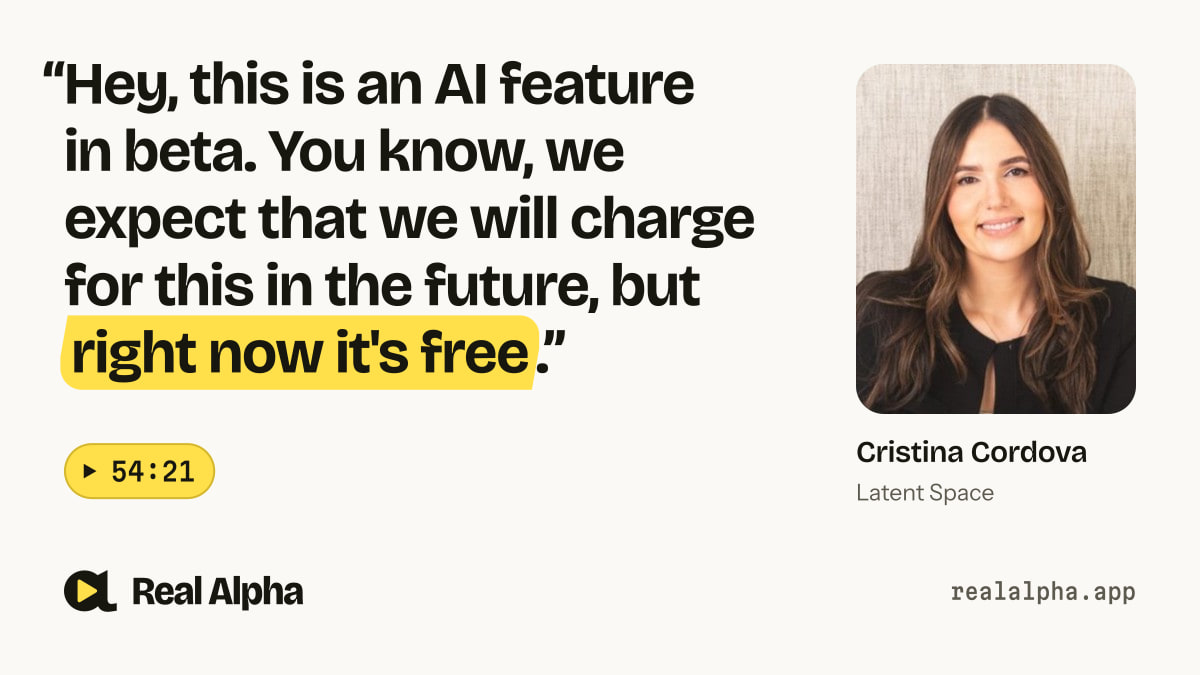
“Hey, this is an AI feature in beta. You know, we expect that we will charge for this in the future, but right now it's free.”
 Cristina Cordovaat 54:21 · Latent Space
Takeaways
- Outcome pricing works best when the value is clear.
- Beta periods help Linear learn what a feature should cost.
- Linear prefers starting conservatively, then lowering prices if possible.
About this segment
Cristina Cordova says outcome-based pricing is hard when the value varies by company, so Linear often charges for AI features based on serving costs. It tests features in beta and gives customers notice before charging.

Cristina Cordova is COO of Linear.
Built Stripe’s partnerships team, led Notion platform and growth, and now leads Linear’s go-to-market and operations.

Shawn Wang (swyx), Host · Co-founder, AI Engineer
Wrote “The Rise of the AI Engineer” and founded Smol AI, maker of AI News.

Alessio Fanelli, Host · Founder, Kernel Labs
Partner at Decibel, backing technical founders who build developer tools.
From “Scaling Linear's GTM to $100M+ ARR — Cristina Cordova, COO”, Nov 19, 2026. Watch the full episode
Answers “How do AI companies make money?” See all 122 answers
Thanks. We'll look at and fix what's off.
Transcript
From the transcript Latent Space publishes with the episode.
- 50:12
So how do you, how do you convince your customers that that's, that's a good idea to go from like seat-based to usage-based? Yeah. Was that hard to convince them? Yeah. I mean, I, I would say like a lot of companies that are in, you know, the SaaS world- Yeah... um, are, are certainly moving to usage-based pricing. I think everyone would love for there to be like almost like the Intercom Fin model that existed for a long period of time where, which was like, oh, if AI responds to your support ticket, like, you know, that costs a dollar.
- 50:41
Yeah. And, and you're like, is every support ticket that gets replied to like worth a dollar? Yeah. Like, okay, great. Like, right? So you're, you're pricing on like the outcome that you drive. Yeah. Right? I think it's a lot harder for other types of businesses to be like, okay, so what is automatically triaging this bug to the right team worth? Yeah. Right? [laughs] Maybe to every company that's a little different. Yeah.
- 51:06
Maybe you believe, oh, that's the PM's job. Like, they, they should be like, you know, triaging bugs- Yeah... into the right queue, right? To the right person. Um, and, you know, maybe another company says, "Well, I'd want my PM to spend their time talking to customers and, you know, building the product roadmap and doing other things instead." So I think there can sometimes be a debate in functions that are not very clearly outcome oriented how you charge for usage-based pricing. Mm-hmm.
- 51:38
Um, so I would love for there to be a world where like there's some kind of like outcome-based model- Yeah... that makes sense for our world. I don't know that there is. [laughs] So, you know, for now, we're mostly charging, um, you know, based off of like costs that we incur to run our services. Mm-hmm. Um, and in some cases, those costs can be, you know, pretty high. Yeah. Um, if you're running like a coding session in Linear or if you're doing things like, you know, run through my entire backlog and tell me what I should work on next, you know?
- 52:08
[laughs] You could have a, a very large backlog- Yeah... of a lot of things, right? So, you know, tho- those kinds of even just like chat questions to the agent can be- Mm-hmm... like more expensive. We've decided to make certain things free, so like, you know, Linear Agent chat conversation's free, and we think we can continue to drive down the costs for that over time. You guys are using like open source models for that? Right now we're using Frontier. Okay. So- Even for the chat? Even for the chat. Okay, okay. Yeah, yeah, yeah. And, you know, TBD what the future- Yeah... holds there.
- 52:38
[laughs] Um, and then, uh, beyond that, when you have a coding session in Linear, you can choose between like right now OpenAI or Anthropic, uh, models and harnesses, and the user ultimately gets to decide there, and we charge basically by saying like, "Here's what we were charged from the- Yeah... API. Here's the published rate," and we charge like a little bit on top of that. Mm-hmm. Um, and that's it. So making it very clear and transparent- Yeah... um, for most users.
- 53:08
And then for products like Loops, we have an AI credits model, um, as well for that feature. So, you know, for everything else it's a little different. The vast majority of our AI features are just like baked into Linear, and you- Yeah... don't have to pay extra for them, so... How do you, like how do you go about going to your customer and saying, "Hey, previously you guys were doing seat-based pricing, and now we're gonna do this"? Yeah.
- 53:29
I mean, I think it helps that like the seat-based pricing isn't going away, right? Yeah. Like, so you're still paying for the core service, and we are not charging for things that were previously otherwise free. Oh, I see. Right? So it's, it's very different, I think, when you go to a customer and you're like, "Yeah, so like [laughs] what was free is now paid and usage-based," right? So these are like new features basically.
- 53:50
Yeah. Okay. Exactly. So sometimes we'll have a feature that's in a beta period, and we don't exactly know what it's going to cost or how to charge for it- Mm-hmm... with usage-based pricing 'cause like, you know, you can, for example, run a very expensive Linear Agent query and you can run a very inexpensive one, right? Yeah. Um, so charging based purely off of like, you know, $1 per, per query like wouldn't make sense- Yeah... in, in, in that world, right?
- 54:14
So sometimes you just need to let customers like play with a new product to determine like what it's going to cost- Mm-hmm... and what the best pricing model is. So typically what we'll do is we'll have like a feature that's in beta and we'll say, "Hey, this is an AI feature in beta. You know, we expect that we will charge for this in the future, but right now it's free." Mm-hmm. Um, like, "Feel free to use it. See if you get value out of it. Give us feedback. Um, and then we're, when we're ready to charge for it, we will let you know and give you notice."
- 54:40
Um, and I think that's worked generally like pretty well for us so far. And, you know, just trying to make sure that we're very clear with our customers. Sometimes, you know, we can have a six-month beta period, and then five months later you're like, "Oh, I totally forgot that this was free and in beta- Yeah... and now I'm gonna be charged for it, and I'm disappointed," right? Um, it's hard... You know, there's nothing we could have done other than, you know, I don't know, warning banners in our product like, "You are using a free feature that- Yeah... will soon be paid."
- 55:07
So there's only so much you can do about that, but I think just trying to like be open and honest with your customers that like we don't know what the business model is for this. Yeah. Like, we know we're going to charge for it because it's expense- it's an expensive product to serve to you. Um, but we are going to try and like be as transparent as possible and, you know, we hope you trust us, right?
- 55:24
And hopefully like every time one of these things happens, you are building more trust over time. I'll also say we tend to bias towards making things like ex- more expensive at the start, and then decreasing costs rather than, like, making things really cheap- Yeah... and then being like, "Oops," like- [laughs]... actually we can't sol- like, serve this product for that cheap, right? Yeah. Um, so just being, like, conservative in that way, and where we are, like, able to lower costs for customers so that we get more adoption, we will. Yeah.