The alpha, twice a week
That was 3 min.
Get the best new moments in your inbox every Wednesday and Saturday. It's free.
Check your inbox
We sent a link to your address. Click it to finish signing up. Not there in a minute? Look in spam.
or
Big Technology Podcast · 3 min · Nov 5, 2026
Local data center votes are becoming a national political signal
 Teddy Schleifer
 says voters in 38 jurisdictions opposed data centers, pushing the industry to spend politically.
The episode’s best minutes
Full analysis- 3:00Local data center votes are becoming a national political signal3 min
- 22:56Musk’s midterm spending leaves him exposed to scrutiny3 min
- 3 more moments in the full episode
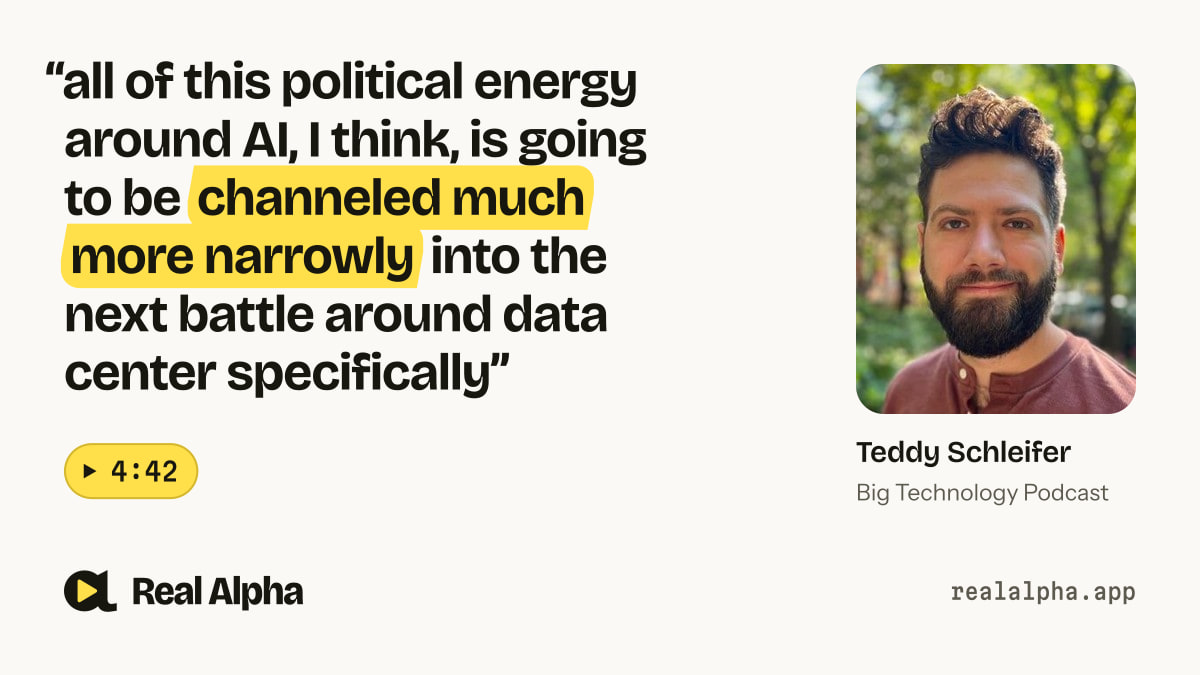
“all of this political energy around AI, I think, is going to be channeled much more narrowly into the next battle around data center specifically”
 Teddy Schleiferat 4:42 · Big Technology Podcast
Takeaways
- Voters in at least 38 jurisdictions backed restrictions or bans.
- A new data center super PAC failed to elect its candidate in South Carolina.
- Schleifer expects more political spending on data centers by 2028.
About this segment
Teddy Schleifer says voters in 38 jurisdictions opposed data centers, pushing the industry to spend politically. He expects the next fight to focus more narrowly on where facilities can be built.

Teddy Schleifer is a New York Times reporter covering billionaires and their influence on politics.
Covers billionaires and their influence across politics, philanthropy and technology for The New York Times.

Alex Kantrowitz, Host · Founder, Big Technology
Former BuzzFeed News senior tech reporter and author of Always Day One.
From “Can AI Keep Going After The Democrats’ Big Win? — With Teddy Schleifer”, Nov 5, 2026. Watch the full episode
Answers “What will AI look like in the next few years?” See all 395 answers
Thanks. We'll look at and fix what's off.
Transcript
Transcribed by machine (Whisper) from the episode’s audio, so a word may be off here and there.
- 3:04
greater backlash than we did previously. And one of the things that makes me think about this is a lot of the things that need to happen for the AI build out to continue are physical, right? The word is build out. They need compute. They need data centers to continue to expand and serve their models. And let me just read you a... A headline from the Washington Post, a nationwide backlash against data centers erupts at the polls.
- 3:30
Voters in at least 38 jurisdictions across the country passed bans or restrictions on data centers on Tuesday. 38 jurisdictions reflecting the widespread public revulsions to the facilities and adding to the growing pushback on the ambitions of the artificial intelligence industry. I mean, enough said, right? 38 jurisdictions voted for bans or restrictions on data centers. So on top of this wave, where, by the way, they're probably going to be reading the tea leaves here, you have a massive amount of voters coming out and saying, we don't want data centers in our backyard.
- 4:03
So what do you think the implications are there? Yeah, I mean, this is as close to a national referendum as you're going to get. I mean, this is obviously a brand new industry with where the politics are still being sorted out in real time. And clearly, a lot of Americans in 38 different places, at least, feel the same way. I haven't reported a ton on these different or at all on these referendum or referenda.
- 4:28
But clearly, 38 to zero is a pretty good average. I mean, we also saw for the first time this election, the data center industry do their own super PAC, which is kind of, I think, speaks to the ways in which the political winds are blowing here, which is that all of this political energy around AI, I think, is going to be channeled much more narrowly into the next battle around data center specifically, where why do you start a data center super PAC?
- 4:58
It's because you have you face political challenges or policy headwinds. And the data center super PAC spent a bunch of money to try to help elect Darlene Graham in South Carolina. She did not win. And I think going forward, a lot of as a lot of these fights kind of take off, you know, there's going to need to be money spent on behalf of the data center industry because clearly regular people are voting the other way.
- 5:27
I mean, that's why advocacy operations happen. It's to basically convince people to do something that they wouldn't do otherwise. And right now, a lot of voters are registering their point of view, and the data center industry is only beginning to kind of play offense. So, you know, I think we're just getting started here. And I think next 2028, I think there's going to be a ton of spending politically on data centers.