The alpha, twice a week
That was 4 min.
Get the best new moments in your inbox every Wednesday and Saturday. It's free.
Check your inbox
We sent a link to your address. Click it to finish signing up. Not there in a minute? Look in spam.
or
Balance of Power · 4 min · Nov 5, 2026
Local opposition may shift data center investment
 Mike Shepard
 says voter pushback will slow or relocate data-center projects, not erase AI demand.
The episode’s best minutes
Full analysis- 34:52Local opposition may shift data center investment4 min
- 42:16Trump can rebuild political capital, but turnover is comingPro pick 3 min
- One more moment in the full episode
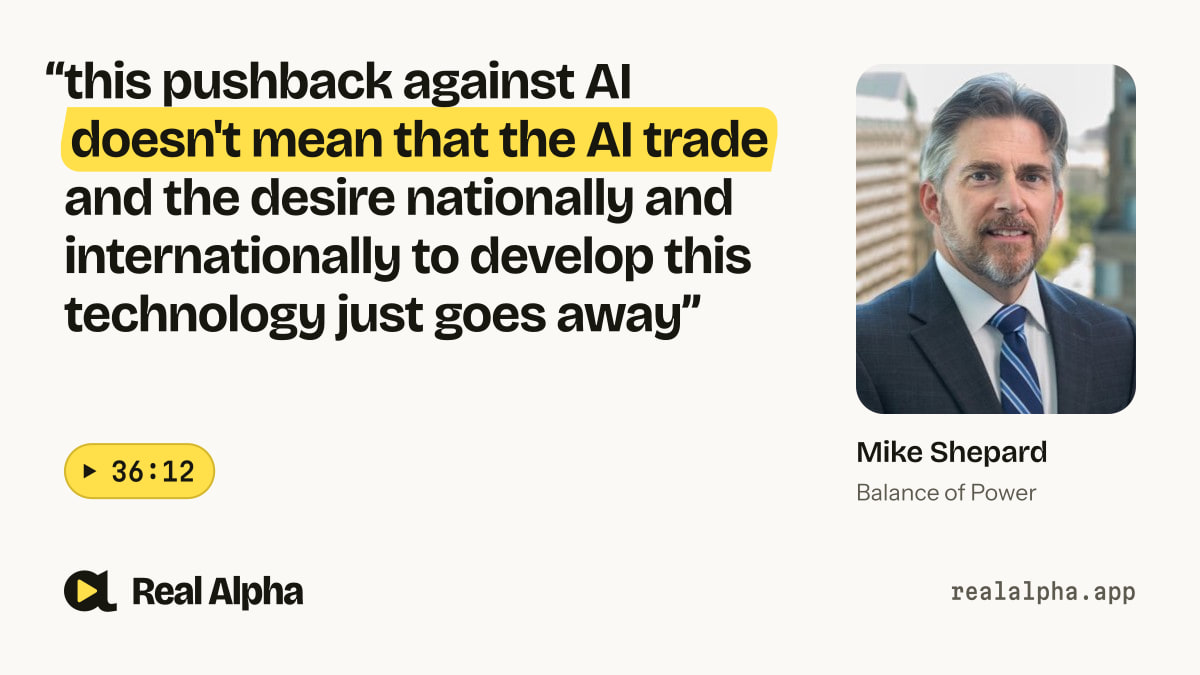
“this pushback against AI doesn't mean that the AI trade and the desire nationally and internationally to develop this technology just goes away”
 Mike Shepardat 36:12 · Balance of Power
Takeaways
- Voters want data centers built more on local terms.
- Some states may welcome projects for tax revenue.
- Big tech may benefit if slower builds improve free cash flow.
About this segment
Mike Shepard says voter pushback will slow or relocate data-center projects, not erase AI demand. Wyoming’s $17 billion Google project shows how investment may shift to welcoming states.

Senior editor of technology & strategic industries, Bloomberg
Edits technology and regulatory coverage at Bloomberg; previously spent 22 years editing at The Washington Post.

Joe Mathieu, Host · Washington Correspondent, Bloomberg
Co-anchors Bloomberg’s Balance of Power and covers Washington; founded and hosted SiriusXM’s POTUS political news channel.

Kailey Leinz, Host · Washington Correspondent, Bloomberg
Co-anchors Bloomberg’s Balance of Power, interviewing presidential candidates, administration officials, lawmakers and regulators on policy.
From “Republican Blame Game Starts”, Nov 5, 2026. Watch the full episode
Answers “What will AI look like in the next few years?” See all 395 answers
Thanks. We'll look at and fix what's off.
Transcript
From the transcript Balance of Power publishes with the episode.
- 35:05
regulation on a regular basis, Shep. That regulation will come on the state level. Is that what Wall Street woke up to here?
- 35:11
That is what they're getting a sense of now. It wasn't just the governor's races, Joe. It's a whole bunch of ballot measures across the country. Thirteen states had more than 40 proposals for voters to consider, and these were measures aimed at slowing the role of tech development in their backyards. They were really concerned. About nondisclosure agreements, they were concerned that these things would be driving up, the data centers would be driving up electricity costs, being noisy, and just not being good neighbors. And people have been complaining increasingly, and it showed up in the polling before the elections. And out of all those jurisdictions, roughly 45 to 1 approved measures that would, if enacted fully, slow the development of these projects.
- 36:00
Okay, so people are looking at Texas. They're worried. They're looking at Ohio. They're worried. New York's already got a moratorium. Arizona, what are we going to do?
- 36:10
But does this create a world in which or a country in which we have a number of states embracing data centers? Do they cross the border into Mexico? Do they show up in the Middle East? They're going to go somewhere.
- 36:22
They are going to go somewhere because this pushback against AI doesn't mean that the AI trade and the desire nationally and internationally to develop this technology just goes away because voters objected to data centers. It's still there, and there's still a strong motivation across the economy to adopt and embrace this technology. Voters are really just saying, look, we would like to have it done a little bit more on our terms. But what that means, as you said, Joe, is perhaps some of these facilities get located elsewhere. And in fact, on election night, I won't forget this interview that you did with David Kelly of JPMorgan Chase Asset Management.
- 37:00
He talked about this phenomenon that, look, there may be jurisdictions that say, no, we are no longer interested in having these kinds of projects. But there will be others that do do the opposite, that say we would welcome this because it will be good for our cash strapped local budgets. We could use the tax revenue. And so you may see a little bit of a rebalancing. And interestingly, today, Google announced a 17 billion dollar data center project in the state of Wyoming. So, you know, we could see different facilities popping up in unexpected places like space.
- 37:35
That's going to be the next thing Elon reminds us of. Well, he reminded us on election night with a joking tweet.
- 37:41
Well, the space laser. How about the space data? Well, he also tweeted about that, too. He said he said data centers in space look more appealing now. And when we think about it, he has that big TerraFab project, Joe, in Texas that he has been pushing. And it's not only a massive chip making project. It is also one. that would be a data center in itself too.
- 38:03
Shep, we've only got a minute before we talk to Mick Mulvaney. I'm curious that the power of incumbency, we talked about this a little bit earlier in the program, that was part of the trade yesterday. MAG7 was lifted because they either have data center, they've got the permits to build more as opposed to a new candidate coming into the business. Is there something to be said for that? Because they're being washed out with everyone else today.
- 38:26
Well, the neoclads are really getting hurt far worse when you compare the numbers. CoreWeave is one example. They're down 12%. Another neighborhood. Applied Digital, a data center developer, they're down roughly 16%. So the market is delineating. So the market is delineating some. And the market is also looking at the balance sheets of some of these hyperscalers. And they are seeing that, wait, maybe if the roll is slowed a little bit on data center build-out, maybe that will flip the picture on free cash flow. Because a lot of those big companies had gone free cash flow negative before. And that was a concern for investors, especially over the past month.