The alpha, twice a week
That was 3 min.
Get the best new moments in your inbox every Wednesday and Saturday. It's free.
Check your inbox
We sent a link to your address. Click it to finish signing up. Not there in a minute? Look in spam.
or
Masters in Business · 3 min · Oct 30, 2026
LPL expects its next growth phase to favor partnerships
 Rich Steinmeier
 says public markets helped LPL fund transformative deals and reach the scale it needed.
In this episode
Full analysis- 30:16LPL aims to preserve what makes acquired firms distinctive6 min
- 38:15AI can shift advisor time from operations to client advice2 min
- 43:12LPL earns advisor loyalty without locking them inPro pick 3 min
- 52:24Only a handful of wealth platforms will sustain major investment2 min
- 54:46LPL expects its next growth phase to favor partnerships3 min
- 11:49Robo advice helped lower the cost of reaching smaller accounts3 min
- 50:04RIA aggregators are beginning to resemble the firms advisors left2 min
- 47:51Private investments may reach investors at lower asset levels2 min
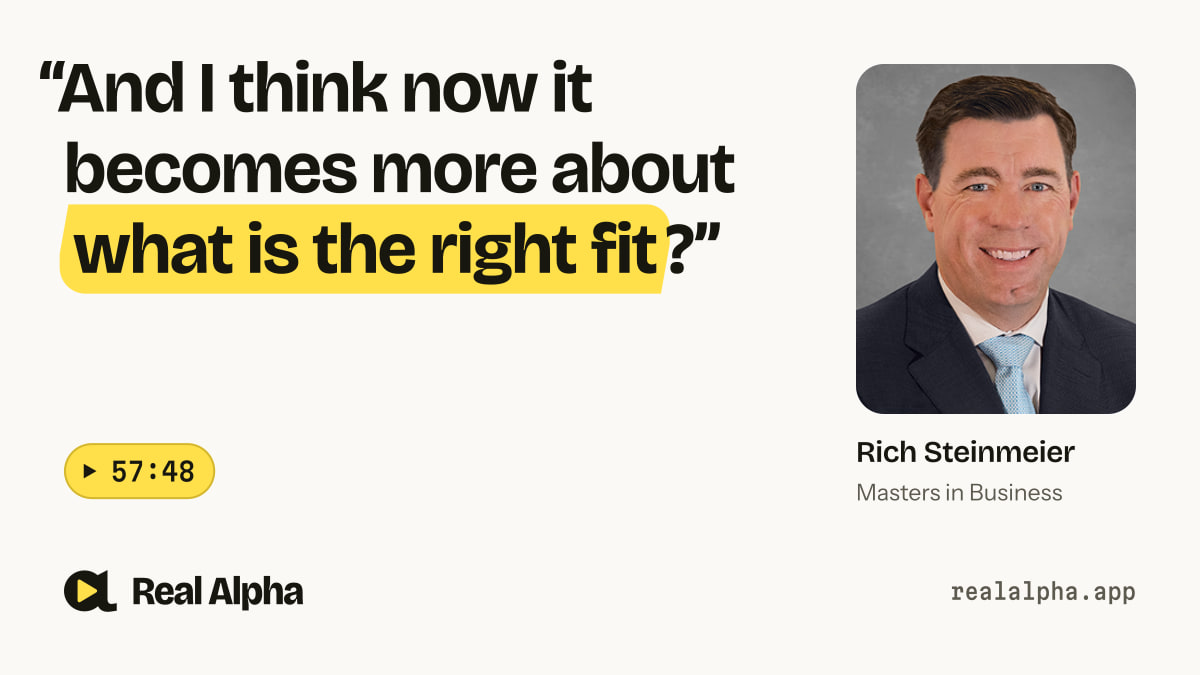
“And I think now it becomes more about what is the right fit?”
 Rich Steinmeierat 57:48 · Masters in Business
Takeaways
- Public debt and equity markets support large deals.
- LPL sees less need for acquisitions after reaching investment scale.
- Steinmeier expects partnerships to play a larger role going forward.
About this segment
Rich Steinmeier says public markets helped LPL fund transformative deals and reach the scale it needed. With that threshold reached, he expects future growth to focus more on fit and partnerships than acquisitions.

Rich Steinmeier is CEO of LPL Financial.
Led LPL’s growth and advisor recruiting, onboarding more than 7,700 producing advisors and 100 institutions.
- BR
Barry Ritholtz, Host
From “The Future of Financial Advice: Masters in Business with Rich Steinmeier | At the Money”, Oct 30, 2026. Watch the full episode
Thanks. We'll look at and fix what's off.
Transcript
From the transcript Masters in Business publishes with the episode.
- 54:48
We mentioned so many firms are staying private longer. Both yourself and a lot of the larger competitors are public. How does being a public company affect how you develop the platform, how you build the culture, and how you think about the advice that your clients, the advisors, give their clients, the investors?
- 55:11
Well, I like that we're public. I like that we have to come out and report quarterly. I like that our clients, our advisors and institutions can see the health of the firm. I like that they can see where we're doing well and where we're challenged. They'll feel it in their interactions with us day to day, but they're able to see on the balance sheet, on the income statement, what is the health of this firm and how are we performing in the marketplace? So in that regard, I actually really like that we're public. I think the other thing about it is we also then aspire to share our story. So we don't just, we tell our story, which is what is the strategy of this firm? What is the market that we're trying to participate in? What is the way in which we're trying to win in the market? think we reveal and most do the relative
- 55:54
competitive advantages. And so again, for us, maybe back to that five by five that we alluded to a little bit earlier, we have a lot of transparency about where we think we're taking the firm. And then we have a scorecard that gets published every quarter. We actually publish monthly as well, every month and every quarter so that you can see as somebody who's in our ecosystem and one of our partners, how well is my partner performing and how healthy are they?
- 56:17
Anytime I see large acquisitions, such as Commonwealth or Atria, being public has to be a huge advantage versus somebody that has to go out and dig up the financing for this. You have valuable paper to use. How does this affect how you look out and think about future acquisitions? What does the roadway look like over the next couple of years?
- 56:41
Yeah, I think being public does help us. I mean, we have access to the public debt markets as well as the public equity markets. And so when we go out and do a transformative acquisition. We think through how the funding occurs and we think in a responsible way, but I think it does allow the art of the possible to be more readily available to us. I think when we think about the role that M & A plays, I think for us, maybe I'll take a backwards looking and then forward looking. I think backwards looking, we felt pretty convicted that we needed to get to a scale for which we would be able to control our own destiny.
- 57:13
And that meant, as you looked into, and I wouldn't even call it AI eight years ago, I joined eight years ago, I would have thought about transformative technology. And again, I kind of framed it in my mind's eye around our ability to be as powerful and as invested in capabilities and supportive advisors as the leading firms who are trying to disintermediate advisors would be. And so there was a threshold. And we thought about that threshold as a capacity for investment. And I think we've gotten to that threshold where we feel like we can go toe to toe in support of advisors. Now, that diminishes the need for M & A forward because I think we needed to get to a critical scale. And I think now it becomes more about what is the right fit?
- 57:54
Where does it work? And maybe even shifts into there are a lot of institutional partnerships that make a lot of sense because we kind of mentioned the threshold for being an at-scale player is going to continue to grow. But there are fantastic brands out there that have wealth franchises that may want to partner. And so I think it probably hems a little bit more towards partnership than it does towards M & A.