The alpha, twice a week
That was 6 min.
Get the best new moments in your inbox every Wednesday and Saturday. It's free.
Check your inbox
We sent a link to your address. Click it to finish signing up. Not there in a minute? Look in spam.
or
Masters in Business · 6 min · Oct 30, 2026
LPL scales without erasing acquired firms’ differences
 Rich Steinmeier
 explains how LPL evaluates acquisitions and protects what made each firm distinct.
The episode’s best minutes
Full analysis- 38:15AI can shift advisors’ time from administration to client advice4 min
- 30:27LPL scales without erasing acquired firms’ differences6 min
- 43:12LPL relies on service, not contracts, to retain advisorsPro pick 3 min
- 5 more moments in the full episode
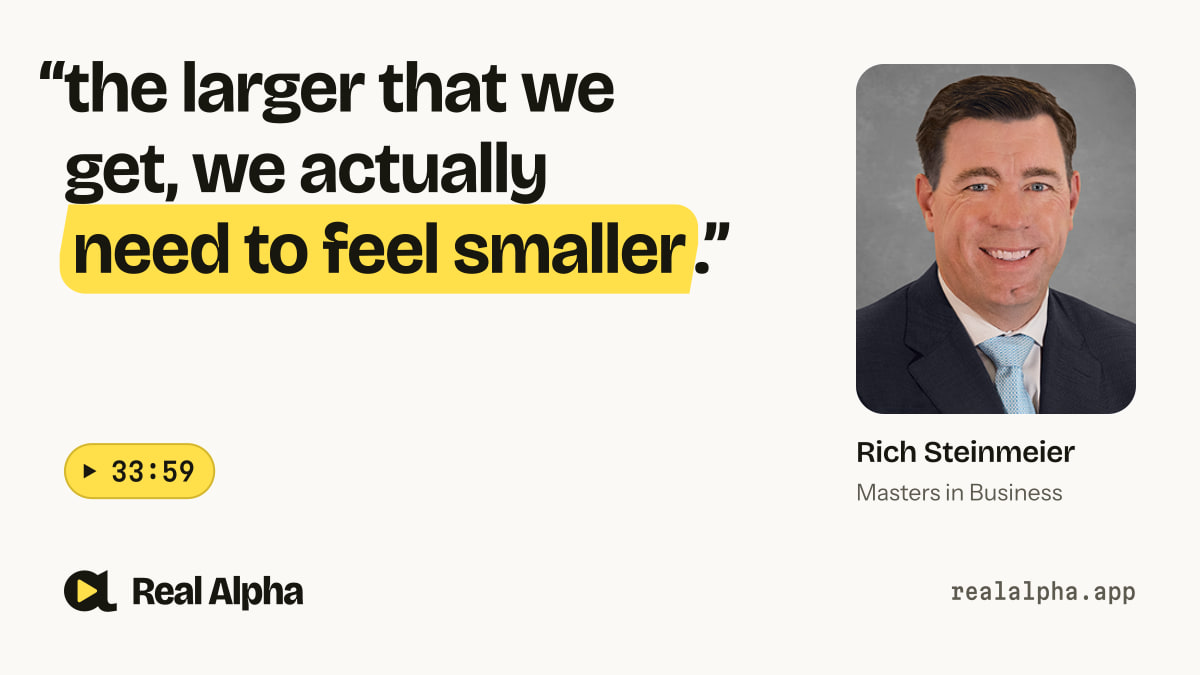
“the larger that we get, we actually need to feel smaller.”
 Rich Steinmeierat 33:59 · Masters in Business
Takeaways
- Acquisitions should preserve the qualities that made firms stand out.
- Core services can be integrated while client-facing practices stay distinct.
- A larger platform still needs to feel responsive and personal.
About this segment
Rich Steinmeier explains how LPL evaluates acquisitions and protects what made each firm distinct. Shared infrastructure can be integrated while advisor practices keep their own approach.

Rich Steinmeier is CEO of LPL Financial.
Led LPL’s growth and advisor recruiting, onboarding more than 7,700 producing advisors and 100 institutions.
- BR
Barry Ritholtz, Host · Columnist, Bloomberg
From “The Future of Financial Advice: Masters in Business with Rich Steinmeier | Masters in Business”, Oct 30, 2026. Watch the full episode
Thanks. We'll look at and fix what's off.
Transcript
From the transcript Masters in Business publishes with the episode.
- 30:30
just rolling up a ton of stuff, but very, very specific deals. The biggest one was Commonwealth, $ 2. 7 billion, on top of Atria, and then you mentioned Prudential. Wintrust is another. Walk us through M & A deals like that. How do you identify a target? How do you think about the cultural fit? It's more than just X number of advisors, X number of households, and so much AUM. How do you put together a deal that's going to last for a long time? Yeah.
- 31:03
And let me clarify just one thing, because my partners at Wintrust and Prudential, those are different in that they're partnerships. And so that's not an M & A. That is actually us working in concert with them. And it's their go-to-market business. But I would tell you, as we look at what we think this firm needs to be to be great, and our aspiration is to become the best firm in wealth management. And we've got definitions for how you get to that and when we will know we're there.
- 31:28
But ultimately... I would like to have the firm for which advisors, when partnered with us, can be more successful at this firm than they can be at any other firm. Now, I'm sure a lot of firms have that same aspiration, but part of that journey for us was to actually get to a scale for which we could make investments that were outsized. And the thought process around that was, if you see the investment levels that firms are making to disintermediate advisors, to make investments in emerging technology, that basically hop in front of the advisor, the thought was, can we get to the same levels of investment? And so that's raw dollars or capabilities delivered, but can we get there, but take those capabilities in support of advisors?
- 32:08
And so you have two alternate paths, both pursuing disruptive and transformative technology, but one of them in promotion of advisor versus one in disinmediation. And so that was what was at the crux of it as I first started to think through this pathway to us getting to become a scale player with capabilities that were unparalleled. I think though you hit the key, which is for us, when we look at M & A, especially in the advisor segment, we're thinking about that as an independence. We, we, we espouse that advisors own their own firms, the institutions that we work with own their businesses as well. Um, but for us, we're looking at, and especially when you look into Atria had an incredible entrepreneurial spirit, um, There was a lot there from the founders that was a lot to like. Commonwealth had this exceptional delivery of exceptional service
- 32:58
to advisors, responsiveness to advisors, reflexive technology that ingested advisors, prioritization, feedback, et cetera. And so for us, there is part of this, which is can we grow this firm so that we can be substantive? Can we stay aligned with our principles? But then can we grow the firm collectively so that the sum of the parts is greater than the whole?
- 33:20
It sounds like when you're doing a post acquisition evaluation, you're looking at a whole lot more than just AUM. How do you integrate those two very distinct skills and really cultural mindsets, entrepreneurship and very high quality service?
- 33:39
So the first is we have to screen to make sure we want to ingest that. And I think that is in the diligence. we look at what will these two firms look like together and what is our goal. And so, so much of where our firm is headed is to make ourselves more malleable. Actually, you know, and this seems counterintuitive, but the larger that we get, we actually need to feel smaller. We have to be large to have the capacity to invest, to deliver fantastic capabilities, technology, product sets, expertise, but it shouldn't feel like we've become impersonal.
- 34:18
And so that's been the strategy behind a lot of our more recent acquisitions, which is how do we defend what made the individual firms great that we may have acquired? And then you have to make it clear to the firm itself that we're not just swallowing things. Because when the firm believes it's swallowing things, it's just going to homogenize everything. And so we actually state to ourselves, part of this goal is to not homogenize, but to actually make us further differentiated.
- 34:46
So that's really interesting because The criticism I've heard of a lot of private equity funded roll-ups, and there's a big one in Canada, there's a ton of them throughout the United States, is that they don't integrate the culture. They just have a collection of frankenfirms that are all slapped together and none of the horses are pulling in the same direction. What do you do to avoid that fate when you're thinking about a big acquisition?
- 35:14
Well, I make two distinctions. One, part of the practices of the advisors for which we have the benefit of serving, I want those and we want those to stay distinct. And so when you think about Commonwealth and 2,000 advisors, maybe 3,000, depending on how you want to strike the line, there are thousands of individual practices there. There, we want them to go to market exactly how they want to go to market, how they want to represent themselves. But then there is the integration of the Commonwealth home office staff the Commonwealth service experience. And so for us, there are two different distinctions there, which is, okay, how as a home office team, there is something special that exists at Commonwealth. And so how do we make sure that whatever is special and differentiated, we actually keep and insulate. But there are things there
- 36:05
that are homogenized, like account opening, right? Like account transfers, like core technology. And there's nuances in core technology, don't get me wrong. But there are There, that can move into an integrated approach. But then you keep that kind of think of it. For me, I think about that final mile delivery is differentiated. But what sits before in this utility terms in the distribution versus transmission in the distribution can be the same. And then as you get to that final mile, you differentiate.