The alpha, twice a week
That was 3 min.
Get the best new moments in your inbox every Wednesday and Saturday. It's free.
Check your inbox
We sent a link to your address. Click it to finish signing up. Not there in a minute? Look in spam.
or
Bloomberg Tech · 3 min · Oct 27, 2026
Luckey says Ukraine shows the value of stopping ineffective purchases
 Palmer Luckey
 describes Project Meridian’s mix of perspectives, then argues future warfare planning should include faster procurement and the ability to stop buying what no longer works.
The episode’s best minutes
Full analysis- 31:47A U.S. computer supply chain needs more than domestic chipsPro pick 7 min
- 23:36SoFi ties growth to products per member and rising-rate resiliencePro pick 5 min
- 40:11Luckey says Ukraine shows the value of stopping ineffective purchases3 min
- 2 more moments in the full episode
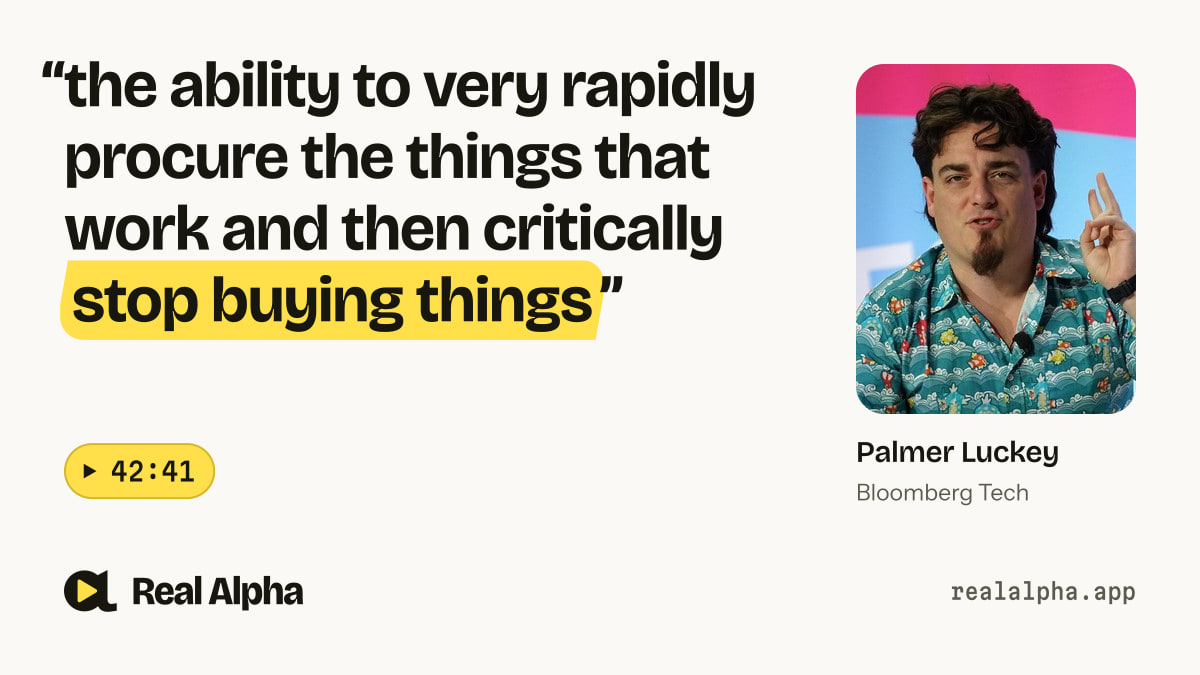
“the ability to very rapidly procure the things that work and then critically stop buying things”
 Palmer Luckeyat 42:41 · Bloomberg Tech
Takeaways
- Project Meridian is meant to consider warfare in 2040 and 2050.
- Ukraine highlights the need to buy effective systems quickly.
- Luckey says forces should stop buying systems that stop working.
About this segment
Palmer Luckey describes Project Meridian’s mix of perspectives, then argues future warfare planning should include faster procurement and the ability to stop buying what no longer works. He says changing Pentagon practices is painful despite broad agreement.

Palmer Luckey is founder of Anduril.
Co-founded Anduril, which builds autonomous defense systems, and designed the Oculus Rift that revived VR.

Ed Ludlow, Host · Host & correspondent, Bloomberg
Hosts Bloomberg Tech and reports on technology, supply chains, deals and finance for Bloomberg News.
From “Meta Boosts Equity Offering, Raising Its AI Bet & Andruil Founder Palmer Luckey | Bloomberg Tech”, Oct 27, 2026. Watch the full episode
Thanks. We'll look at and fix what's off.
Transcript
From the transcript Bloomberg Tech publishes with the episode.
- 40:14
This is also the first opportunity I've had to ask you about Project Meridian. You, Elon Musk, Newt Grinch leading that project. I know this might sound like an odd starting question, but what are those meetings actually like? Like when you guys get together, what are the problems that you debate with each other? Well, a few things.
- 40:32
One, there's actually about 20 people that are on Project Meridian. You're right. We're the three chairs of the steering committee. Look, we're just getting started, right? It's a 120-day project. I think that it's still starting to come together. The whole project's being run by the MITRE Corporation, and they've done a lot of analysis of this. Type of thing before. What I've seen is that everyone is bringing a very different, unique perspective. I think it's a matter of public record, so hopefully I'm not getting into trouble here. But like, Rick Smith, CEO, founder of Axon, is one of the other people there, and he's bringing a really unique perspective on things that can reduce collateral damage, reduce impact on civilian lives in warfare. You have other people who are coming from the computing industry, other people who are coming
- 41:14
from the automotive industry. It's a lot of different perspectives. And again, we need to wait until this thing gets further along. But at least my personal opinion is I'm hoping that the report reflects the diversity of different perspectives that people are bringing to the table. I don't want this to just be a think tank report that says the same five things that everyone's known for 10 years. Look, we all know what the threat is in the Pacific.
- 41:38
We all know what the threat is on the bio and the chem side. I would really like this to focus on the things that otherwise might not get attention, including things that might not get my attention.
- 41:48
We're live on Bloomberg Television and Radio. We're speaking to Palmer Luckey. I just asked about Project Meridian. I mean, the report's due in January, right? And I get that that's going to publish. You have to wait for that. But that was really interesting. Rather than just a think tank, I think people are asking, have you found evidence that there are things the Pentagon can do differently?
- 42:07
I think they can, but I don't think that's really what this is about. I think there's been a lot of talk about how this is about how the Pentagon operates.
- 42:18
The reality is, I mean, you can go watch the announcement. It's about what the future of warfare looks like, particularly think about 2040, 2050, the things where you don't necessarily have a daily impetus to do anything. really spend your time thinking about what it might look like and what steps you might take today if you're building towards that future. The things the Pentagon can change in terms of faster procurement, in terms of more lean development cycles, or things that I think everyone's learning from Ukraine, like the ability to very rapidly procure the things that work and then critically stop buying things when they're no longer working. That's maybe the most important thing we've seen out of Ukraine, giving units the decision to buy or stop buying things when they're no longer relevant, no longer working. I mean, that's
- 43:01
a really, really powerful development. But I think everyone knows that we need to do it. But it's the difference between knowing that you're fat and losing weight. You can know what you need to do, but sometimes you got to eat less and move more. But it's so painful that it takes time sometimes to make it happen. And I think that's the problem of the deity. They all know what the problems are. And it's really painful to actually go about solving it.