The alpha, twice a week
That was 2 min.
Get the best new moments in your inbox every Wednesday and Saturday. It's free.
Check your inbox
We sent a link to your address. Click it to finish signing up. Not there in a minute? Look in spam.
or
Training Data · 2 min · Nov 5, 2026
Malde sees specialization lifting AI adoption from 1% to 99%
 Ronak Malde
 argues that AI must move beyond one general-purpose model, letting companies customize models and harnesses for specialized workflows.
In this episode
Full episode- 13:05Single rollouts can train agents without replay environmentsPro pick 3 min
- 20:11Continual learning keeps humans in the loopPro pick 4 min
- 10:27Continual learning starts with traces, replay and training2 min
- 4:40Harvey raised its legal benchmark score from 4% to 18%4 min
- 29:04Malde sees specialization lifting AI adoption from 1% to 99%2 min
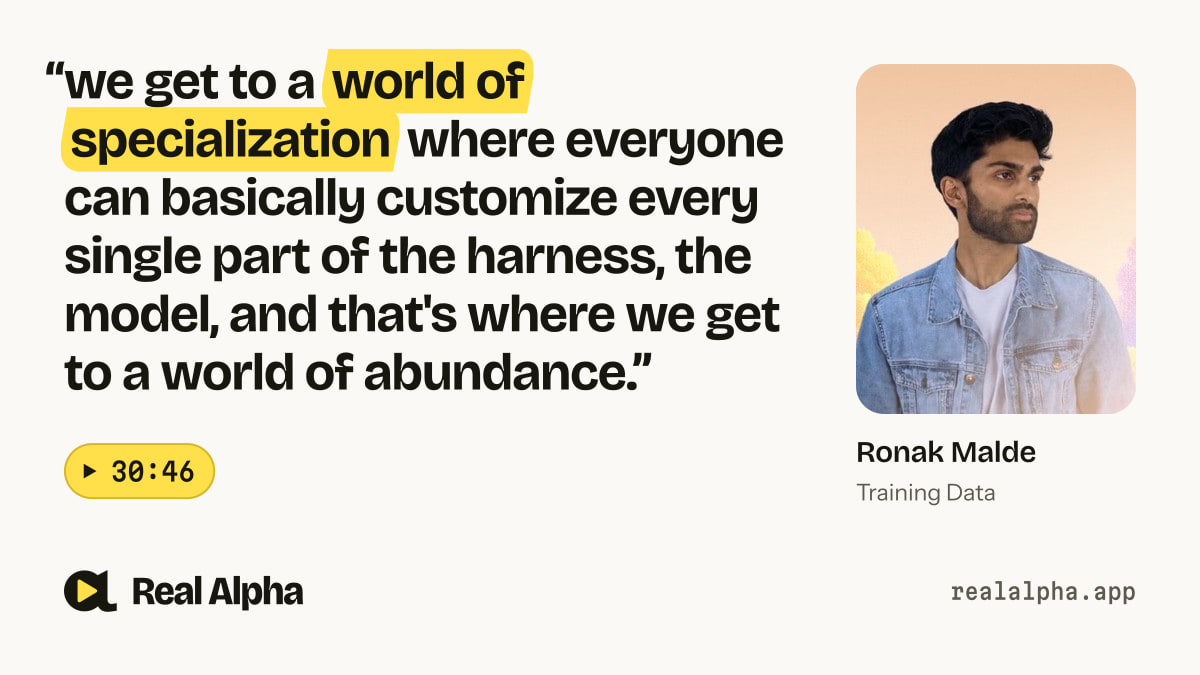
“we get to a world of specialization where everyone can basically customize every single part of the harness, the model, and that's where we get to a world of abundance.”
 Ronak Maldeat 30:46 · Training Data
Takeaways
- Customize models and harnesses for specialized workflows.
- Specialization can help automate work that remains manual.
- Malde's target is growth from 1% to 99% enterprise AI adoption.
About this segment
Ronak Malde argues that AI must move beyond one general-purpose model, letting companies customize models and harnesses for specialized workflows. He wants adoption to grow from 1% of enterprise to 99%.

Ronak Malde is cofounder of Trajectory.
Built SWE-1 at Windsurf and now leads Trajectory's continual-learning platform for improving agents from production use.

Pat Grady, Host · Co-steward, Sequoia Capital
Joined Sequoia in 2007; backed Snowflake, Zoom, ServiceNow and OpenAI.
- LR
Lauren Reeder, Host · Sequoia Capital
From “Bringing Continual Learning to Every Company: Trajectory’s Ronak Malde”, Nov 5, 2026. Watch the full episode
Thanks. We'll look at and fix what's off.
Transcript
Transcribed by machine (Whisper) from the episode’s audio, so a word may be off here and there.
- 29:07
ago was this idea that the world right now has plentiful intelligence, thanks to the Foundation Model Labs, and plentiful experience, thanks to all the people who do hard work in lots of different domains every day, but there's this big gap between the two. And in some ways, continual learning is kind of the thing that bridges that gap. And it's kind of the thing that honors all of this earned experience that people have and like makes it legible to the intelligence coming out of the foundation models. And I thought that was like a very kind of elegant and beautiful way to think about what it is you guys are doing. And then the question that that leads to is what is your most optimistic view of the future in terms of where continual learning can take us? I love that question. A good example of this is Adam Smith's Wealth of Nations.
- 30:00
where we started out in the 1700s in this world where everyone was kind of doing the same thing, right? You would do this end-to-end workflow, you could call it, of an artisan. And what he theorized basically is a world of abundance needs specialization, where you want someone to basically not be context switching all of the time and work on the thing that they've built up experience about. And it seems like in AI right now, we're in this pre-industrial revolution society, or even a hunter-gatherer sort of society where everyone is just doing the same work over and over again. We're consulting one oracle of technology. I think what needs to happen is basically get to a world where it's no longer just one manufacturer of a car, one manufacturer of like every single unit, but we get to a world of specialization where everyone can basically
- 30:53
customize every single part of the harness, the model, and that's where we get to a world of abundance. And there's a reason why only 1% of enterprise has actually been adopted by AI. And there's so many workflows out there that are super manual and could be automated and actually increase intelligence based on all of these agents that could be in production. And so my goal is to basically take that 1% and turn that into 99% so that we are actually learning from all of this built-up experience that lives in the world right now. Love it. Ronak, thanks for being here.