The alpha, twice a week
That was 6 min.
Get the best new moments in your inbox every Wednesday and Saturday. It's free.
Check your inbox
We sent a link to your address. Click it to finish signing up. Not there in a minute? Look in spam.
or
Bloomberg Surveillance · 6 min · Oct 30, 2026
Many ordinary businesses create substantial wealth through ownership
Owen Zidar describes how everyday private businesses—from auto dealers to plumbing firms—create millionaires outside the usual tech and finance spotlight.
The episode’s best minutes
Full analysis- 23:57Use age and income to set a retirement savings targetPro pick 3 min
- 32:22Many ordinary businesses create substantial wealth through ownership6 min
- 2 more moments in the full episode
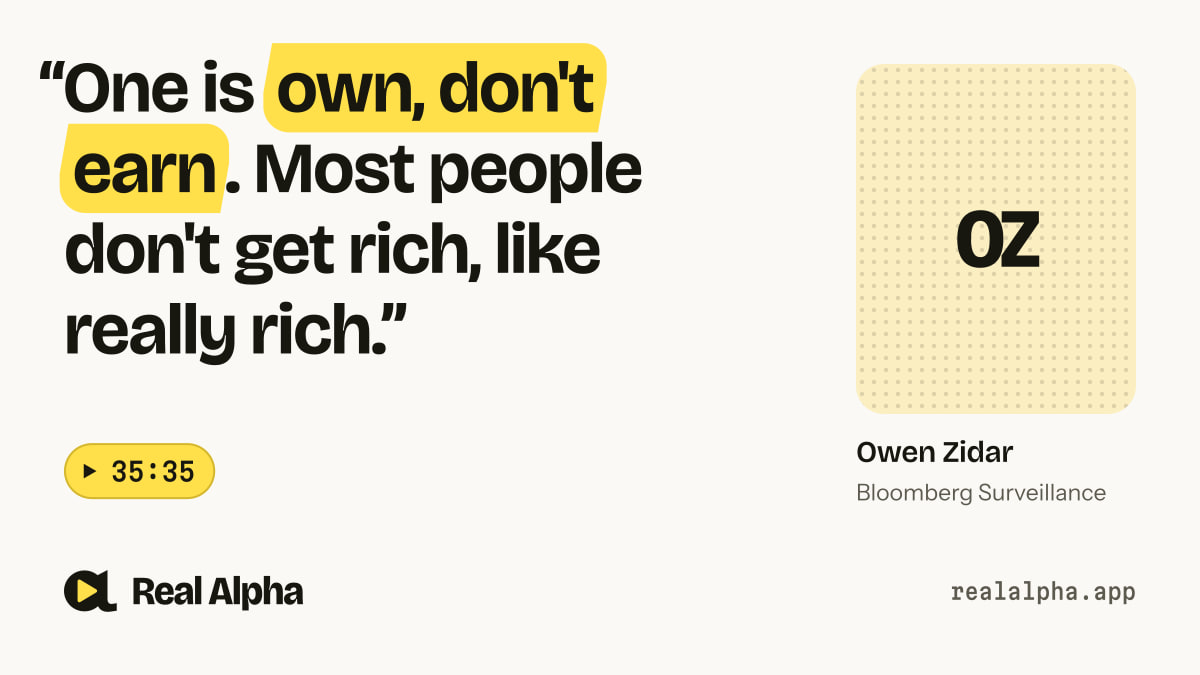
“One is own, don't earn. Most people don't get rich, like really rich.”
Takeaways
- Private business owners make up a large, less-visible group of millionaires.
- Ownership, not a high salary, is a common path to substantial wealth.
- Buyers can take over a retiring owner's business with seller financing.
About this segment
Owen Zidar describes how everyday private businesses—from auto dealers to plumbing firms—create millionaires outside the usual tech and finance spotlight. He also explains how buyers can acquire retiring owners’ businesses.
Author
From “'Ugly' Midterms, Increasing Your Nest Egg, Everywhere Millionaires | Bloomberg Money”, Oct 30, 2026. Watch the full episode
Thanks. We'll look at and fix what's off.
Transcript
From the transcript Bloomberg Surveillance publishes with the episode.
- 32:24
beyond the Elon Musks, Jeff Bezos, and indeed Mike Bloombergs, who are the really rich in America, what surprised you the most as you combed through the data to get a better understanding of who the very rich are but not the super wealthiest? And if you go to any nice part of the
- 32:39
country where there's a nice lake or a golf resort and you go and ask who owns that $ 4 million vacation house or who has that nice boat, it's very often not someone like Elon Musk or the moon men who are kind of extraterrestrial. It's much more mundane. It can be very common businesses like auto dealers or beverage distribution companies or restaurants. People who, you know, are clearing. Snow from a bunch of people's driveways and they do that enough that they can make $ 5 million. And there's $ 3 million of, or sorry, there's 3 million of these everywhere millionaires across the country doing relatively ordinary things, making a ton of money from it.
- 33:14
And what's key to them is that they are able to organize their business as a pass-through business. Why is this important? Why do we care?
- 33:21
I mean, that's one of the interesting things is that that's how we're able to see them for the first time because it creates a paper trail in terms of the record keeping. And generally, it's just hard to know who's wealthy if you just read what public companies are saying because there's this huge legion of private business owners that don't have to report how they're doing. And through the pass-through structure, as researchers working with the Treasury Department, we were able to see this hidden world of everywhere millionaires that can inspire a lot of people to know that there's a lot of opportunity and abundant wealth in America nearby, and it's not just in Manhattan and California.
- 33:56
I think Scarlett undersold a book, a laureate up at MIT. That's a school up in Boston, if you didn't know that, Owen. Simon Johnson says, shut up and read it. And the giant, I dearly miss him every day, Angus Deaton says, a vitally important book. My childhood is in your book. I went to camp. I knew the Wegman family of Rochester. New York, and there were two kids on the block. They lived on Monroe Avenue, and their name was Sands, and dad started a beverage distribution company, as you put it, called Canandaigua Wine. They start seat of the pants, don't they?
- 34:30
And they don't want the government taking their money, you know, as a broad sense.
- 34:35
Yes. So we tell one of the industries that we tell the story of is beverage distribution from the prohibition to when you had people with a pickup truck and some ice, and that was enough to be a beverage distribution owner. Then if you fast forward, it was an extremely lucrative thing where the Coors family in the 70s had over 1,000 people applying to be one beverage distribution owner. And now. You know, in the book, we have anecdotes like you go to San Antonio and the mayor will say, you know, why are there so many private jets in San Antonio?
- 35:07
I've never seen so many private jets here. And it's like, oh, it's the beer distribution conference.
- 35:11
So it's amazing because we're talking about very unglamorous businesses. We're not talking about fancy businesses that get people excited, that show up in the covers of magazines or anything, or that even get talked about on television. I mean, a lot of these are plumbing businesses, dental practices, things that kind of get overlooked. If I'm determined to become super rich then, I can't rely on my salary job then, right?
- 35:33
I need to go and take a risk. So there are a few lessons in terms of getting wealthy. One is own, don't earn. Most people don't get rich, like really rich. you know, $ 10, $ 25 million from earning a W-2 or a salary. The typical person, especially as you go up from $ 25 million to $ 100 million, they almost all own private businesses like the families of your childhood, Tom.
- 35:55
I look at this, Professor, and it's as simple as you're at a school, and with the media frenzy today, these kids think their starting pay ought to be $ 212, 000 a year, and if I'm not popping $ 450, 000 after three years, I'm a failure. How do we adapt to a younger generation that's talked themselves into big six-figure income, which we all know is a fiction?
- 36:17
I think the definition of success right now is just really narrowed, and one of the goals of the book is to broaden the aperture to say— And you succeeded at that. I hope, being on shows like this. One interesting thing is you just don't have to be elite to be rich.
- 36:32
You don't have to start at one of these fancy jobs. I think there's tremendous opportunity to have these private business owners, many of whom are reaching retirement, who want to hand it off to the next generation.
- 36:41
I'm in Switzerland as a spoiled rich kid in a room looking out at the Geneva and the Mont Blanc in Italy, and I'm reading a book I pick up called Think and Grow Rich, Napoleon Hill. I looked at it a million. Years ago and thought, this is a, it was in the 30s. It was my grandparents and parents, and I never got it. I thought it was so simplistic. Napoleon Hill, very controversial, built that franchise.
- 37:07
On spirit and energy, go get them and all that. And the magic of your book is I don't see that there. How do you feel about that American get up and go spirit that was codified 40, 50 years ago? It really shines through.
- 37:22
We talked to several of these business owners and they're relentless and they work for decades. So I think You know, for young people, there's a sense that you can get rich quick and create an app.
- 37:32
And most of these stories are, you know, you. Roll up your sleeves and it's several decades of hard work and a lot of gumption and, you know, real competitive drive. So I think it goes back to some of these classic views. And it's just we have better data than anyone's ever had before on wealth and opportunity in America. And that's what makes it exciting.
- 37:51
So for people who own these businesses that are doing very well, they don't realize their wealth until they sell it. And a lot of the times, the selling it, realizing it, involves selling it to private equity. How big of a role does that play in the everywhere millionaire?
- 38:04
So a big market, private equity has really grown since ERISA, and it's... They're just very hungry for these types of companies. And the typical everywhere millionaire in this country is 62. As I said, it took decades to get there. And now they're seeing retirement. And often they can give it to their kids if their kids want to do it. They could sell it to private equity, which you can think of as the child they never had. Or they can sell it to a young person who comes in and says, hey, I'll shadow.
- 38:31
You for a few years. Let me learn the ropes. I'll be your apprentice. I'll be your apprentice.
- 38:35
And then I'll use some seller financing to have you finance it with some share of the future profits. And that's a very common way that even top MBA. Students are now doing. They're going and buying these businesses rather than working for Goldman Sachs or McKinsey.
- 38:47
Is that what you're hearing from readers, from people you talk to?