The alpha, twice a week
That was 3 min.
Get the best new moments in your inbox every Wednesday and Saturday. It's free.
Check your inbox
We sent a link to your address. Click it to finish signing up. Not there in a minute? Look in spam.
or
Machine Learning Street Talk · 3 min · Jun 24, 2025
Marcus expects neurosymbolic AI to take off within four years
 Gary Marcus
 predicts a neurosymbolic shift, with LLMs still used but no longer central by 2035.
In this episode
Full analysis- 35:12AI lab leaders race because they trust themselves to manage the risks7 min
- 47:47Compute, data and funding all constrain AI scaling4 min
- 1:41:43Alignment needs adaptive capacity, not a one-time technical fixPro pick 8 min
- 22:52States can draw three red lines for AI development3 min
- 52:50Compute priors and coding benchmarks shape Kokotajlo's forecast6 min
- 1:19:00AI progress is uneven across cognitive abilities5 min
- 1:08:19Tool use can make an LLM system neurosymbolic3 min
- 1:55:39Marcus expects neurosymbolic AI to take off within four years3 min
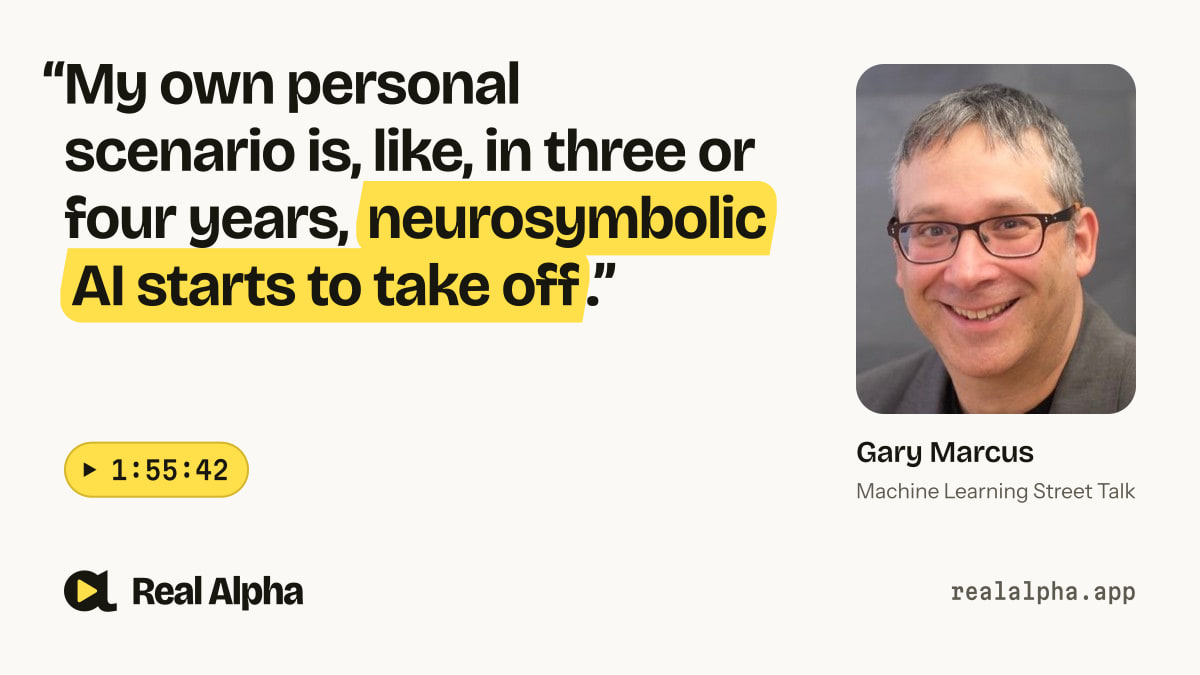
“My own personal scenario is, like, in three or four years, neurosymbolic AI starts to take off.”
 Gary Marcusat 1:55:42 · Machine Learning Street Talk
Takeaways
- Marcus sees neurosymbolic methods gaining ground in three or four years.
- He expects LLMs to remain useful but not be the full answer.
- He predicts stronger reasoning and world models over five to ten years.
About this segment
Gary Marcus predicts a neurosymbolic shift, with LLMs still used but no longer central by 2035. He expects new approaches to improve reasoning and world models.

Professor emeritus of psychology and neural science, New York University
Founded Geometric Intelligence, acquired by Uber, and researches human language development and cognitive neuroscience.
- TS
Tim Scarfe, Host · Host, Machine Learning Street Talk

Keith Duggar, Host · Co-host, Machine Learning Street Talk
From “Explosive AI Timeline Predictions [Gary Marcus, Daniel Kokotajlo, Dan Hendrycks]”, Jun 24, 2025. Watch the full episode
Answers “What will AI look like in the next few years?” See all 395 answers
Thanks. We'll look at and fix what's off.
Transcript
Transcribed by machine (Whisper) from the episode’s audio, so a word may be off here and there.
- 1:55:44
I think that that would be helpful. My own personal scenario is, like, in three or four years, neurosymbolic AI starts to take off. Like, I already see signs of this. Alpha Fold just won a Nobel Prize. That's a nice thing for neurosymbolic AI. Conferences for it are getting bigger and so forth. And I think eventually there will be a state change. I find it very hard to know when there will be a state change.
- 1:56:09
But I think in 2035, we will look at LLMs and be like, nice try. We still use them for some things, but that wasn't really the answer. I think Jan LeCun would say the same thing. Again, despite our differences, I think we both think LLMs are not really the route to AGI and that when we get there, it's going to look pretty different. It might use LLMs. They're great at kind of distributional learning.
- 1:56:32
It might replace them because they're very inefficient in terms of energy and data. So somebody might find a better way to do the same kind of thing of learning the models of distributions of things, which is a super helpful cognitive skill. It's not the only one, but it's super helpful. But we'll have much better ways of doing reasoning and planning. We'll have much more stable world models. I think it will take five or 10 years to develop that.
- 1:56:54
I think the semantics that the current models have is very superficial. It's really about distributions of words. And we need a deeper one. Like, if you talk about three in a row, you should understand what a three in a row is. And I think we're missing something to get that. We will get it. Like, I don't think it's impossible. And I don't think we'll get it after automating AI R&D. We'll get it in a – like, humans will come up with the ideas that get us there.
- 1:57:16
I mean, I guess it relates – so for me, automating R&D, like, there's a plausible version and a much more distal version. So the near-term version is, like, a lot of people do a lot of experiments on LLMs. And I think you can automate a bunch of that. But having genuinely new ideas has not been the forte of this. Somebody just did a paper, I'll try to dig up the reference, in which they looked at whether these systems develop new or are able to infer causal laws.
- 1:57:45
And they're not that good at it. I don't expect that an LLM is going to do Einstein level, look at a problem, come up with a completely different solution anytime soon. All the solutions they have seem to me to be kind of inside the box. And I think that getting to AGI is going to require outside-the-box solutions. They might automate the stuff inside the box. And inside the box, they may even do better than people.
- 1:58:10
Like the famous, was it Move 37 or one of the Go championships? It's kind of inside the box. It was still within the realm of things that, you know, it's still within Go. You know, it's not outside the box the way that thinking about relativity, like there's whole different way to think about physics than we thought before i think that we will need some einstein level innovations in order to get to agi um and certainly to get to asi and i don't expect