The alpha, twice a week
That was 6 min.
Get the best new moments in your inbox every Wednesday and Saturday. It's free.
Check your inbox
We sent a link to your address. Click it to finish signing up. Not there in a minute? Look in spam.
or
Prof G Markets · 6 min · Nov 24, 2026
Markets may miss national-security and governance risks
 Scott Galloway
Ed and Scott Galloway challenge the claim that China would not seek Nvidia chips, citing export-control circumvention and IP theft.
The episode’s best minutes
Full analysis- 7:55Reinstating Huang may prolong Nvidia's shareholder risk6 min
- 15:41Markets may miss national-security and governance risks6 min
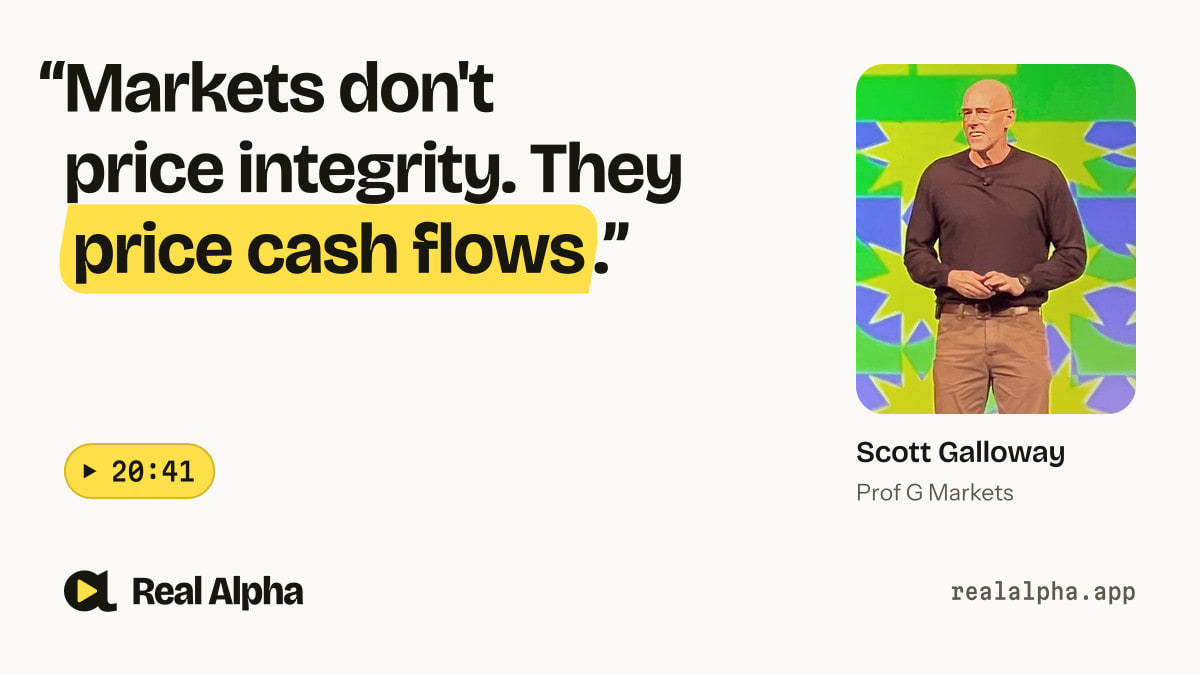
“Markets don't price integrity. They price cash flows.”
 Scott Gallowayat 20:41 · Prof G Markets
Takeaways
- China's chip ambitions could serve both AI development and domestic chipmaking.
- Scott argues intellectual-property theft has helped Chinese industries scale.
- Markets price cash flows, leaving governance to boards and regulators.
About this segment
Ed and Scott Galloway challenge the claim that China would not seek Nvidia chips, citing export-control circumvention and IP theft. Scott argues markets reward cash flows, so boards and regulators must police risks markets don't price.

Scott Galloway, Host

Ed Elson, Host
From “Unprecedented Corruption: How Jensen Huang Got His Job Back”, Nov 24, 2026. Watch the full episode
Thanks. We'll look at and fix what's off.
Transcript
Transcribed by machine (Whisper) from the episode’s audio, so a word may be off here and there.
- 15:53
We're back with Prof G Markets. Something else you brought up is this idea of papering over the national security risk element in this story, which I find to be particularly pernicious. I keep seeing these arguments that this doesn't make sense. China would never employ a spy to spy on Jensen Huang because actually China doesn't want NVIDIA's chips. China would rather build their own chips, which obviously is ignoring the idea that actually China might want NVIDIA chips to start advancing their own AI and perhaps use a lot of that IP to, yes, build their own chips as well. But also, you have to ignore the evidence that was literally just reported on last week, which told us that China's Ministry of State Security explicitly stated that its goal was to circumvent and undermine US export controls
- 16:46
on semiconductors. The evidence is right there. The campaign included acquiring and smuggling advanced chips into China. So no, this argument that no, China wouldn't want that. China wouldn't be so rude as to spy on us and try to get their hands on our most sensitive intellectual property and then use that to advance their own technology, the likes of which has been compared to enriched uranium they would never do that that i mean i i can't begin on how delusional that is um and i'm really the only the only reason you would be making that argument is if you had significant financial interests in believing it, which is the case for a lot of these people, or if you had a delusional level of confidence in Jensen Huang associated with, as you talk about often, the fact that he is a billionaire and the
- 17:42
fact that he is a visionary in Silicon Valley. You have to ignore a lot of things in order to believe those things. China wants to build its own chips. Okay. So the Chinese economy of the last 40 years has been a marvel. They brought a half a billion people out of poverty. It's been an urbanization where they brought in people from rural areas, trained them, they've invested in education, they've made massive investments in infrastructure. But the chaser and probably the key attribute of their outsized economic growth has been the following. They steal our intellectual property and they sell it back to us for pennies on the dollar and they hollow out our manufacturing base. They get the plans to a Siemens cell tower. They make it for less, and then they sell it back to German telcos for 40 cents on the dollar. And Siemens is a shadow of itself. They create
- 18:36
industry. I mean, there are Chinese spies who steal the plans for dyes from Monsanto, and then they sell the dyes that are in your napkins or in your furniture back again for 40 to 60 cents on By the way, we did this in the 19th century to British factories and artisans. This is the best way to grow an economy, and they massively engage in this. But returning to the homeland, we used to have a curved road in terms of accountability. Now we have a fork in the road, and it's entirely different.
- 19:12
And one is a one is a, you know, an HOV lane where you can go 120 miles an hour. If you're a 22 year old with a security clearance and you lose your laptop, your career is over. If you're worth one hundred and fifty billion dollars and your company moves the S&P, then laws are just a suggestion. And then the thing that really like I mean, it's like insult upon insult. We have to protect our geniuses.
- 19:38
No, that was that literally that reasoning. That was the direct quote from the White House Communications Director, Stephen Chung, who said, yes, Trump did get involved in the return of Jensen because we have to protect our geniuses. Just want to clarify that as a literal statement. No, we have to protect the institutions that make geniuses possible. Yeah. There are geniuses in Myanmar. There are geniuses in Rwanda.
- 20:04
But without our institutions and rule of law and rule of fair play that attracts capital and institutions that have certain norms, it doesn't matter how fucking smart you are. Trust and institutions are what produce geniuses that we can set against a system that creates economic value and prosperity and rights for people. And one of the key attributes of our institutions is that we apply the law equally to people.
- 20:33
And when you decide some people are too smart to be accountable, historically, that's not a sign of strength. It's a symptom of decline. And let's be clear. Okay, the markets are up. NVIDIA is up 30%. Markets don't price integrity. They price cash flows. and the reason why we have boards and regulators and courts is because the market won't do this and this week all three blinked and we're basically again i go back to young people we're we're telling young people and young managers the character is for suckers and the only thing that matters is be so rich and so essential that no one no one can touch you And we wonder why young people are so...
- 21:27
cynical, we're showing them in real time that the rules, that rules, quite frankly, are for losers and poor people, that the bottom 99% are subject to the law and not protected by it. And the top 1% are protected by the law, but not subject to it. 100%. Just final point here. And then we can