The alpha, twice a week
That was 7 min.
Get the best new moments in your inbox every Wednesday and Saturday. It's free.
Check your inbox
We sent a link to your address. Click it to finish signing up. Not there in a minute? Look in spam.
or
Lex Fridman Podcast · 7 min · Jun 5, 2025
Merging Google Brain and DeepMind took patience
 Sundar Pichai
 describes bringing two teams with different research cultures together and making consequential decisions.
The episode’s best minutes
Full analysis- 34:18AI progress may be dramatic even before AGI arrives7 min
- 55:53Merging Google Brain and DeepMind took patiencePro pick 7 min
- 1:30:35AI has raised Google’s engineering velocity by 10%7 min
- 5 more moments in the full episode
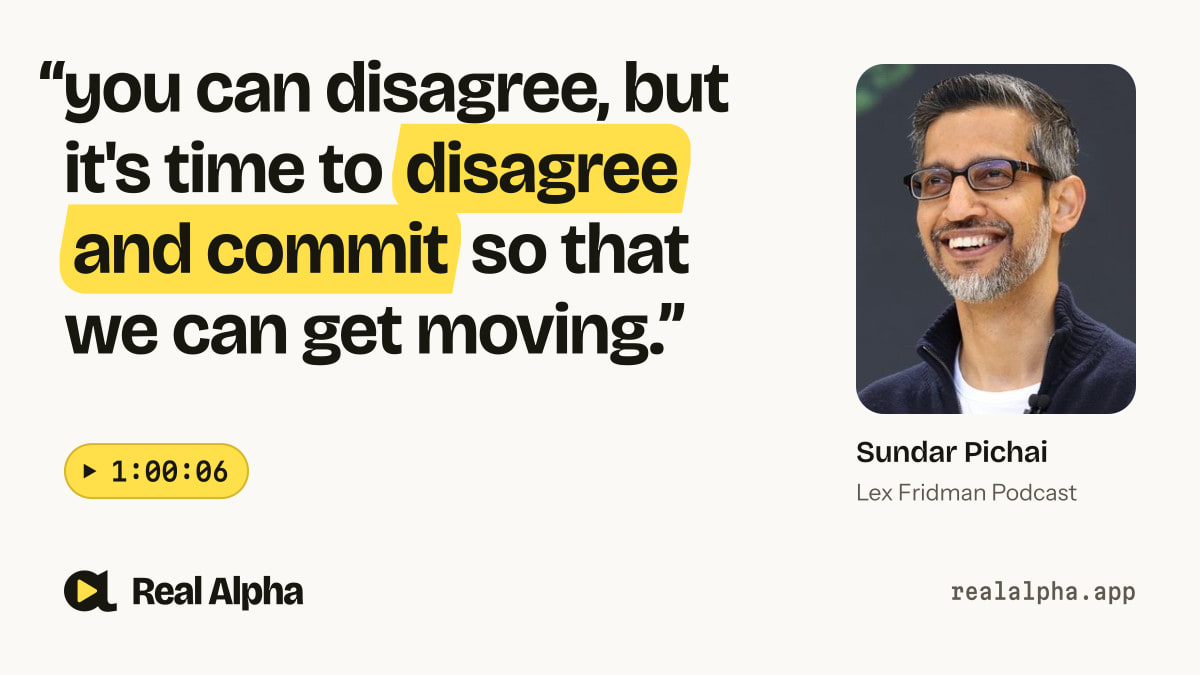
“you can disagree, but it's time to disagree and commit so that we can get moving.”
 Sundar Pichaiat 1:00:06 · Lex Fridman Podcast
Takeaways Pro pick
- Brain was more bottom-up; DeepMind had a strong AGI vision.
- The merger took time and patience to work well.
- Hear people out, then make a clear decision and commit.
One of Pro's picks, open to you here. Try Pro free for 7 days
One of Pro's picks. The rest of the summary and the 3 takeaways are in Real Alpha Pro; the video, the quote and the transcript stay free.
Read it with Pro, 7 days freeAbout this segment
Sundar Pichai describes bringing two teams with different research cultures together and making consequential decisions. He explains when leaders should hear everyone out and when to make a call.

Sundar Pichai is CEO of Google and Alphabet.
Helped build Google Toolbar and Chrome, then led Google from 2015 and Alphabet from 2019.

Lex Fridman, Host · Host, Lex Fridman Podcast
Robotics and AI researcher at MIT; started the show in 2018.
From “Sundar Pichai: CEO of Google and Alphabet | Lex Fridman Podcast #471”, Jun 5, 2025. Watch the full episode
Thanks. We'll look at and fix what's off.
Transcript
Transcribed by machine (Whisper) from the episode’s audio, so a word may be off here and there.
- 55:59
I mean, you had to make some consequential, bold decisions. Like you mentioned the merger of deep mind and brain. Uh, maybe it's my perspective, just knowing humans. I'm sure there's a lot of egos involved. It's very difficult to merge teams and I'm sure there were some hard decisions to be made. Can you take me through your process of how you think through that? Do you go to pull the trigger and make that decision? Maybe what were some painful points? How do you navigate those turbulent waters?
- 56:31
Look, we were fortunate to have two world-class teams, but you're right. It's like somebody coming and telling you, take Stanford and MIT and then put them together and create a great department, right? And easier said than done. But we were fortunate. Phenomenal teams, both had their strengths, but they were run very differently, right? Brain was a lot of diverse projects, bottoms up, and out of it came a lot of important research breakthroughs. DeepMind at the time had a strong vision of how you want to build AGI, and so they were pursuing their direction. But I think through those moments, luckily tapping into, Jeff had expressed a desire to go back to more of a scientific individual contributor roots. He felt like management was taking up too much of his time. And Demis naturally, I think, was running DeepMind and was a natural choice there. But I think you're right. It took
- 57:38
us a while to bring the teams together. Credit to Demis, Jeff, Korai, all the great people there. They worked super hard to combine the best of both worlds when you set up that team. a few sleepless nights here and there as we put that thing together. We were patient in how we did it so that it works well for the long term, right? And some of that in that moment, I think, yes, with things moving fast, I think you definitely felt the pressure.
- 58:10
But I think we pulled off that transition well. And, you know, I think, you know, they've obviously... Ha doing incredible work. And there's a lot more incredible things I had coming from them. Like we talked about, you have a very calm, even-tempered, respectful demeanor. During that time, whether it's the merger or just dealing with the noise, were there times where frustration boiled over? Like, did you have to go a bit more intense on everybody than you usually would? Probably, you know, probably. You're right. I think in the sense that, you know, there was a moment where we were all driving hard. But when you're in the trenches working with passion, you're going to have days, right? You disagree, you argue. But like all that, I mean, just part of the course of working intensely, right? And, you know,
- 59:07
at the end of the day, all of us are doing what we are doing because the impact it can have, We are motivated by it. It's like, you know, for many of us, this has been a long-term journey. And so it's been super exciting. The positive moments far outweigh the kind of stressful moments. Just early this year, I had a chance to celebrate back-to-back over two days, like, you know, Nobel Prize for Jeff Finton and the next day, a Nobel Prize for Demis and John Jumper.
- 59:40
You know, you worked with people like that. all that is super inspiring. Is there something like with you where you had to like put your foot down maybe with less versus more where like I'm the CEO and we're doing this? To my earlier point about consequential decisions you make, there are decisions you make people can disagree pretty vehemently. But at some point, like you make a clear decision and you just ask people to commit Right. Like, you know, you can disagree, but it's time to disagree and commit so that we can get moving. And whether it's putting the foot down or, you know, like, you know, it's a natural part of what all of us have to do. And, you know, I think you can do that calmly and be very firm in the direction you're making the decision.
- 1:00:31
And I think if you're clear, actually, people over time respect that, right? Like, you know, if you can make decisions with clarity, I find it very effective in meetings where you're making such decisions to hear everyone out. I think it's important when you can to hear everyone out. Sometimes what you're hearing actually influences how you think about and you're wrestling with it and making a decision.
- 1:00:56
Sometimes you have a clear conviction and you state so, look, I... I, you know, this is how I feel. And, you know, this is my conviction. And you kind of place the bet and you move on. Are there big decisions like that? I'm kind of intuitively assume the merger was the big one. I think that was a very important decision, you know, for the company to meet the moment. I think we had to make sure we were doing that and doing that well. I think that was a consequential decision.
- 1:01:26
There were many other things. We set up an AI infrastructure team to really go meet the moment, to scale up the compute we needed to, and really brought teams from disparate parts of the company, kind of created it to move forward. You know, bringing people, like getting people to kind of work together physically, both in London with DeepMind and what we call Gradient Canopy, which is where the Mountain View, Google DeepMind teams are.
- 1:01:58
But one of my favorite moments is I routinely walk multiple times per week to the Gradient Canopy building where our top researchers are working on the models. Sergey is often there amongst them, right? Just looking at getting an update. on the model, seeing loss curves. So all that, I think the cultural part of getting the teams together back with that energy, I think ended up playing a big role too.