The alpha, twice a week
That was 3 min.
Get the best new moments in your inbox every Wednesday and Saturday. It's free.
Check your inbox
We sent a link to your address. Click it to finish signing up. Not there in a minute? Look in spam.
or
Bloomberg Businessweek · 3 min · Oct 26, 2026
Merk says AI investment could help the US outgrow its debt
 Axel Merk
 contrasts today's debt-driven AI buildout with the 1990s tech boom.
In this episode
Full analysis- 33:39AI model winners can change with a line of code4 min
- 26:45Merk says AI investment could help the US outgrow its debt3 min
- 23:00Merk argues Fed asset buying can politicize credit3 min
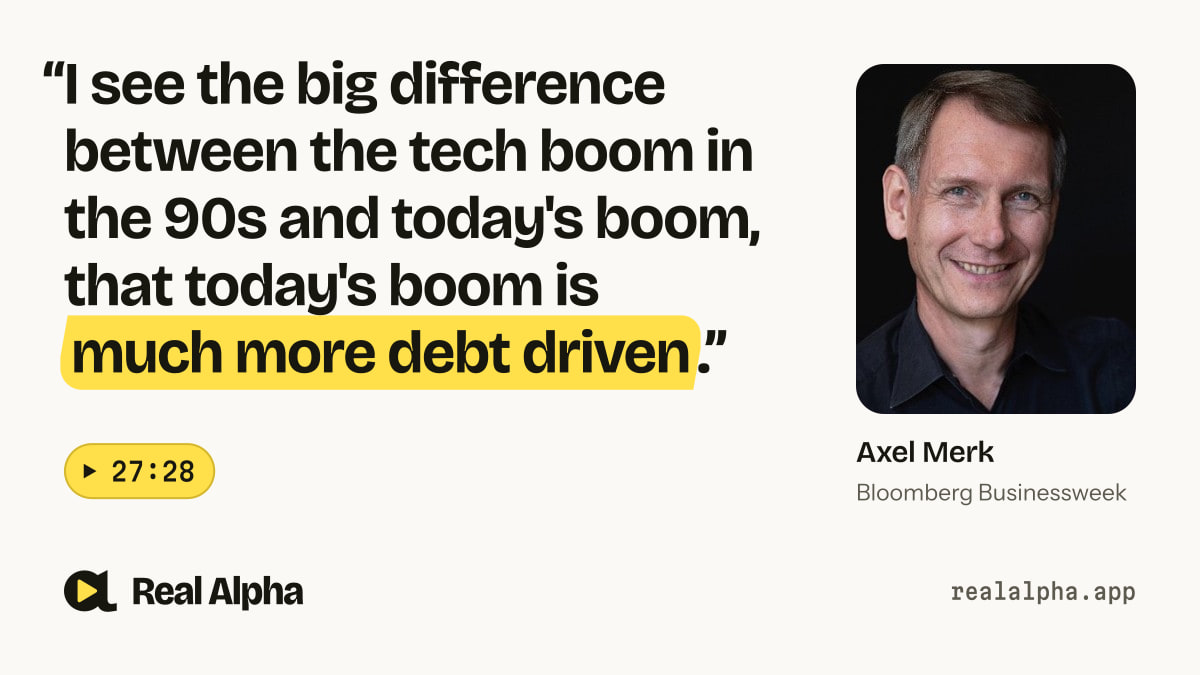
“I see the big difference between the tech boom in the 90s and today's boom, that today's boom is much more debt driven.”
 Axel Merkat 27:28 · Bloomberg Businessweek
Takeaways
- He sees today's AI boom as more debt-driven than the 1990s.
- AI productivity could help growth outpace debt.
- He expects the Fed to respond if debt markets turn down.
About this segment
Axel Merk contrasts today's debt-driven AI buildout with the 1990s tech boom. He thinks productivity gains could help the US grow out of its debt, though a downturn would bring a Fed response.

President & Chief Investment Officer, Merk Investments
Founded Merk Investments and grew the investment advisory firm, applying a macro-trends lens to global markets.
From “Bloomberg Businessweek Daily: Anthropic Files for IPO (Podcast)”, Oct 26, 2026. Watch the full episode
Answers “Will AI boost economic growth?” See all 34 answers
Thanks. We'll look at and fix what's off.
Transcript
From the transcript Bloomberg Businessweek publishes with the episode.
- 26:57
Speaking of things that matter a great deal, we talk every day, I'm sure you know this, Axel, about the amount of money that is being spent to build out on the artificial intelligence world that. We're in right now. And every day. It's increasingly into the credit side of things. But there's also equity. And I just wonder, do you also see, and I'm curious if that came up at all in your conversation, in terms of how the Fed keeping a watch on something that could be potentially a strain or stress for the financial system? Because it just feels so intertwined.
- 27:31
And we talk about circular financing. I'm just curious how you see that or he sees that factoring in.
- 27:37
So I'll tell you how I see it, because we didn't talk about that specifically. But I see the big difference between the tech boom in the 90s and today's boom, that today's boom is much more debt driven. I believe Walsh is on record for having said that he much rather deal with a boom that comes in the current environment than many other situations. I think it's pretty clear that if or when There is a downturn because the implications for the debt markets, the Federal Reserve will react to that, and appropriately so, right? But in the meantime, I think one reason I believe Walsh got the job, and again, that's from me, is that he overall believes in the productivity boom that is there as a potential because of the AI growth. He, at the same time, is a hawk at heart. And so he has to kind of bridge those two views. But we have a
- 28:32
great deal of debt in this economy. And so outgrowing the debt is one of the few chances we can do this in a way that is not too disruptive. And to the extent that the inflationary environment allows this.
- 28:45
What you're saying, AI is a way for us to outgrow this debt? The fiscal debt? Well, potentially, because I mean, the massive investments that are taking place does boost growth. Now, obviously, at some point, there will be a pushback and the like. But if you keep in mind, right, when the railways were built, the infrastructure persisted. Now, maybe these assets are depreciating faster, but there are also tremendous advances being made. And And if you look at the rest of the world, the U.S.
- 29:09
growth is far superior than the rest of the world. So I think it's that mindset that helped get him the job. But at the same time, yes, he is a hawk at heart. He says inflation is too high. And one thing maybe before I go I should mention, I think the statement that he has to remove a dose of accommodation is telling about where we are. No need to use the sledgehammer, but we need to have tighter financial conditions to get inflation down.