The alpha, twice a week
That was 3 min.
Get the best new moments in your inbox every Wednesday and Saturday. It's free.
Check your inbox
We sent a link to your address. Click it to finish signing up. Not there in a minute? Look in spam.
or
Bloomberg Businessweek · 3 min · Oct 26, 2026
Merk says Fed purchases should not direct credit by sector
 Axel Merk
 says monetary policy should manage money and rates, not channel credit into sectors like housing.
In this episode
Full analysis- 1:46Anthropic must turn fast growth into returns on compute6 min
- 9:15Anthropic's compute contracts make growth essential4 min
- 36:36AI buyers can swap models as strengths change3 min
- 15:55AI lab valuations may take two years to prove out3 min
- 23:24Merk says Fed purchases should not direct credit by sector3 min
- 27:44AI investment could help the US outgrow its debt3 min
- 31:26Anthropic needs patient investors for its heavy spending3 min
- 34:16Anthropic lacks the side businesses that can subsidize AI2 min
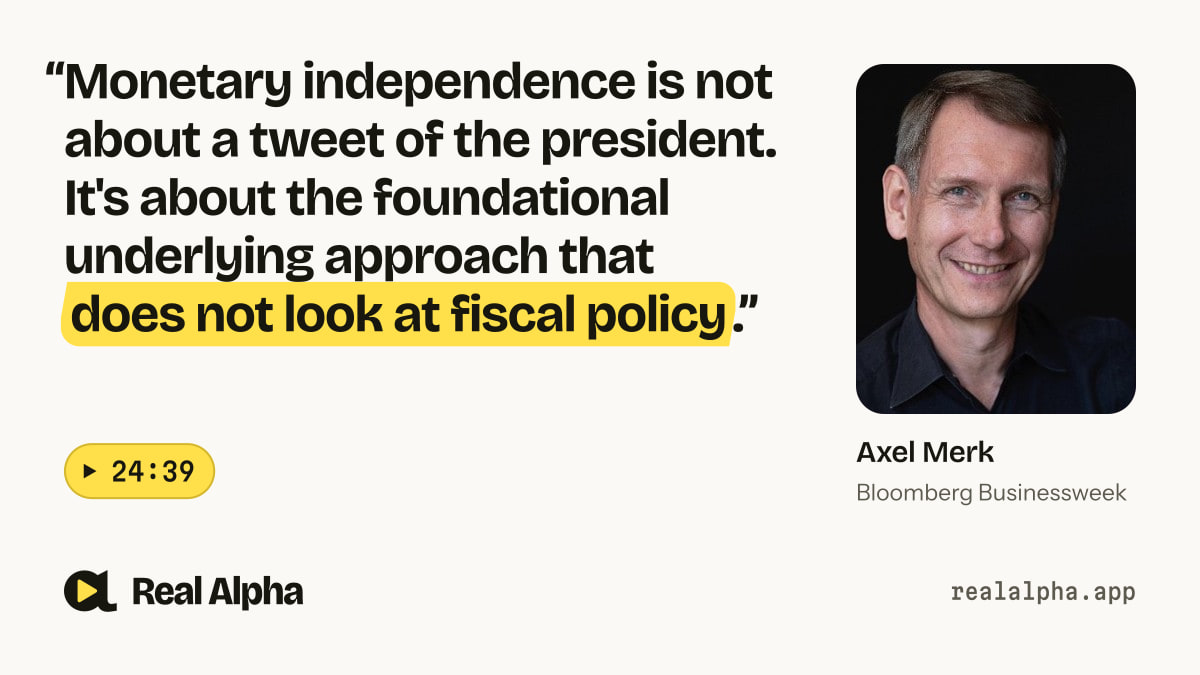
“Monetary independence is not about a tweet of the president. It's about the foundational underlying approach that does not look at fiscal policy.”
 Axel Merkat 24:39 · Bloomberg Businessweek
Takeaways
- Buying mortgage-backed securities directs credit to housing.
- Sector-specific support invites political interference, he argues.
- A standing Fed put can weaken accountability for market losses.
About this segment
Axel Merk says monetary policy should manage money and rates, not channel credit into sectors like housing. He argues mortgage-backed security purchases invite political pressure and a standing Fed put weakens accountability.

President & Chief Investment Officer, Merk Investments
Founded Merk Investments and grew the investment advisory firm, applying a macro-trends lens to global markets.
- CM
Carol Massar, Host

Tim Stenovec, Host · Co-host, Bloomberg
Interviewed leaders including Reed Hastings, Stephen Schwarzman and Mary Barra as a Bloomberg Businessweek co-host.
From “Anthropic Files for IPO in Global Race to Raise Cash for AI | Bloomberg Businessweek”, Oct 26, 2026. Watch the full episode
Thanks. We'll look at and fix what's off.
Transcript
From the transcript Bloomberg Businessweek publishes with the episode.
- 23:27
So is he, you know, based on your conversation, based on what you think maybe people are misreading, is he the right, we always talk about, Axel, the right Fed chair at the right time. Is he the right Fed chair? Absolutely, absolutely.
- 23:44
Absolutely, because the Fed had, starting in the financial crisis, the Fed had gone on a slippery slope from ever more micromanaging the economy. And by the way, Walsh has been super consistent. Some people said he changed his tune as he was trying to, quote unquote, lobby for the job. But the reason, to take a step back, A lot of people don't realize that monetary policy is simply about allocating credit. It's about the amount of money in the economy, about interest rates. It is not about allocating that credit.
- 24:20
That is fiscal policy. And I am a purist in that I say that buying mortgage-backed securities already, and that's my personal view, is already wrong. Because buying mortgage-backed securities... allocates money to the mortgage sector. And what that does is it attracts political interference. Monetary independence is not about a tweet of the president. It's about the foundational underlying approach that does not look at fiscal policy. And Ben Bernanke, he may be the worst offender in that. He published a book towards the end of the pandemic that was praising how the Fed is ever more micromanaging the economy.
- 25:04
And that just gets you more and more into politics. And the politicians then rightfully tried to step on the Fed's turf.
- 25:10
Is that the same case for financial markets then, too, that they shouldn't be looking– necessarily at financial markets? Or should they? I mean, they obviously have to look at credit and rates and stress, but I mean.
- 25:22
The Fed has this roundabout way. They look at financial conditions, right? And it happens to be that risk assets happen to be correlated with financial conditions. And rightfully or wrongly, mostly wrongly, then people think about how the Fed reacts when the markets tank. No, I mean, the Federal Reserve, of course, is looking at the bond market as they should. And you need to look at the financial conditions more broadly.
- 25:47
But that doesn't mean, of course, you need to have a Fed put that always jumps in when something happens. And that was the risk since the financial crisis. that nothing bad is ever supposed to happen. Well, you need to have the markets to function. And it goes way beyond monetary policy because a lot of the young folks these days believe the system is rigged and they vote towards the socialists. And I can't blame them because the system has been rigged when everybody gets bailed out and so forth. And one of the great things in recent months is that We've been talking less about the Fed, right?
- 26:22
We've talked more about Iran. We've talked about fiscal policy. When the bond market has had a hiccup, we talk about Besant. And that's a good thing because there's political accountability. And that's where the short focus should be.