The alpha, twice a week
That was 2 min.
Get the best new moments in your inbox every Wednesday and Saturday. It's free.
Check your inbox
We sent a link to your address. Click it to finish signing up. Not there in a minute? Look in spam.
or
Bloomberg Businessweek · 2 min · Oct 28, 2026
Merrill uses DPI to return capital and avoids timing real estate cycles
Christopher Merrill says essential-service assets can hold up across administrations and rate environments.
In this episode
Full analysis- 1:27Conflicting signals make the Fed’s inflation trade-off harderPro pick 4 min
- 10:00Aging demographics are outpacing senior housing supplyPro pick 3 min
- 21:44Prologis limits data center risk with pre-leased projects3 min
- 25:59Quant firms are funding research and building AI labs to recruit PhDs4 min
- 18:26Data center infrastructure costs ultimately flow into rents3 min
- 7:49Merrill expects up to one in five universities to close2 min
- 14:44Merrill uses DPI to return capital and avoids timing real estate cycles2 min
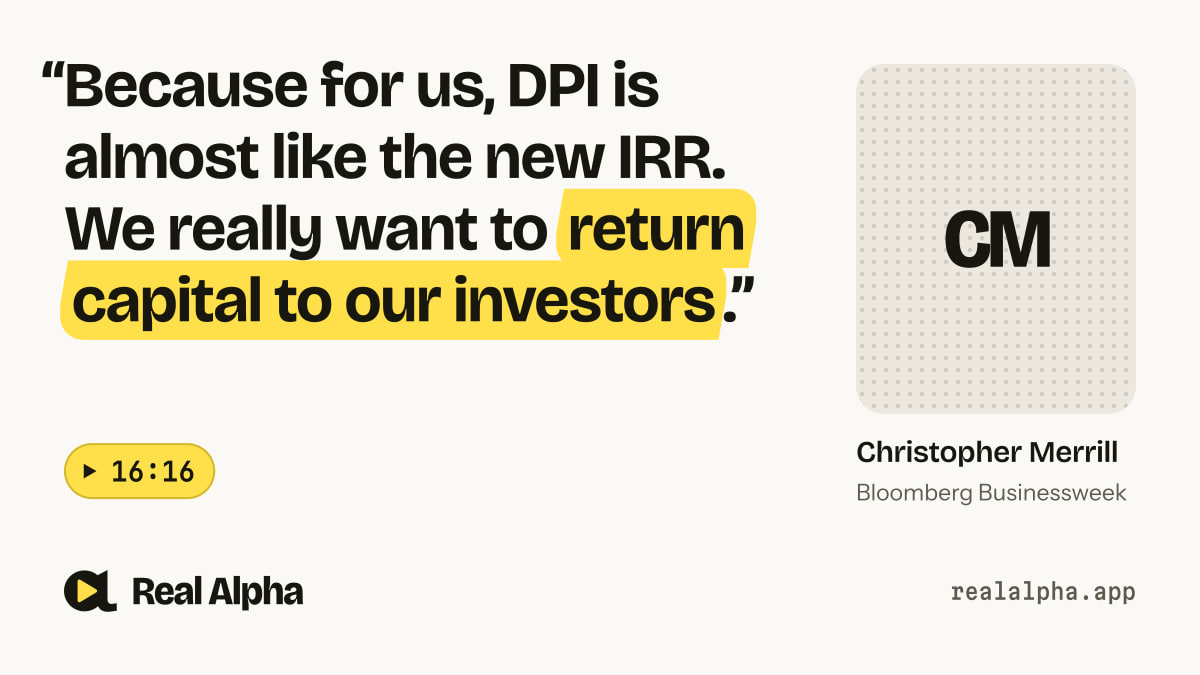
“Because for us, DPI is almost like the new IRR. We really want to return capital to our investors.”
Takeaways
- Need-based assets are meant to hold up through political shifts.
- Higher rates can increase demand for existing portfolios.
- Merrill expects $6–7 billion in sales and focuses on DPI.
About this segment
Christopher Merrill says essential-service assets can hold up across administrations and rate environments. He expects $6–7 billion in sales this year and prioritizes returning capital to investors.
Managing partner, co-founder & global CEO, Harrison Street Asset Management
Co-founded Harrison Street, a global real-assets investor managing over $110 billion across real estate and infrastructure.
- CM
Carol Massar, Host

Tim Stenovec, Host · Co-host, Bloomberg
Interviewed leaders including Reed Hastings, Stephen Schwarzman and Mary Barra as a Bloomberg Businessweek co-host.
From “Fed Meets Amidst "Most Confusing Economy Yet" | Bloomberg Businessweek”, Oct 28, 2026. Watch the full episode
Thanks. We'll look at and fix what's off.
Transcript
From the transcript Bloomberg Businessweek publishes with the episode.
- 14:46
Do the midterms and the outcome of the midterms affect your strategy at all? It's interesting. We've tried to develop this strategy such that when you think about investing in need-based assets, it really is resilient in good and bad times. So it certainly will have some impact on what might happen with interest rates, what might happen with rent growth, with new supply. But it's not going to impact people's need to be educated.
- 15:12
It's not going to impact people's, the aging population. And so it would allow us in certain situations, like I remember with Obamacare, pushing more people to doctor visits. It pushed our medical office strategy. And so certain things might evolve differently because of it. But for us, if you're focused on essential services, you know, it really, you know, you hate to say it, but we can perform in a higher rate environment. We can perform whatever administration there is, because these are assets that it's social infrastructure.
- 15:43
So there isn't a point if yields go up eight, 9% that would make it a little bit trickier. For you guys?
- 15:49
It's not that it's not trickier. It might be trickier to develop, but for our existing portfolio, you'll then start seeing higher growth rates and you'll see more, more demand for our existing portfolio because what's happening is as capital comes into the market, there's not capital chasing office and chasing retail. So folks are coming to us saying, boy, we'd love to buy portfolios from you because we'd love to get in these segments. So it's holding values as we've been very active sellers. One of the things I'm most proud of is our DPI.
- 16:15
To buy and selling. Yeah, we probably will sell $ 6 or $ 7 billion this year. Okay. Because for us, DPI is almost like the new IRR. We really want to return capital to our investors.
- 16:27
I mean, no, it's like you play almost, it's almost like you play everywhere. What's one area you don't want to be in?
- 16:36
You know, what we don't want to do is we don't want to be in asset classes where we're trying to time markets, where we're trying to time cycles, economic cycles. So for us, we just want to be, if it doesn't have this sort of essential services component, this need-based feel to it, we don't want to plan it.