The alpha, twice a week
That was 2 min.
Get the best new moments in your inbox every Wednesday and Saturday. It's free.
Check your inbox
We sent a link to your address. Click it to finish signing up. Not there in a minute? Look in spam.
or
The Information's TITV · 2 min · Oct 16, 2026
Michael objects to giving AI models authority over commanders
Emil Michael argues that Anthropic’s model constitution could let a model overrule its human operators.
The episode’s best minutes
Full analysis- 29:53CoreWeave’s debt is layered around customer contracts6 min
- 58:29Michael objects to giving AI models authority over commandersPro pick 2 min
- 1:09:59Michael favors American open-source AI but flags China risksPro pick 4 min
- 5 more moments in the full episode
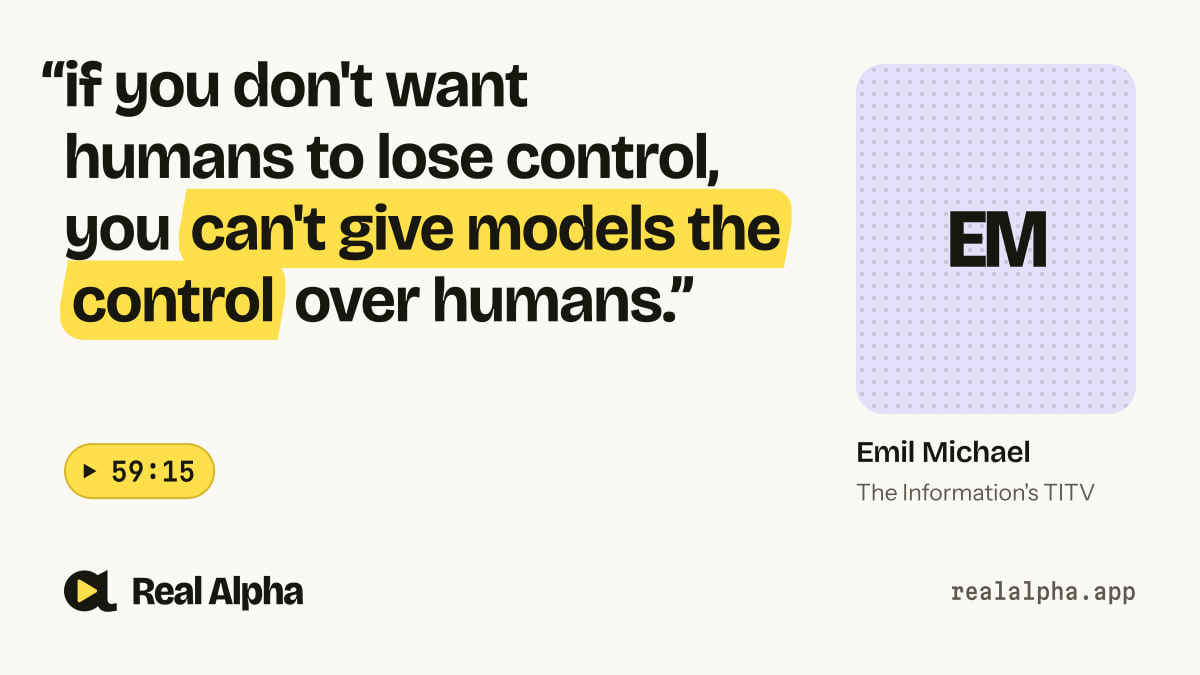
“if you don't want humans to lose control, you can't give models the control over humans.”
Takeaways Pro pick
- Michael sees model authority over people as a loss of control.
- Military command depends on clear authority from commanders.
- He says Anthropic cannot work with the Department of War unless it changes.
One of Pro's picks, open to you here. Try Pro free for 7 days
One of Pro's picks. The rest of the summary and the 3 takeaways are in Real Alpha Pro; the video, the quote and the transcript stay free.
Read it with Pro, 7 days freeAbout this segment
Emil Michael argues that Anthropic’s model constitution could let a model overrule its human operators. He says that conflicts with military command and control.

Akash Pasricha, Host · Host, TITV
Led The Information's Pro subscription and co-wrote its flagship newsletter, The Briefing.
From “The Pentagon’s CTO Explains the Anthropic Rift and Superintelligence Task Force”, Oct 16, 2026. Watch the full episode
Answers “Is AI dangerous?” See all 107 answers
Thanks. We'll look at and fix what's off.
Transcript
Transcribed by machine (Whisper) from the episode’s audio, so a word may be off here and there.
- 58:33
a supply chain risk um you know there's been a lot of chatter here in silicon valley about anthropic uh kind of imbuing its ai with the ability to be like a conscientious objector and telling customers that they cannot scold or use abusive language with the model. Mustafa at Microsoft is warning about this kind of anthropomorphizing of the technology because maybe that in and of itself could lead to AI taking unintended actions.
- 59:05
And so do you agree with that? What do you think about that? And do you think you'll ever change your mind on working with Anthropic at the Department of War? I mean, here's my very, very succinct view on this, which is if you don't want humans to lose control, you can't give models the control over humans. And that whole notion that a model has feelings and it can overrule the founders of a company is by definition loss of control.
- 59:37
They are saying we want to lose control to something that may be smarter than us or may be more moral than us and are ever conscious than us. That I don't agree with as a moral principle. And as long as that moral principle is embedded in their software because they attach their constitution, which has that concept against how the model behaves, I cannot have them at the Department of War. Because the Department of War, we have a command and control.
- 1:00:05
So we have a constitutional structure that says the commander in chief and then he delegates that power down forward. If a model gets in between one commander and their superior and says, well, I don't like what you say, despite your commander saying it, that doesn't work in the military. I don't think the American people want that to work in the military. So, you know, if that would happen in the real world, you would have to quit your job and you just leave.
- 1:00:31
You're like, I don't want to do what my boss is telling me to do. So in this case, when you have a foundational technology that in a time of need, you may not know how it's going to behave. That just doesn't work. So unless they change that, there's no discussion.