The alpha, twice a week
That was 2 min.
Get the best new moments in your inbox every Wednesday and Saturday. It's free.
Check your inbox
We sent a link to your address. Click it to finish signing up. Not there in a minute? Look in spam.
or
Bloomberg Businessweek · 2 min · Oct 29, 2026
Midterms have historically been followed by stronger market returns
Mike Townsend says the S&P has been nearly flat in the three months before midterms, then risen after elections since 1974.
In this episode
Full analysis- 20:00AI’s bubble risk may be in expectations, not valuations5 min
- 1:48Intel’s data center growth is weighing on its margins5 min
- 8:15Data center delays could put AI growth forecasts at riskPro pick 2 min
- 16:31SanDisk investors care more about contract terms than the next guide3 min
- 25:04Rapid market rotations favor regular portfolio rebalancing2 min
- 28:12Midterms have historically been followed by stronger market returns2 min
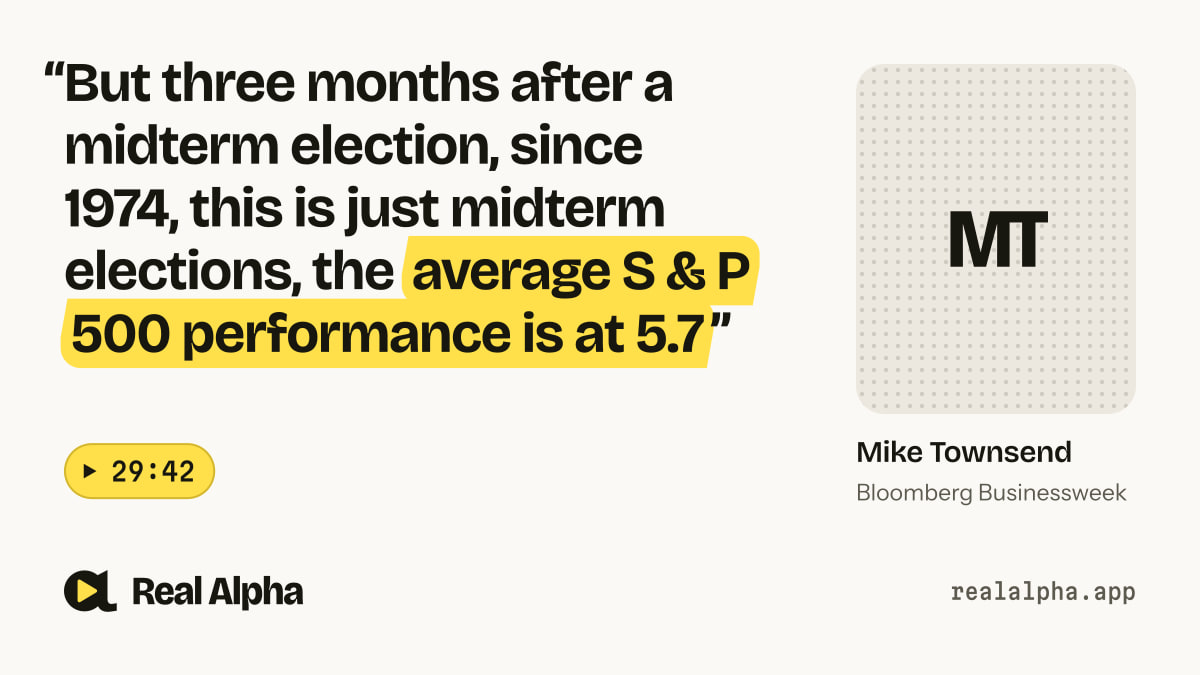
“But three months after a midterm election, since 1974, this is just midterm elections, the average S & P 500 performance is at 5.7”
Takeaways
- The S&P averaged 1.7% in the three months before midterms.
- Three months after, the historical average was 5.7%.
- Six months after, it averaged 12.4%; it was never down since 1974.
About this segment
Mike Townsend says the S&P has been nearly flat in the three months before midterms, then risen after elections since 1974. The figures show how election uncertainty has historically eased once results were known.
Managing Director of Legislative & Regulatory Affairs, Schwab
- CM
Carol Massar, Host

Tim Stenovec, Host · Co-host, Bloomberg
Interviewed leaders including Reed Hastings, Stephen Schwarzman and Mary Barra as a Bloomberg Businessweek co-host.
From “Amazon, Intel, Sandisk Report Earnings on Heels of Disappointing Alphabet Report | Bloomberg...”, Oct 29, 2026. Watch the full episode
Thanks. We'll look at and fix what's off.
Transcript
From the transcript Bloomberg Businessweek publishes with the episode.
- 28:14
I'm going to put you on the spot. Start with your prediction. What happens Tuesday? Sure.
- 28:20
I think we've moved from can the Democrats win the House to by how much will the Democrats win the House? So I think we're reasonably talking about a A double digit margin, 12, 15, something like that. So I think that's the most likely outcome in the House. I'm 85, 90 percent there. I think the Senate is where all the intrigue is. And I've been telling people we have nine Senate races within the margin of error. And those could, you know, go a little bit one way, a little bit the other way. You could be looking at a radically different.
- 28:52
Or they could all go one way or all go the other way. Yeah. I mean, that happened in 2024 with the presidential election, right? Yeah.
- 28:59
The momentum seems to be with the Democrats, right? But, you know, some of these races, Iowa's Senate race, you know, the average poll is like 0.4%. It's meaningless. So it's tied. And we'll see which way they go.
- 29:12
What does it mean in terms of if indeed it's a blue wave. And maybe, so we're talking maybe even the Senate. What does that mean in terms of the business environment, the market environment?
- 29:24
Yeah, look, I've been telling people on the market environment for months that, you know, the history of midterm elections, if you look at the three months leading up to a midterm election, S & P 500 is up an average of 1.7%. It's basically flat, which is not surprising, right? Elections are a big source of uncertainty. But three months after a midterm election, since 1974, this is just midterm elections, the average S & P 500 performance is at 5.7%.
- 29:56
And six months after an election, it's 12.4%. And it has never been down since 1974. Right. What changes? So my point is that. the markets don't care who wins. The market just wants the election to be over. Because once the election is over, the market can make some assumptions about what the landscape will be over the next couple of years. But will it be over right away, Mike?