The alpha, twice a week
That was 3 min.
Get the best new moments in your inbox every Wednesday and Saturday. It's free.
Check your inbox
We sent a link to your address. Click it to finish signing up. Not there in a minute? Look in spam.
or
All-In · 3 min · Mar 23, 2026
Mistral trains enterprise models without moving customer data
 Arthur Mensch
 describes deploying training tools on a customer’s own infrastructure and pairing Mistral scientists with domain experts.
The episode’s best minutes
Full episode- 18:33How CoreWeave finances GPUs through ring-fenced contracts4 min
- 1:11:23Mistral trains enterprise models without moving customer dataPro pick 3 min
- 1:26:04West Texas renewables can power data centers at the source3 min
- 5 more moments in the full episode
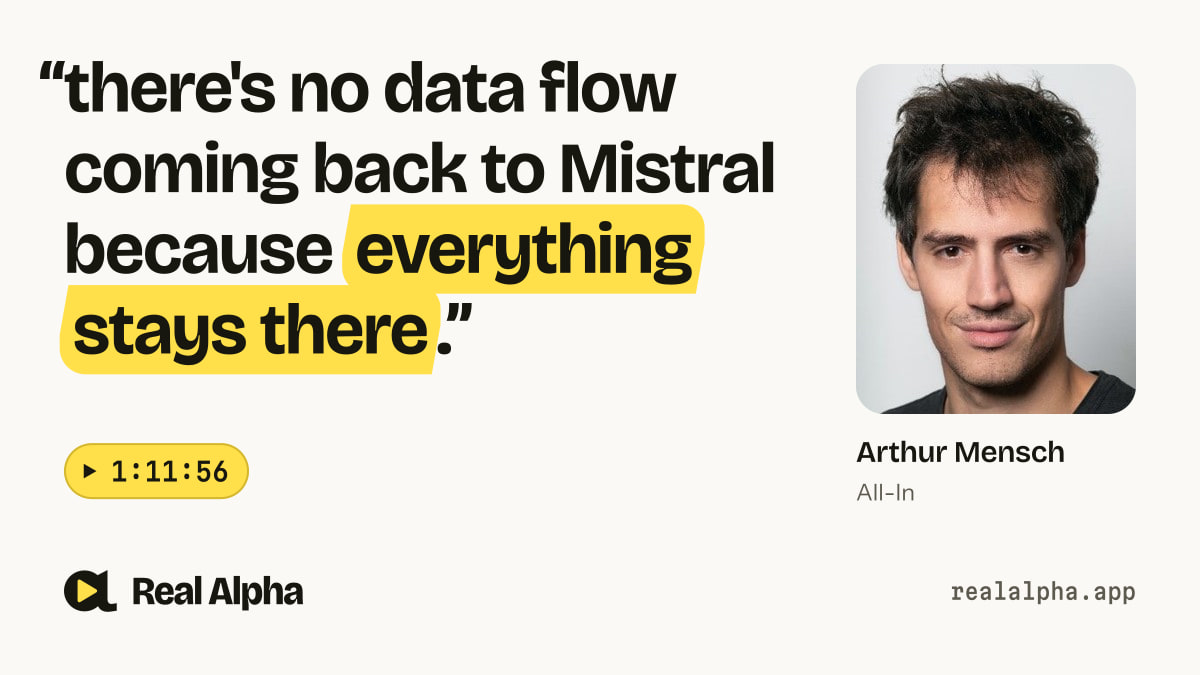
“there's no data flow coming back to Mistral because everything stays there.”
 Arthur Menschat 1:11:56 · All-In
Takeaways Pro pick
- Training tools can run on a customer's infrastructure.
- Experts help define the task and relevant training data.
- Synthetic data helps, but doesn't replace human signal.
One of Pro's picks, open to you here. Try Pro free for 7 days
One of Pro's picks. The rest of the summary and the 3 takeaways are in Real Alpha Pro; the video, the quote and the transcript stay free.
Read it with Pro, 7 days freeAbout this segment
Arthur Mensch describes deploying training tools on a customer’s own infrastructure and pairing Mistral scientists with domain experts. Synthetic data can help at first, but human feedback is still needed.

CEO, Mistral
Co-founded and leads Paris-based Mistral AI as CEO; named to Time's 100 Most Influential People in AI.

Chamath Palihapitiya, Host · Founder & CEO, Social Capital
Led Facebook's growth team; his firm backed Slack and AI chipmaker Groq.

Jason Calacanis, Host · Founder & CEO, LAUNCH
Early Uber angel; sold Weblogs Inc. to AOL; hosts This Week in Startups.

David Sacks, Host · Co-founder & partner, Craft Ventures
PayPal's first COO, founded Yammer; White House AI & crypto czar 2025–26.

David Friedberg, Host · CEO, Ohalo
Founded The Climate Corporation, sold to Monsanto for about $1.1B in 2013.
From “Four CEOs on the Future of AI: CoreWeave, Perplexity, Mistral, and IREN”, Mar 23, 2026. Watch the full episode
Thanks. We'll look at and fix what's off.
Transcript
Transcribed by machine (Whisper) from the episode’s audio, so a word may be off here and there.
- 1:11:33
Because if you're working with one customer in aerospace or fintech, they might have a need set, but they may not want that training to go to a competitor. I can use a few examples. I think overall, the data segregation is super important. And the way we have solved that is through a portable platform. So our technology is a set of services, a set of training tools, a set of data processing tools that I can take and that I can put on the infrastructure of my customers.
- 1:12:00
So suddenly from an IT perspective, and when we talk to the CIOs, they realize that from security perspective, the flow of data doesn't go, there's no data flow coming back to Mistral because everything stays there. Now, the way we then use that technology that has been deployed is that we're going to be working with the team that is doing image scanning and default detection with ISML, for instance. And we're going to be sending forward deployment engineers, scientists, they're all PhDs, they know how to train models, and they spend some time with the subject matter experts that can explain how an image is being detected, how do you detect defaults, etc.
- 1:12:35
And based on that, we're going to work out what kind of data needs to be used to train the models that it's going to solve the task in itself. And so we send the technology, typically we send a little bit of scientists because you do need that expertise transfer and that knowledge transfer in between our teams and the vertical experts. And then we make sure that eventually our team no longer needs to be there to retrain the models to get more data access, et cetera. So that combination of data segregation, expertise transfer, knowledge transfer is the one thing that makes us quite unique and allows us to sell the most critical use cases, the most critical processes in industries that actually need to take their data and put it into models for it to work. Yeah, this seems to be once the entire open web, what was available,
- 1:13:22
legally, gray market, et cetera. I wouldn't have you comment on that controversy, but we kind of exhausted what's in the open crawl yeah we have and and it's time to actually either make synthetic data or actually use experts do you believe in synthetic data and where does that work and where does it fail we use synthetic data as a way to warm up the models it's a way to actually be quite efficient at the beginning if you have a large model and you want to train a small model you would you will use your large model to process and to produce a lot of synthetic data at the beginning, but eventually you do need to have human signal. So the human signal is something that is always a bit costly to acquire because you need to talk to the experts, they need to give feedback to the machines. And so at the beginning, synthetic data allows you
- 1:14:09
to do the compression, to further compress the models. At the end, you do need to go and get data that is produced by humans. So yeah, it's mostly an efficient way of training models to have bigger models that are used as teachers for smaller models, but it's not enough. And so you also need human signal. Arthur, we've seen an incredible explosion. We're sitting here on AO