The alpha, twice a week
That was 3 min.
Get the best new moments in your inbox every Wednesday and Saturday. It's free.
Check your inbox
We sent a link to your address. Click it to finish signing up. Not there in a minute? Look in spam.
or
20VC · 3 min · Nov 2, 2026
Model ownership matters for some workflows, not all
 Erik Bernhardsson
Fine-tuned open models offer a stable base that customers can keep adjusting.
In this episode
Full episode- 13:34Inference providers need a broader platform to avoid commoditizationPro pick 5 min
- 17:46Aggregating GPU demand helps Modal manage capacity4 min
- 33:39Infrastructure products can take years to find their killer use4 min
- 41:18Post-training favors tasks with short feedback loops3 min
- 52:00Employee liquidity can strengthen AI recruiting3 min
- 46:57Model ownership matters for some workflows, not all3 min
- 7:52Founders should not maximize every round's valuation3 min
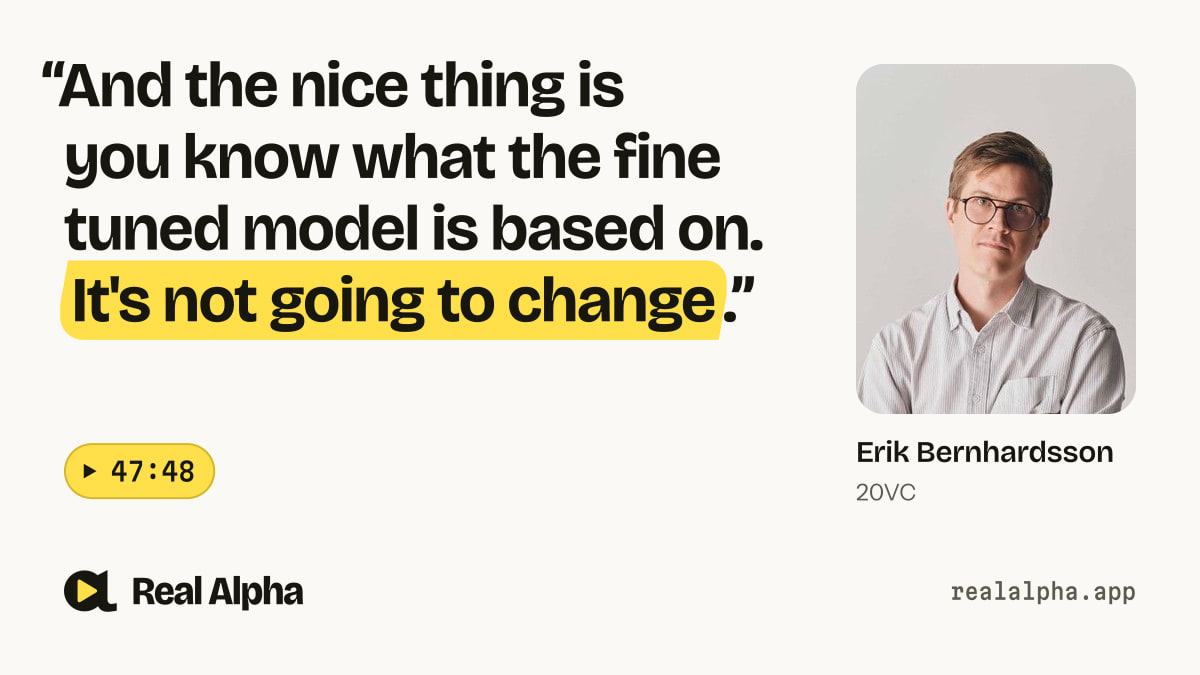
“And the nice thing is you know what the fine tuned model is based on. It's not going to change.”
 Erik Bernhardssonat 47:48 · 20VC
Takeaways
- A fine-tuned model can stay consistent as a company keeps adjusting it.
- Some frontier models may change or become unavailable.
- Latency, cost and performance matter alongside model ownership.
About this segment
Fine-tuned open models offer a stable base that customers can keep adjusting. Erik Bernhardsson says ownership is one factor among latency, cost and performance, not a universal need.

Erik Bernhardsson is co-founder and CEO of Modal.
Co-founded Modal, the high-performance cloud for AI teams; previously led Spotify's music recommendation and data infrastructure teams.

Harry Stebbings, Host · Founder, 20VC
Built a venture firm on his podcast; its third fund closed at $400M.
From “Modal CEO: Has Open-Source LLM Inference Peaked? | What Happens to the Cost of Compute”, Nov 2, 2026. Watch the full episode
Thanks. We'll look at and fix what's off.
Transcript
Transcribed by machine (Whisper) from the episode’s audio, so a word may be off here and there.
- 47:09
in the very long run. But today, you can have extremely good cash flow selling these data sets. Can I ask, when we think about that kind of implementation, working with partners so closely. You've said, and Lynn has said too from Fireworks, about the importance of owning your own intelligence. Can you unpack how this looks? Because specialized models for companies in this way, the kind of jury's still out.
- 47:30
We have Harvey who says that it's fantastic and it's been amazing. And then you have Legora who say, ridiculous, the underlying models move so fast, it's the wrong strategy. Yeah, for some stuff, it's good to own your own intelligence. For other stuff, I don't think it matters. We have a lot of customers that run proprietary models on Model 2, and their customers, they use a proprietary model. I don't think it makes sense for everyone to own their own intelligence.
- 47:54
Why does it make sense for you two versus not? I think for certain use cases, you can take an open source model and you can fine-tune. and you can get really good performance. And the nice thing is you know what the fine tuned model is based on. It's not going to change. They're not going to take away the model from you. It's nice to have that consistency and the ability to continue to tweak it without the underlying model changing, which has happened in some cases with the Frontier Labs. That's nice. I support that, but I think there's many other things that matter to people. Owning your intelligence is just one thing out of many. I think latency matters. I think cost matters, performance. I think hackability.
- 48:29
I think, you know, having a platform of a lot of adjacent services. Like, these things matter too. So owning your own intelligence, like, yeah, I'm supportive. But, you know, there's many other things. Isn't that kind of going against your business? No, I don't think so. I mean, I love the honesty. But, like, dude, it would be in your favor to say, yes, every company is going to need it. And we're the partner to help you.
- 48:50
I kind of fucking teed you up there. Well, I mean, not really. I mean, if you think about TypeSafe with Jeff, right, like, you know, it's a highly proprietary model. I want people to use Jav. I mean, it runs on Modal. So we have many customers that themselves are proprietary model that are hosting on Modal that are serving their customers. And I'm very, very in favor of that too. I think the beauty of Modal is always that it's like a general purpose platform and we support so many different things.
- 49:15
That to me is like the beauty. It's like, if you want to use open source models, that's great. We'll help you. And there's many customers that build incredible AI applications on top of open source models, fine tuning them, reinforcement learning, have a bunch of adjacent sandbox use cases or training or whatever. But there's a lot of companies that have built highly successful businesses, you know, Suno, Runway, TypeSafe, and many others like running their own proprietary model on modal and their customers don't care.
- 49:41
And that I think is like, you know, puts us in a really good spot. I want to ask two more questions before I do a quick fire. Okay.