The alpha, twice a week
That was 6 min.
Get the best new moments in your inbox every Wednesday and Saturday. It's free.
Check your inbox
We sent a link to your address. Click it to finish signing up. Not there in a minute? Look in spam.
or
Founders · 6 min · Nov 8, 2026
More products make enterprise customer acquisition pay off
 Nikesh Arora
 explains why he expanded beyond Palo Alto Networks’ firewall product and why buying can beat building.
The episode’s best minutes
Full analysis- 8:54More products make enterprise customer acquisition pay offPro pick 6 min
- 18:52Align on the product roadmap before signing an acquisition4 min
- 55:07AI raises cyber risk but does not replace security infrastructure4 min
- 5 more moments in the full episode
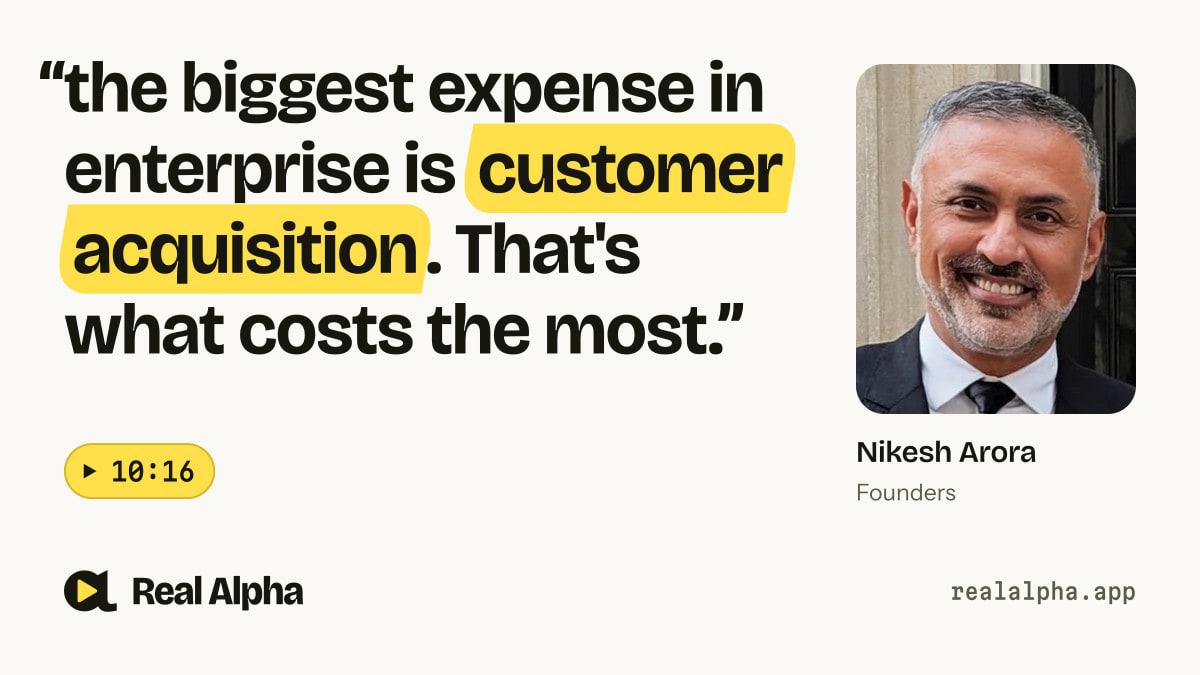
“the biggest expense in enterprise is customer acquisition. That's what costs the most.”
 Nikesh Aroraat 10:16 · Founders
Takeaways Pro pick
- Enterprise customer acquisition is a major cost.
- More products give sales teams more to offer each customer.
- Building a mature product can take four to seven years.
One of Pro's picks, open to you here. Try Pro free for 7 days
One of Pro's picks. The rest of the summary and the 3 takeaways are in Real Alpha Pro; the video, the quote and the transcript stay free.
Read it with Pro, 7 days freeAbout this segment
Nikesh Arora explains why he expanded beyond Palo Alto Networks’ firewall product and why buying can beat building. Selling more to each customer helps spread the cost of winning them.

Nikesh Arora is chairman and CEO of Palo Alto Networks.
Chairman and CEO of Palo Alto Networks, which he grew into a $300 billion cybersecurity leader.

David Senra, Host · Host, Founders
Has read an entrepreneur's biography every week for Founders since 2016.
From “How to Win Deals & Grow a $250B Business | Nikesh Arora, Palo Alto Networks”, Nov 8, 2026. Watch the full episode
Thanks. We'll look at and fix what's off.
Transcript
Transcribed by machine (Whisper) from the episode’s audio, so a word may be off here and there.
- 9:01
You had a hilarious line where it's like, I thought cybersecurity was two words or something. Yeah, you know, honestly, in my interview, I ended up talking a lot more about executive security. I thought that was an important topic and then I realized it was a very small market. But, you know, sitting and talking about how each of us need to be secure. It's like, no, that's a consumer business. You don't want to get involved in that.
- 9:16
That's a lot of marketing, a lot of error. are. So I came in with more of an enterprise framework study than I did the cybersecurity framework study. I sat there and looked and said, which are the largest companies that exist in enterprise? And you look at them and say, I don't know, Cisco or Salesforce at that point in time, these were hundreds of billions of dollars market cap. We were an $18 billion market cap company. I'm like, how do I go from an $18 billion market cap company to north of 100? That was the original expectation. I said, if you look at the P&L, of any enterprise company, most companies spend 15% to 18% in product development.
- 9:54
That's kind of where R&D sticks around. Everything else, administrators, is 6% to 10%. So the entire difference between... operating margin, and your gross margin is sales and marketing and customer support. If you can find a way of taking 60% of your costs, which typically live in sales, marketing, and customer support, take them down to 20, you can be a 40% operating margin business. That was my insight. How do I get sales and marketing amortized over time? Then you figure out the biggest expense in enterprise is customer acquisition. That's what costs the most.
- 10:28
So if you have a low revenue product, which you can only sell one product to a customer, it's really hard to build a big business. And if you look at the largest businesses, Microsoft Enterprise business or Salesforce or take your largest businesses, they sell a lot to the same customer. That was the insight. I'm like, well, if you're going to be big at Power Auto, we've got to find out you're selling a lot to a customer.
- 10:48
You only have one thing to sell. So you go knock on the door, you knock on 20 doors, you spend all the time, and 15 people say, I'm sorry, I don't need it, I already have it. You're stuck with five. If you knock on the door, you have a truck behind you saying, what do you want? Do you want this? You don't want this. You want this? You want this? It's like, you know, the world's your oyster. What can I get you?
- 11:06
On with that insight, I'm like, well, we need to figure out a way that we can find adjacencies to our business, which the customers will trust to buy from us, so that we can keep expanding what we sell to customers, so we can go serve the top 10,000 customers in the world and increase the amount of money you can get for them. You only get that if you earn their trust. You only get that if your shit works.
- 11:25
You only get that if it's kind of best in class because nobody wants to buy the second best product to cybersecurity. It kind of sucks. So you want to buy the best, then our need was you've got to be the best. Now, that's kind of one part of the insight. The other part of the insight is, which is still true, it takes four to seven years to build a good technology product. It doesn't matter who you are, what you are, where you are.
- 11:50
You look back and say, hmm, this thing was not fully ready. it's been seven years, this thing looks closer to being ready. Whether it's an Uber, it's a YouTube, it's Facebook, it's Google search. It took four to seven years, sometimes longer, to build a useful product that the customers found exciting and interesting. That's true in enterprise as well. So I sometimes say, holy shit, and I just joined this company.
- 12:12
We don't have a large product pipeline. It's going to take me four to seven years to build real products. What am I going to do? You're going to acquire them. That's right. But you've got to be careful about it, because generally, history is littered with bad acquisitions and companies destroy acquisitions for the most part, whether it's the enterprise or consumer. So you've got to figure out and say, Then I spend the next time, the next sort of part of my life studying that.
- 12:33
I'm like, what makes for a good acquisition and what makes for a bad acquisition? What were you studying? Like, how are you learning about this? You go back to look at patterns, right? Like, how many companies did company X buy? How many did company Y buy? Why did they work? Why did they not work? Which ones worked? What are the key characteristics? Was it a failure of the market? Was it a bad idea?
- 12:50
You shouldn't have done it. Was it bad execution? Was it bad leadership? You go and figure it out and say, great. The other seven reasons why they failed. How can I minimize the risk of failure? And you minimize that by saying, okay, let me control five variables in a different way. And then I only have two risks. I have a risk of I picked the wrong idea. So I bought the right company. The market didn't show up.
- 13:11
We had one of those. We bought a company. We thought the market was going in this direction. Market ended up going there. What was that company and how much did you pay for it? That company was called Operato. We thought the world was going to go to IP-based segmentation, but it never went there. But we bought it. We cut our losses quickly once we decided it wasn't going to go there. We moved on. So it's kind of like, almost like portfolio business, right?
- 13:31
It's like marginal venture capital. It's like product development. The pharma companies do it, right? They try a whole bunch of drugs. They take them to a certain phase and say, God, wait, it's not going to work. You've got to do the same thing. I've been in companies where somebody says, you know what, we should do this. We should build this. We should buy this. I'm like, no, we can't buy it. We can build it.
- 13:53
I was at Google when I said, let's go buy Netflix. and we have YouTube, we can build the same capabilities, the same thing so the video serving platform is going to get professional content instead of consumer content that's easy to do technically great, it goes $10 million, it goes to 20 engineers, we'll solve it it never works like that so I had the same thing at Palo Alto if I tell my team of engineers we need to buy this, we can build it well if you build it, you have two or three problems one, the guys we're seeing succeed they're already an year and a half ahead of us they have a functioning team of 50 to 75 people are working on it, you want to go hire 50 engineers.
- 14:27
By the time you hire the right people, get your shit together, you start building, you'll have version one, and there'll be two years ahead.