The alpha, twice a week
That was 3 min.
Get the best new moments in your inbox every Wednesday and Saturday. It's free.
Check your inbox
We sent a link to your address. Click it to finish signing up. Not there in a minute? Look in spam.
or
Lenny's Podcast · 3 min · Nov 15, 2026
Muse uses layered evals and handwritten behavior specs
 Mona Sarantakos
Muse groups evals into safety, capability, behavior, and use-case layers, with different priority levels.
In this episode
Full analysis- 2:13A weekend with OpenClaw sparked MusePro pick 6 min
- 9:39Muse delayed launch to earn users’ trustPro pick 4 min
- 38:01Agent swarms turn conversations into product insightPro pick 4 min
- 46:38Word of mouth and starter prompts move activation5 min
- 42:41Muse uses layered evals and handwritten behavior specs3 min
- 15:56Meta's leaders shaped Muse through direct product work7 min
- 29:49Shopping became a top use case after user testing4 min
- 51:07Muse chose chat to make a personal agent feel familiar6 min
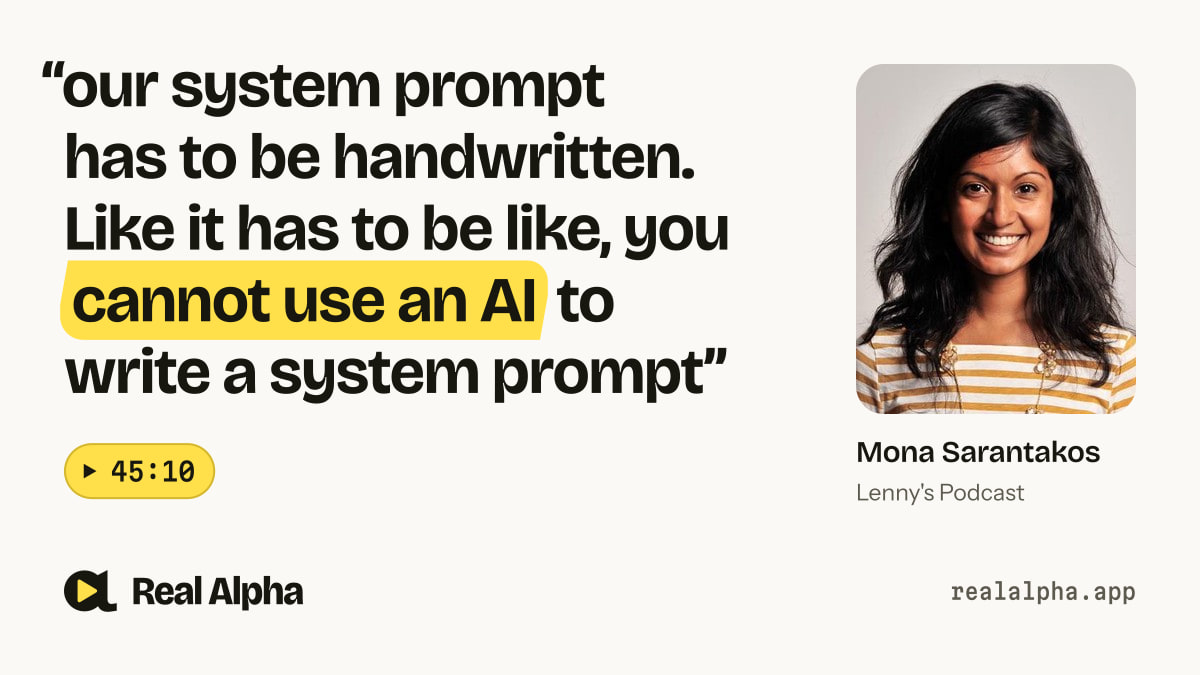
“our system prompt has to be handwritten. Like it has to be like, you cannot use an AI to write a system prompt”
 Mona Sarantakosat 45:10 · Lenny's Podcast
Takeaways
- Safety, capability, behavior, and use-case evals sit in distinct layers.
- PMs, engineers, and researchers all write evals.
- Humans review generated data; system prompts and behavior specs are handwritten.
About this segment
Muse groups evals into safety, capability, behavior, and use-case layers, with different priority levels. Humans review agent-generated data, while system prompts and behavioral specs stay handwritten.

Mona Sarantakos is VP of Product at Meta Superintelligence Labs.
Led product on Muse from day one, shaping Meta’s personal AI agent around proactive help and user trust.

Lenny Rachitsky, Host · Host, Lenny's Podcast
Spent seven years at Airbnb; his product newsletter has over 1M subscribers.
From “Meta’s Muse: How we launched the most successful consumer product this year | Mona Sarantakos”, Nov 15, 2026. Watch the full episode
Thanks. We'll look at and fix what's off.
Transcript
Transcribed by machine (Whisper) from the episode’s audio, so a word may be off here and there.
- 42:44
anxiety this is the job yeah oh man um i want to hear a bit more about the evals so the way i think about it is you just kind of have these evals that define success for all the core use cases and ways you expect people to use muse how many evals do you have roughly and who's who's writing these generally is it you is it pms is it engineers yeah and we have a ton i couldn't even of count the number because for sure like so the way that it is so there's major evals priority evals that we look at those tend to be like kind of core it's like you know there's some like if these don't exist the product isn't working safety is an example of that right um so we have like evals for prompt injection we have evals for general safety for you know harm like all of these kinds of things so like that's like a whole category we have a capability you know we have
- 43:35
capabilities versions of evals um you know how can like is it using the browser well is it able to you know task complete and then you have like behavioral evals um which is really about the personality of the agent and uh you know how it behaves with the user right um and in there you know you've got like is it asking follow-up questions is it you know how good Thank you. Is it an intent understanding, right?
- 44:02
Can it, like, figure out what the user is saying? And then you've got your use case evals, like, that kind of category, right, of the priority use cases. And so, and each of these have, like, lots of sub evals kind of within those that we create. And I think for any given time, like, again, there's, like, kind of, like, you're always priority evals. So anything that comes in has to, like, pass those.
- 44:24
Safety is the great example of that. And then there are these kind of like secondary evals that you don't really want to regress too much, but like, you know, maybe it's OK. You can trade off a little bit on. And so and then you've got kind of evals that are like more feature level, right, that, you know, specific teams have. So. So we have some hierarchy. We have a ton of these evals. People who write them, they are a range of people.
- 44:53
PMs write some evals. Engineers write a lot of them. Researchers write a lot of them. And we work with the agents, obviously, to be able to create these. But it's super important that people review all the data because I think that's where, when we don't, we always have issues. And so there's actually been this funny trend recently where our system prompt has to be handwritten. Like it has to be like, you cannot use an AI to write a system prompt, any part of it. It must be handwritten. The evals, the prompt distribution needs to be checked, right? Like you have to make sure, cause it's like, you have to make sure this is like matches to what the product reality is, right? The behavioral spec needs to be handwritten. And so we are like, we use agents a