The alpha, twice a week
That was 6 min.
Get the best new moments in your inbox every Wednesday and Saturday. It's free.
Check your inbox
We sent a link to your address. Click it to finish signing up. Not there in a minute? Look in spam.
or
Bloomberg Businessweek · 6 min · Nov 7, 2026
Musk needs political influence to protect his business interests
 Max Chafkin
 argues Musk’s companies depend on government rules, contracts and approvals, so he has reasons to stay engaged in politics.
The episode’s best minutes
Full analysis- 19:29Musk needs political influence to protect his business interestsPro pick 6 min
- 28:28Consumers keep spending despite gloomy sentimentPro pick 5 min
- 3 more moments in the full episode
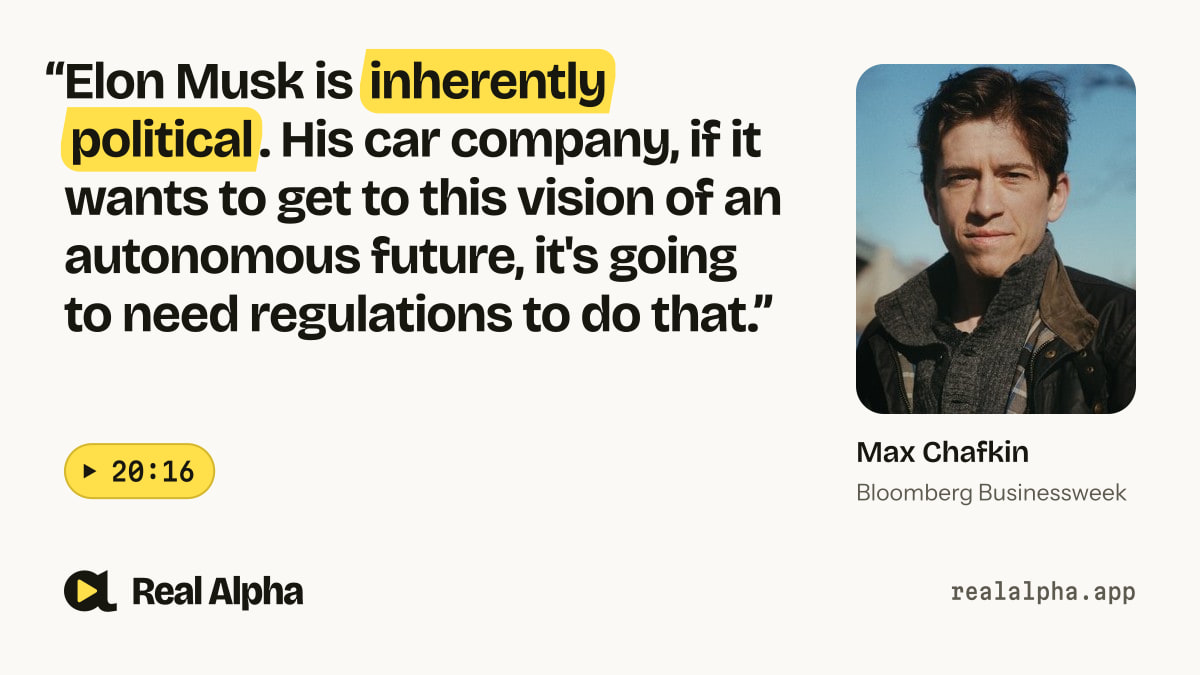
“Elon Musk is inherently political. His car company, if it wants to get to this vision of an autonomous future, it's going to need regulations to do that.”
 Max Chafkinat 20:16 · Bloomberg Businessweek
Takeaways Pro pick
- Tesla’s autonomous-driving plans depend on regulation.
- SpaceX relies on government business and faces potential competitors.
- Hearings and merger approvals could keep Musk politically engaged.
One of Pro's picks, open to you here. Try Pro free for 7 days
One of Pro's picks. The rest of the summary and the 3 takeaways are in Real Alpha Pro; the video, the quote and the transcript stay free.
Read it with Pro, 7 days freeAbout this segment
Max Chafkin argues Musk’s companies depend on government rules, contracts and approvals, so he has reasons to stay engaged in politics. Hearings and scrutiny could also push him to seek influence across party lines.

Senior Reporter, Bloomberg Businessweek
Wrote The Contrarian, a biography tracing Peter Thiel’s influence and Silicon Valley’s pursuit of power.
- CM
Carol Massar, Host

Tim Stenovec, Host · Co-host, Bloomberg
Interviewed leaders including Reed Hastings, Stephen Schwarzman and Mary Barra as a Bloomberg Businessweek co-host.
From “Trump Taps Stephen Miller as New Chief of Staff; Chip Stocks Climb After Rout | Bloomberg...”, Nov 7, 2026. Watch the full episode
Thanks. We'll look at and fix what's off.
Transcript
From the transcript Bloomberg Businessweek publishes with the episode.
- 19:31
So why do you argue that with all the money he's spent, the success that he had in 24, the lack of success that he had in 2026 max, Why do you argue that this is just a preview of what's to come? We'll see.
- 19:49
On Wednesday, Elon Musk, he's not someone who likes to be perceived as someone who loses, and he lost in a very big way.
- 19:56
We saw him delete a bunch of his social media messages. He deleted them? He deleted a bunch of Tallarico warnings, a message that said, vote red on Tuesday. So he dialed back just a little bit. I think there's a little bit of brand maintenance going on. You don't want to be associated with a necessarily losing cause. The issue is, Well, it's two things. One is that Elon Musk is inherently political. His car company, if it wants to get to this vision of an autonomous future, it's going to need regulations to do that.
- 20:31
He needs friends in Washington, friends in state houses and in foreign capitals as well to make this happen in the way he wants it to happen.
- 20:41
Same thing with SpaceX. This is a massive defense contractor. Yes, AI is becoming a bigger part of their revenue mix, but the federal government is still a major customer, and that touches the government. So that is one piece of it. The other piece of it is you have the Democratic Party now who are basically out for blood. I mean, there's a lot happening right now among Democrats who are either in Washington or about to get to Washington as part of the next Congress, but one of the things they're going to do is haul a bunch of these Trump-connected executives in front of Congress and investigate them in an attempt to, I think, get some reforms to perhaps lower prices or something, but of course also as a kind of political spectacle, as a way to satisfy their voting bases. And Elon Musk is very vulnerable to that.
- 21:29
You're seeing Democrats say some pretty extreme things right now. They're saying, oh, we need to nationalize SpaceX. We need to defund SpaceX.
- 21:37
Now, I don't know how... I don't buy it. Well, I mean, there's a question about how realistic that is. I don't buy it because he has the cards. Max, the government is a big client, a big customer of SpaceX because there's no alternative. Unless you want to go to Russia and launch on a Soyuz. So, well, a couple of things.
- 21:58
I mean, it is true that Elon Musk is a very, very important defense contractor. But there are other aerospace companies. Jeff Bezos is very quickly building his own Starlink competitor. There are competitors on the horizon. And you could imagine a situation where the U.S. government decides to put more.
- 22:23
Of its chips on those numbers rather than the Elon Musk number. And I think the other point is they don't necessarily have to defund Elon Musk, whatever that would mean, to make life very difficult for him. But just some hearings, some subpoenas would not surprise me if we're talking about Doge investigations or even Doge talk of criminal– So just the threat of that is going to be, I think, enough to keep Elon Musk engaged. And it's true. It's possible that he could try to win over the Democrats.
- 23:00
He's kind of flip-flopped over the course. Of his career. That's what I wanted to ask you. I mean, politics makes strange bedfellows.
- 23:05
My jaw is agape. Well, because people— You just blew my mind. Well, little— People run races. They're expensive, right? You need campaign donations. So it's kind of funny.
- 23:15
But look how he's viewed by so many people now. I mean, you just talked about his polling. Would a politician even want to accept that money for fear of being associated with him?
- 23:25
I think there are plenty of politicians that would gladly. you know. Welcome Elon Musk back into the fold if he, if he apologized and so on. But what I'll say is I'm not sure that American voters would do that. And that is going. To be an important, you know, the, the, and you look at the poll numbers there, they are not good. There's dark money made. Yeah.
- 23:43
It's just, it, there is the question of which Democrat would do that. And then on the Republican side, you have JD Vance, who is close to Elon Musk, who is the sitting vice president, who is clearly, uh, you know, angling to be the 2028 nominee. We saw that on Wednesday and yesterday. And he will be, I mean, he is kind of the front runner for the person who would have Musk's support. You're also seeing Ron DeSantis kind of vie for Elon Musk's support.
- 24:14
Tagging him on X. I don't see any Democrats, including some Democrats you might expect to be in this lane, like Gavin Newsom or something like that.
- 24:23
Gavin Newsom in the past was close to Elon Musk. It's kind of hard to imagine him finding a way. You'd be walking a very, very narrow line between populist outrage and the money of Elon Musk.
- 24:36
Well, speaking of the money of Elon Musk, I mean SpaceX is a massive– company. Tesla's a massive company. We're talking about the potential for them to come together. I think about our audience, it's an investing audience. A lot of people have exposure to this or other things within, you know, kind of the expectations around what Elon will do going forward.
- 24:56
How much of that, that wealth, those companies are at risk? Because of Elon falling out of favor. Yeah.
- 25:04
I mean, there's a reason. The stock is up again today. But I mean, we saw kind of a freak out
- 25:08
yesterday where Musk's companies fell by around 10% each. He has lots and lots of exposure here. The AI trade, which has its challenges right now, that is also an Elon Musk trade. He needs to keep this thing going. He needs data centers. His SpaceX is trying to get another data center built. in Southern Arizona right now.
- 25:34
He needs to be able to build these things. He needs to be able to avoid scrutiny.
- 25:38
And Carol, the merger that you mentioned, that is another thing that is going to need government approval. I mean, my expectation is that he will try to get that done before 2028. I think we're going to see lots of mergers try to get done before 2028 because of the concern that a new government comes in and you get a different policy.