The alpha, twice a week
That was 5 min.
Get the best new moments in your inbox every Wednesday and Saturday. It's free.
Check your inbox
We sent a link to your address. Click it to finish signing up. Not there in a minute? Look in spam.
or
Unsupervised Learning · 5 min · Oct 28, 2026
NeoCloud growth depends on debt and GPU resale value
 Erik Bernhardsson
 sees NeoClouds as viable but capital-intensive, with high leverage and limited differentiation.
The episode’s best minutes
Full analysis- 5:19Modal’s early sandbox bet became a major revenue line5 min
- 9:59Modal built core infrastructure to make cold starts faster3 min
- 42:58NeoCloud growth depends on debt and GPU resale value5 min
- 5 more moments in the full episode
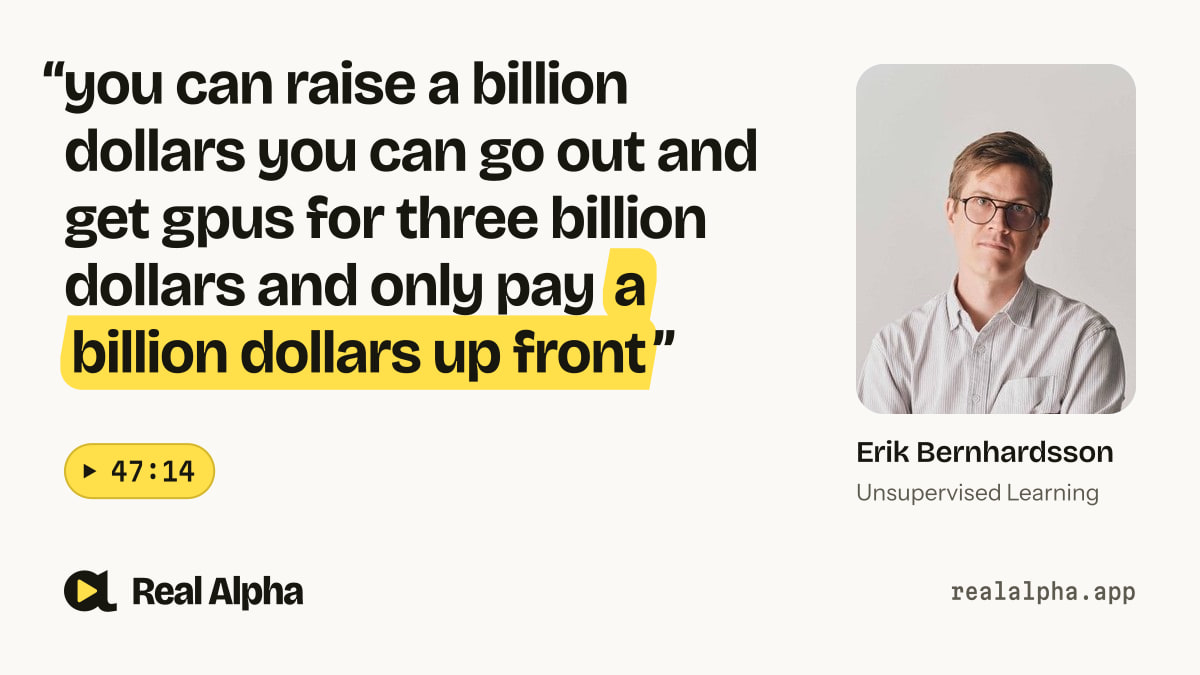
“you can raise a billion dollars you can go out and get gpus for three billion dollars and only pay a billion dollars up front”
 Erik Bernhardssonat 47:14 · Unsupervised Learning
Takeaways
- NeoClouds finance expensive hardware against customer contracts.
- High leverage makes their equity more sensitive to GPU prices.
- GPU resale value may help, but commitments require ongoing funding.
About this segment
Erik Bernhardsson sees NeoClouds as viable but capital-intensive, with high leverage and limited differentiation. He explains how GPU commitments create exposure to future funding needs, while resale value can cushion the downside.

Erik Bernhardsson is co-founder and CEO of Modal.
Co-founded Modal, the high-performance cloud for AI teams; previously led Spotify's music recommendation and data infrastructure teams.

Jacob Effron, Host · AI Investor, Redpoint Ventures
Growth investor in Abridge, Ramp and Physical Intelligence; ex-Flatiron Health.
- PC
Pat Chase, Host · AI Investor, Redpoint Ventures
From “Modal CEO on the Future of Inference, the Chaos of the GPU Market & Origins of the Sandbox Bet”, Oct 28, 2026. Watch the full episode
Thanks. We'll look at and fix what's off.
Transcript
Transcribed by machine (Whisper) from the episode’s audio, so a word may be off here and there.
- 43:00
maybe most top of mind these last few weeks i feel like there's been tons of discourse about neoclouds right they like you know how the debt's trading they've traded down they're kind of back up a little bit now and i'm curious like what do you think happens to this landscape over time I think the neoclots are like fine business models. I think people have been confusing it a little bit. They're like, wow, there's so much demand.
- 43:21
Revenue is going to grow so fast. And then there's a little bit of almost like a VC mindset of thinking in revenue multiples. But I think all of these neoclots, growth is actually quite expensive for them because they have to go and raise a lot of debt. And so I don't know if necessarily just because they grow a lot, it's very capital inefficient. Like these companies are at their core, like, you know, financing vehicles, like they're very, they're like, they're doing leasing, like of hard assets.
- 43:48
And that's, you know, that's like an inherently, you know, harder to scale the capital. Now that that market is kind of saying, well, we deployed a lot of capital into NeoCloud. It's like, maybe, maybe hold on for a second. Like, you know. We don't have that much more capital to lend. And so the interest is starting to go up. But also, by the way, like these companies have incredibly high leverage.
- 44:08
So of course, they're going to have more volatility. Like the residual equity value is going to go up and down much faster on the stock market with GPU prices and stuff like that. But they're like fine business models. Like, you know, they kind of locked in customer contracts and raised debt against it. And like, you know, now they're paying off that debt. And in many cases, it turns out the residual value has been higher than people expected.
- 44:30
Lifetime of GPUs has been longer than people expected. So they can resell once they paid it off like at a higher price than people thought. So like they're going to make a bunch of money from that. Like it takes a few years to get there. But I think in that sense, like Neoclass will do well. They're not particularly differentiated. So, you know, long-term, I think they're going to start with that.
- 44:47
Yeah, I mean, you work with a lot of them. Like, is there any differentiation you see? I mean, it's like a little bit, but like at its core, it's like, you know, like relatively undifferentiated space. So, I mean, my view is like, you know, I mean, Elon was, like, tweeting the other day, like, all the new clouds are going to die. Like, I think that's kind of bullshit. I do think Elon had a point when, like, basically, like, when he implicitly was saying, like, SpaceX has a much lower cost of capital.
- 45:12
I don't think there's a coincidence that if you look at the, like, the three successful hyperscalers, Amazon, Azure, or AWS, Azure, and GCP, that they're all attached to companies that have very solid cash flow. And they're all public companies that have very low cost of capital. because that at its core makes the life a lot easier if you want to build something that's very capital-intensive. So I think in general, that is something that Neoclasts will struggle with.
- 45:39
They're going to have a high cost of capital and it's going to be hard for them to grow fast because of that. So we'll see about the market, but they're like decent business models. I think there might be an opportunity to buy the dip. I don't know. You had an interesting tweet that was a lot of the Neo Labs could become NeoClouds, you know, if their model doesn't work out, but they have locked in these contracts.
- 46:03
I definitely could see the world going that way. If, you know, if you have valuable compute that continues to appreciate because there's so much demand. But yeah, I mean, Mistral kind of did that, right? And, you know, like it seems to be fine. I think a lot of people are making these like very large buying decisions and they kind of rationalize it. Like they're like, well, if you don't need the GPUs, we can just resell them, right?
- 46:23
Like that's almost like a form of insurance. And you have to, you know, assume with like all these Neolab, you know, there's so many Neolabs out there that have each raised $1 billion. They always raise exactly $1 billion for some reason. I don't know why. I guess they like that number. And then buying GPUs. Very precise financial modeling that points to that. Yeah. So some of them, I think, will probably work out really well.
- 46:47
And, you know, but I imagine in the grand, you know, like some of them will not work out. And if they don't work out, well, now they're sitting on a ton of GPUs. like you know let's resell those gpus right like especially if there's ever like a scenario where like vc funding pulls back because i think what's what's kind of a scary thing about some of these commitments is like you know effectively like what happens today when you make a gpu commitment is you only have to pay about 30 up front sometimes a little bit more sometimes a little bit less but what that means is like you can raise a billion dollars you can go out and get gpus for three billion dollars and only pay a billion dollars up front i mean not exact math but the problem is like you know in a year now you're on the hook for another few hundred million and like
- 47:28
every month like now you have to pay so so i i think that creates like a little bit of like implicit leverage in a lot of these companies and and and a dependence on subsequent fundraising and you know that works as long as they can go and raise vc dollars to fund the gpu bills but at some point it might not work and in that case i think you're going to see a little bit more of a secondary market where some of these Neolabs might, you know, pivot to doing a little bit more of the sort of NeoCloud style, like we have a bunch of GPUs or just resell it back to the cloud or I don't know.
- 48:00
Bullish on AI as a whole, but, you know, I always, like, look for these, like, sort of structural, like, risks. So, overall, I think there's going to be, like, incredible application, incredible demand. But, like, you know, is 100% of the Neolabs going to succeed and, you know, be a trillion-dollar company? Like, probably not.