The alpha, twice a week
That was 3 min.
Get the best new moments in your inbox every Wednesday and Saturday. It's free.
Check your inbox
We sent a link to your address. Click it to finish signing up. Not there in a minute? Look in spam.
or
Sourcery · 3 min · Jun 17, 2025
New categories need more top-of-funnel awareness
 Paul Klein IV
Klein says Browserbase must inspire developers to build in a category it is creating.
The episode’s best minutes
Full analysis- 30:01Director lets non-coders prototype browser automationsPro pick 3 min
- 41:26Start a company when no one else is building what you need3 min
- 10:42New categories need more top-of-funnel awarenessPro pick 3 min
- 5 more moments in the full episode
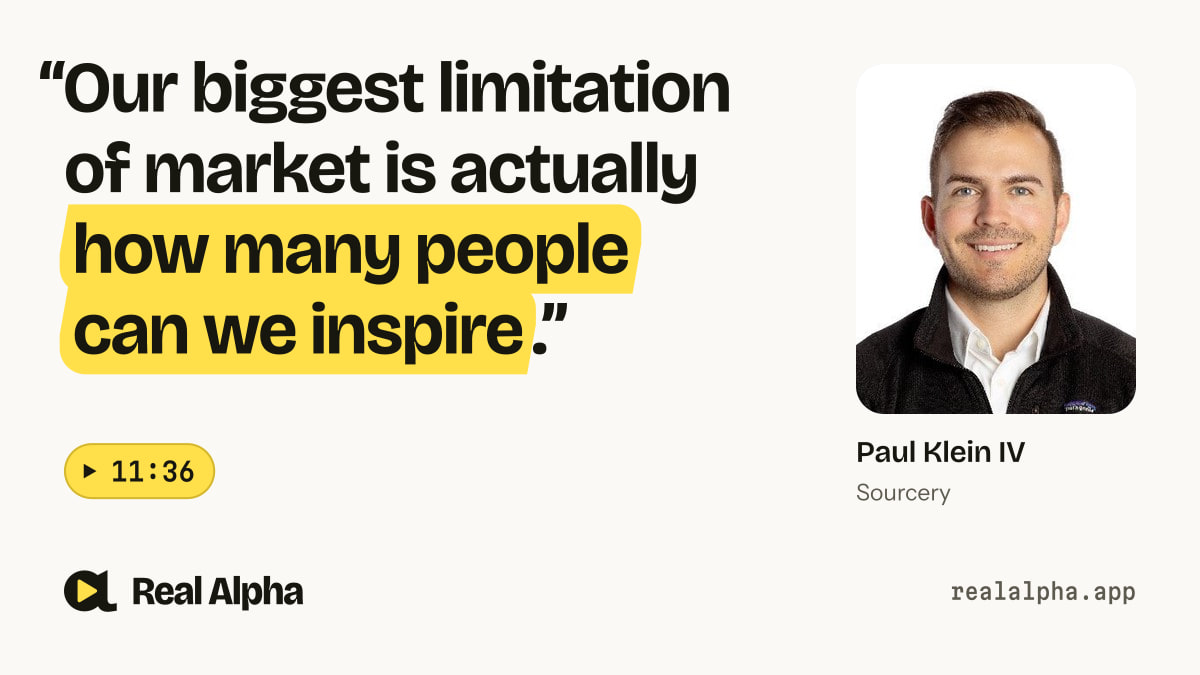
“Our biggest limitation of market is actually how many people can we inspire.”
 Paul Klein IVat 11:36 · Sourcery
Takeaways Pro pick
- New categories need awareness before sales-led targeting.
- Product and go-to-market efforts reinforce each other.
- Usage-based pricing aligns revenue with customers shipping.
One of Pro's picks, open to you here. Try Pro free for 7 days
One of Pro's picks. The rest of the summary and the 3 takeaways are in Real Alpha Pro; the video, the quote and the transcript stay free.
Read it with Pro, 7 days freeAbout this segment
Klein says Browserbase must inspire developers to build in a category it is creating. Product development and marketing reinforce each other, while usage-based pricing ties success to customers shipping.

Paul Klein IV is founder and CEO of Browserbase.
Founded Browserbase, web infrastructure letting AI agents navigate sites and complete tasks; co-founded Stream Club.

Molly O'Shea, Host · Founder, Sourcery
Ex-Upfront Ventures investor; has interviewed Alex Karp and Palmer Luckey.
From “How Browserbase Raised $67.5M to Power AI Agents & Vibe Coders”, Jun 17, 2025. Watch the full episode
Answers “How do AI companies make money?” See all 122 answers
Thanks. We'll look at and fix what's off.
Transcript
Transcribed by machine (Whisper) from the episode’s audio, so a word may be off here and there.
- 10:50
a very non-traditional way for an infrastructure company. Can you unpack how you determine how much time you want to spend on go-to-market versus product? Yeah. For us, I've really thought about what do those category-defining companies do well. And for BrowserBase, we are building in a new category. We earned our spot on the market map and created that. So to do category creation, you have to do a lot of top-level awareness.
- 11:17
You have to show people this is a thing, and if you want to do some sort of automation of a browser, you should think of BrowserBase. So I think it's a lot more top-of-funnel awareness than other infrastructure companies do. If you're building another database company, well, databases are kind of a well-known problem, right? And you can go maybe more top-down, sales-led, go into the customers that are in your ICP that need that problem.
- 11:40
But for us, we're inspiring a market of developers to go build. Our biggest limitation of market is actually how many people can we inspire. So on GoToMarket, we spend a bunch of time doing a lot more awareness, a lot more brand development, a lot more category creation to inspire developers to get started building on us. A lot of our customers are Greenfield. just starting and building these features and at the same time i'm a solo founder so you ask how do i break down go to market and product well i do a lot of both um and i'm lucky to have great you know teams on our epd our engineering product design and our go-to-market teams and great leaders on both of those teams actually but in the end i think there's not much difference because if you're building great product you can put that on the market and inspire people so i think they
- 12:25
actually are very closely interlinked uh we don't build one-off features for customers we have you know a thousand customers now and the way that we do product development is like every time we ship a new feature it's like well how many of our customers will this impact and what's the greatest common denominator of like requests that we can ship in a feature and when you have a large enough you know base of customers you get good direction on where you need to take the product to really improve it and we just kind of listen to the customers build that and then tell our customers about the features we're building and they end up talking about it out in the world too and we get to amplify that and support them and be their biggest cheerleader. I'll end with this. Our pricing models really align with the customer because we're usage-based. We only win when
- 13:05
they win. We only win when our customers succeed and they ship to prod. So a lot of the work I do is how can I help my customers win? How can I tell them, hey, here's how you should launch this product or here's some feedback I have after I use it? Because I really want our customers to have breakout success so we can be powering them and hopefully play a small part in their journey to building something very great. What are some of your most proud go-to-market strategy moments? Well, I think every fundraise we do a good job. I think we really are figuring