The alpha, twice a week
That was 2 min.
Get the best new moments in your inbox every Wednesday and Saturday. It's free.
Check your inbox
We sent a link to your address. Click it to finish signing up. Not there in a minute? Look in spam.
or
Bloomberg Businessweek · 2 min · Nov 13, 2026
New funds need several market cycles before reallocating capital
Bobby Jain says the top 20% of PMs generated 53% of first-year revenue, rising to 62–64% later.
In this episode
Full analysis- 33:09Jain chose Millennium for scale, not just capital5 min
- 13:06Jain built a diversified hedge fund all at oncePro pick 4 min
- 47:23Jain hires traders who understand portfolio risk4 min
- 16:58A hedge fund must build its operating platform before fundraising4 min
- 26:48New funds need several market cycles before reallocating capital2 min
- 55:11Multistrats lower the cost of capital for diversified strategies2 min
- 1:02:49AI will raise hedge fund entry barriers in the near term4 min
- 1:06:28SMAs let allocators reduce capital tied up in offsetting positions3 min
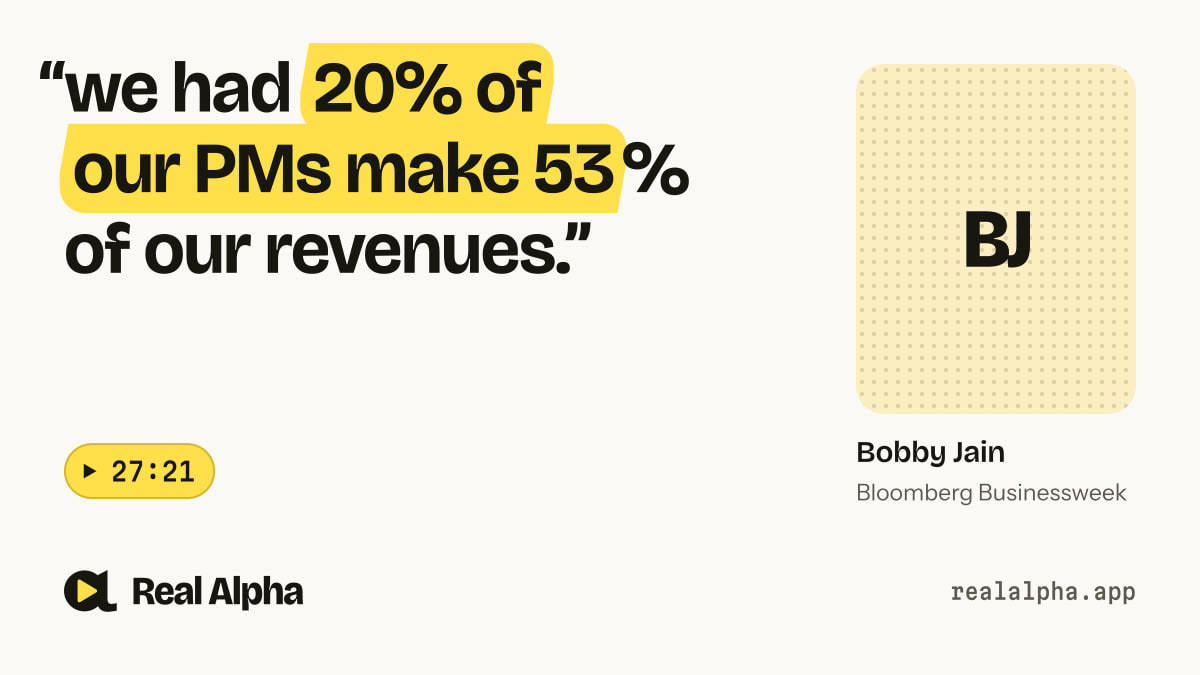
“we had 20% of our PMs make 53% of our revenues.”
Takeaways
- The top 20% of PMs made 53% of first-year revenue.
- Jain says that share rose to roughly 62–64% the next year.
- He says three years helps reveal how a strategy handles market cycles.
About this segment
Bobby Jain says the top 20% of PMs generated 53% of first-year revenue, rising to 62–64% later. He waits for strategies to pass through cycles before making larger allocations.
Bobby Jain is CEO and CIO of Jain Global.
Built Jain Global after leading investment at Millennium and holding senior trading roles at Credit Suisse.
- NK
Nishant Kumar, Host · Bloomberg
From “Special Episode: Bobby Jain on Why He Chose Millennium Again | Bloomberg Businessweek”, Nov 13, 2026. Watch the full episode
Thanks. We'll look at and fix what's off.
Transcript
From the transcript Bloomberg Businessweek publishes with the episode.
- 26:51
The biggest challenge that people don't know is that When you start, let's say you start everyone equal weighted. So now the business over time, you're going to give more capital to the people that are successful and you have higher conviction in. But two years is not a long time. So what we have is we have like our first year, we had 20% of our PMs make 53% of our revenues. And most firms at 20% of the PMs make 80% of the revenues. And so in a way, that's a very good thing. And another way, it's just because I didn't have the conviction to give the best people more capital. Okay, so then this year it's higher. It's 20, 60 something, I think 62, 64.
- 27:44
And it will go higher. Another way to look at it is our median Sharpe ratio across our PMs and our average Sharpe ratio. You actually want that number to be as high as possible. That shows you that you're doing a good job of capital allocations. Mine's actually not that wide. Because again, it takes time to forget the data to say, hey, and to get through the cycles. You start a strategy, you really want to live three years before you can live through enough cycles to say, I have the conviction. It just takes that long to start one of these strategies and to go through it. And when people say they want a three-year track record, it literally takes three years.
- 28:20
And so that's been the biggest challenge is just time. And now, frankly, I think it took us about 20 months to get mature. After about 20 months, I felt like actually I got through most of that. And so that's on the cost side. But it's really on the deployment side. The deployment side is the biggest challenge in launching these businesses. And there's no good way around it. There's no good way. If you're starting a hedge fund, how are you going to get through that deployment cycle?
- 28:47
You could just wing it and start, raise a bunch of money, and then. Just put it to work. But if you're going to do it properly and you're doing it for duration, you have to phase it in over time. And that's difficult.