The alpha, twice a week
That was 3 min.
Get the best new moments in your inbox every Wednesday and Saturday. It's free.
Check your inbox
We sent a link to your address. Click it to finish signing up. Not there in a minute? Look in spam.
or
The Real Eisman Playbook · 3 min · Oct 27, 2025
New investment wrappers can recreate old leverage risks
 Andrew Ross Sorkin
 sees echoes of 1920s investment trusts in private credit, tokenized stakes and crypto vehicles.
The episode’s best minutes
Full analysis- 42:22Fed political pressure worsened the Depression4 min
- 45:50New investment wrappers can recreate old leverage risks3 min
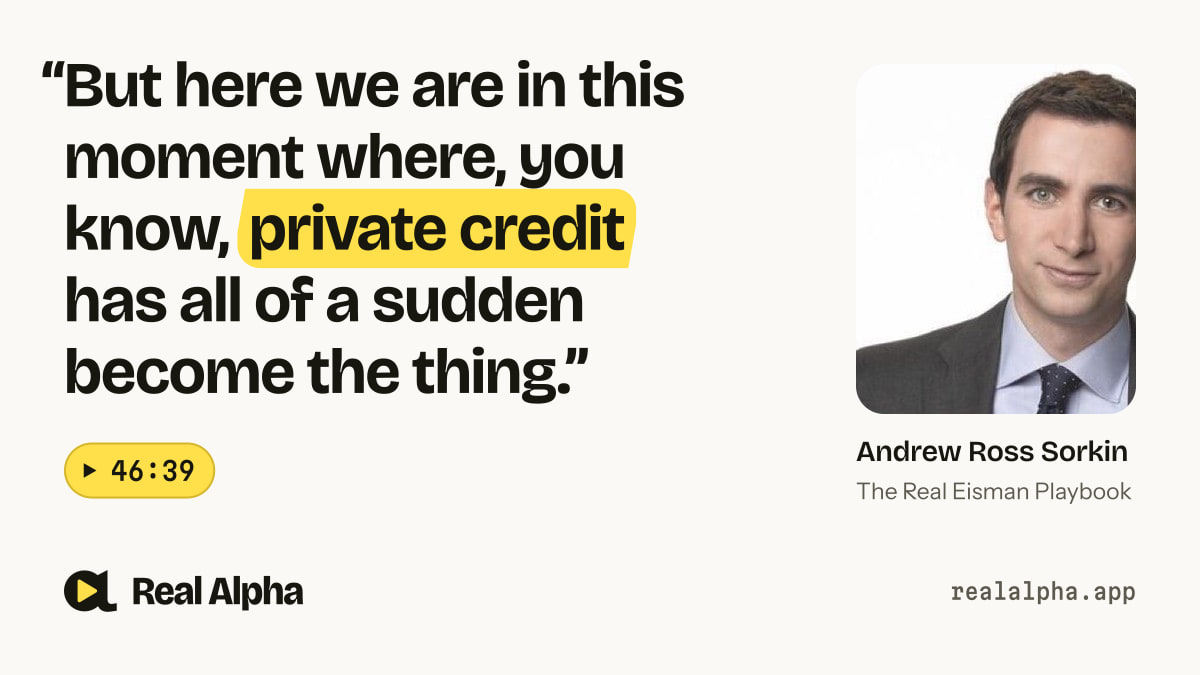
“But here we are in this moment where, you know, private credit has all of a sudden become the thing.”
 Andrew Ross Sorkinat 46:39 · The Real Eisman Playbook
Takeaways
- 1920s investment trusts bundled investments and added leverage.
- Sorkin compares some modern crypto vehicles to those trusts.
- He urges attention to new structures, not a prediction of another crash.
About this segment
Andrew Ross Sorkin sees echoes of 1920s investment trusts in private credit, tokenized stakes and crypto vehicles. He says layered structures and leverage deserve attention, without claiming a crash is imminent.

Andrew Ross Sorkin is author of 1929 and Too Big to Fail.
Founded DealBook and co-anchors CNBC’s Squawk Box; wrote the bestselling books 1929 and Too Big to Fail.

Steve Eisman, Host
From “Andrew Ross Sorkin on the Crash of 1929 & The Parallels We See Today | The Real Eisman Playbook”, Oct 27, 2025. Watch the full episode
Thanks. We'll look at and fix what's off.
Transcript
Transcribed by machine (Whisper) from the episode’s audio, so a word may be off here and there.
- 46:03
i don't know how much i would draw between the two books so much as one of the things and this was not something i expected as i was working on this is how much i found things that were happening in 1929 that felt very 2025 ish like what so if you think about the 1920s as this sort of revolution in finance. And there were all of these new products, investment trusts, folks are creating the equivalent of mutual funds, investment pools. There's all sorts of things that are happening in the investment community. It seems to me, and I don't think I, again, this was not my intent, and I'm not suggesting we're on the precipice of another 1929. But But here we are in this moment where, you know, private credit has all of a sudden become the thing.
- 47:00
Private equity and venture capital are about to be made available to us in 401k plans. Right. People are tokenizing private company, you know, stakes in private companies. So they can trade them. So they can trade them. They're buying them in, you know, special purpose vehicles and then they're chopping them up and who knows what. But, you know, the crypto guys are creating these, you know, the equivalent of investment trusts.
- 47:27
I mean, if you look at, you know, micro strategy now called strategy is kind of like an investment trust, designed to just buy crypto. They raise capital and they buy crypto. And it's leveraged. Right. And back in the 1920s, that's what an investment trust was. And it became a Russian doll. Right. Because it was leveraged. Unleverage. Unleverage. Unleverage. Unleverage. Yeah. And so I look at those things.
- 47:51
Again, I'm not suggesting we are there. I don't know what you'd be doing with your money these days as it relates to shorting the market or being long the market. But I think there are things that are happening that we need to pay attention to. And I'm actually hoping – again, this was not the goal of this book when I went into it. But I am hoping that as people think about some of these things that were happening then, they relate them to some extent to what's going on now and say, OK, we got to keep our eyes on this.
- 48:23
I just want to end with the moment in Too Big to Fail, which I thought was very important to me. And in some sense, if it wasn't so tragic, it was actually comedic.