The alpha, twice a week
That was 7 min.
Get the best new moments in your inbox every Wednesday and Saturday. It's free.
Check your inbox
We sent a link to your address. Click it to finish signing up. Not there in a minute? Look in spam.
or
Big Technology Podcast · 7 min · Feb 18, 2026
NotebookLM grew from a research tool into an audio product
 James Manyika
 traces NotebookLM from a five-person project grounded in users’ own sources to Audio Overviews and other experiments.
The episode’s best minutes
Full analysis- 27:55AI tutoring works best when it teaches the steps6 min
- 10:39NotebookLM grew from a research tool into an audio product7 min
- 1:11DeepMind gives researchers room to explore, then doubles down7 min
- 5 more moments in the full episode
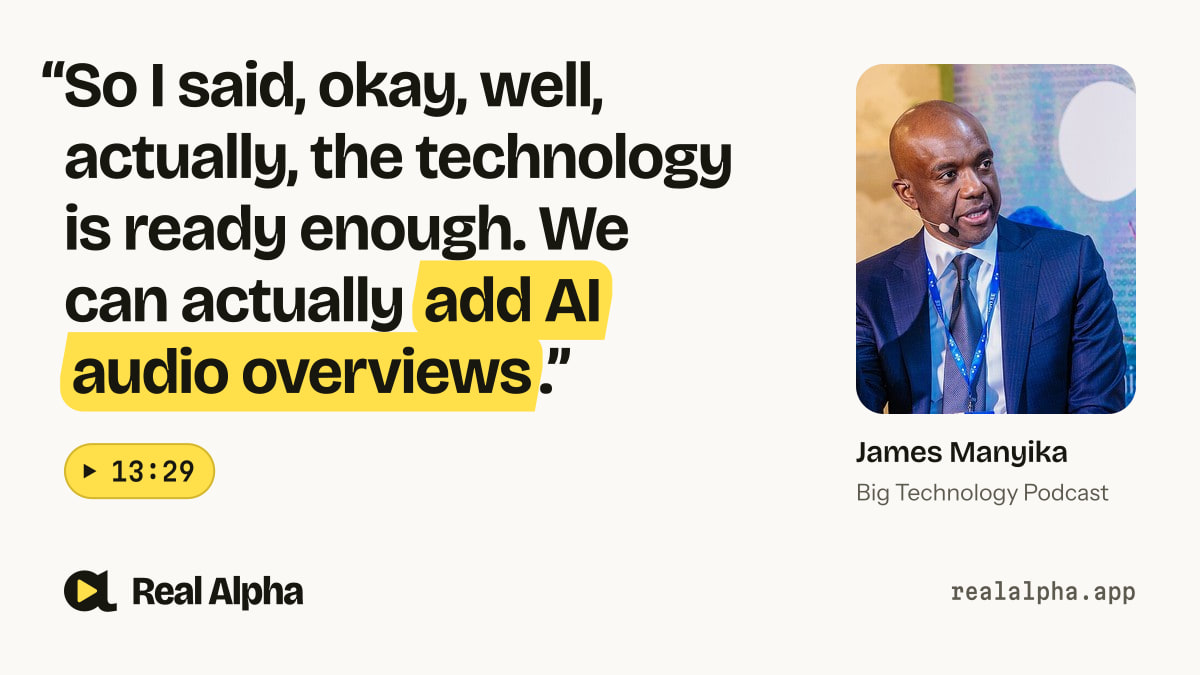
“So I said, okay, well, actually, the technology is ready enough. We can actually add AI audio overviews.”
 James Manyikaat 13:29 · Big Technology Podcast
Takeaways
- NotebookLM began as a research tool grounded in sources users provide.
- Audio Overviews started as a way to listen to research papers while commuting.
- Labs works with creatives to make experimental tools more useful.
About this segment
James Manyika traces NotebookLM from a five-person project grounded in users’ own sources to Audio Overviews and other experiments. He explains how Labs tests research in products and uses feedback from creatives to improve them.

Senior Vice President for Research, Technology, and Society, Google
Leads Google and Alphabet’s efforts to responsibly shape ambitious innovations for the benefit of people and society.

Alex Kantrowitz, Host · Founder, Big Technology
Former BuzzFeed News senior tech reporter and author of Always Day One.
From “How Google DeepMind Operates & Experiments — With Lila Ibrahim and James Manyika”, Feb 18, 2026. Watch the full episode
Thanks. We'll look at and fix what's off.
Transcript
Transcribed by machine (Whisper) from the episode’s audio, so a word may be off here and there.
- 10:44
So Google Labs, a lot of us who used Google products in the early days, you know we saw this era of experimentation within Google and then Labs went away for a bit not that Labs was the only bit of experimentation within the company but then Labs was revived and and it seems like we're starting to see many more experimental projects come out of Google proper in a way that we hadn't seen in a long time so how responsible is Labs for that and why why is Labs back? Oh Labs is so much fun so what actually happened was three years ago you know you know, this is a kind of an inspired, you know, Sundar moment said, let's reboot labs.
- 11:24
And, you know, we're in this AI moment. How do we kind of explore and experiment and build these AI first AI products that are totally AI first? So the idea with labs is let's take the most amazing research coming out of Google DeepMind and Google Research and any other place, quite frankly, in the company where there's incredible research and focus primarily on how do we build experimental AIF first products. I think what most people probably know of the most is what's now, you know, notebook L.M.
- 11:54
You know, the way that started, by the way, is incredible because I remember when I first encountered so many What is Notebook Element? Tell the story. So Notebook is fun. So it started out as a project called Tailwind. There were five people working on it. And the idea was, you know, can we build a very AI-native research tool that is grounded on what you put into it? So in other words, you know, your sources, you might have books, you might have papers, you might have drafts.
- 12:20
You may have whatever your content that you want to ground it on. Put it in Notebook and be able to engage with it. So that was the conception of the idea. And in fact, in some ways, he got an additional impetus from Stephen Johnson, who's a writer. And Stephen Johnson is one of these people who kind of keeps everything. So he has notes from the 90s and drafts of books and all kinds of things. He said, I'd love a product where I can dump all that stuff in and engage with it.
- 12:47
What was I thinking in 1997? What was that draft I did? And so what NotebookLM has become is this incredible research tool grounded on what you've put in. And when you engage with it and it summarizes or drafts something, it gives you these citations. And that's in some ways is a key feature of it. So if it says, Alex, you said this or your source says this and summarizes in some way, it'll give you citations.
- 13:15
If you want, you can click on the citations. They take you all the way back to the original content, which is incredibly useful. Then a fun thing happened, which was, So it was already a very useful tool. Then we said, well, actually, you know what? Sometimes I want to hear my sources as opposed to just engage with them. So I said, okay, well, actually, the technology is ready enough. We can actually add AI audio overviews.
- 13:41
Which is like effectively a podcast. You can have it with like two hosts. You can have it. Actually, the original, the idea wasn't even to do that. So initially, the idea was a few of us, you know, Jeff Dean and this legendary Jeff Dean said, well, actually, you know what? we're reading all these papers that are coming out at this incredible pace in the computer science field it'd be nice to be able to hear a summary of them verbally while i'm driving into work or something so just you know and then i can figure out which people i'm going to read so that was the original idea they said actually no you know what it's it's easier to learn stuff when you have you hear people talking about it engaging that's why seminars are interesting right as a learning mechanism so that's where the idea came from so we did these audio overviews which you know in the
- 14:23
form of a podcast or a discussion with two hosts discussing it and now it's evolved and that's when The product just kind of took off. Yeah, whenever I give a presentation about AI, that's the party trick, where I build one of these notebooks in front of the audience, and then I hit play on the podcast, and people who haven't seen it before, it's like a jaw-drop moment. And in fact, we've had multiple people on our YouTube feed and coming from the podcast, they've asked, Alex, did they train on your voice?
- 14:51
Because it sounds a lot like me. And I say, no, listen, they always say, let's unpack this at the beginning, and you have to understand every podcaster says so it's not me actually you know one of the most fun use cases of a notebook by the way is um because now you can put in things in all kinds of formats that can be papers that can be youtube videos that can be whatever's on your hard drive uh one of my fun use cases was actually when i had to do this thing where i was seeing all these papers from literally over 100 countries in different languages so i put them all in and just engage with content in multiple other languages because notebook lm can handle multiple languages and now you can do video overviews and so but i think it can make like an animated not an animated video but a video with like graphics with graphics and slides but i think this is an
- 15:36
example of the kind of thing that happens in labs where we try to take this incredible research that lila and colleagues and others are doing at google deep mind and google research to say how do we build amazing ai first products flow is another example and if you play oh i just so i i'll tell you a story about flow then i'll let you talk a little bit more about it um i just did a a my first and last mountain climb and it was cotopaxi in ecuador right and i wanted to make a video sort of capturing the moment uh but there were a couple things that happened that i just could not that i didn't videotape because i decided to spend the climb actually climbing as opposed to youtubing which is apparently from what i hear rare these days and there was a moment where my water bottle fell out of my backpack and rolled up down the glacier and then kind of disappeared into the
- 16:24
darkness. And I wanted to illustrate that. So I went to flow the Google video generator. And I said, I want to make an animation documentary style to show this and slotted that into the video. So now you can, and before I would have to hire an animator. Now you can do it. Yeah, it's incredible. But I think, well, you know, flows an example of the magic that happens in labs. So I remember a bunch of us got together. So Josh, who runs labs and, you know, Demis and a few of us say, what if we put all these tools we now have together into something that's actually useful?
- 16:53
And in fact, the initial version of it that we have, you know, in some ways was. clunky uh then we said well actually let's just talk to some actual filmmakers and get their input so one of the things that happens in labs by the way is we try to engage a lot with creatives and others uh to help us think about how we build these tools so anyway that's how flow came about it's you can build scene by scene prompting into video yeah and you can have continuation i think that's probably where the name comes it can flow and and what you just said was an insight that came from filmmakers in fact the initial version said no no what you've got is actually not very useful i'd like to be able to build things scene by scene and be able to stitch them together be able to do this so you know so that's why it's been helpful so if you say what is labs it's a
- 17:37
place where we try to experiment with all these things at any one time we probably have about 30 experiments cooking so if you go to the google lab site you'll probably see about 30 different things but i have a request for you broaden the access because there's a lot of product you know