The alpha, twice a week
That was 6 min.
Get the best new moments in your inbox every Wednesday and Saturday. It's free.
Check your inbox
We sent a link to your address. Click it to finish signing up. Not there in a minute? Look in spam.
or
Bloomberg Businessweek · 6 min · Nov 24, 2026
Nvidia’s board lacked meaningful oversight of its CEO
 Dorothy S. Lund
Dorothy Lund says long-standing ties to Jensen Huang left Nvidia’s board weak on guardrails, succession planning and compliance.
The episode’s best minutes
Full episode- 30:37Companies can own specialized AI models for less8 min
- 12:13Nvidia’s board lacked meaningful oversight of its CEO6 min
- 5:27AI’s long-term promise does not guarantee near-term sales2 min
- 2 more moments in the full episode
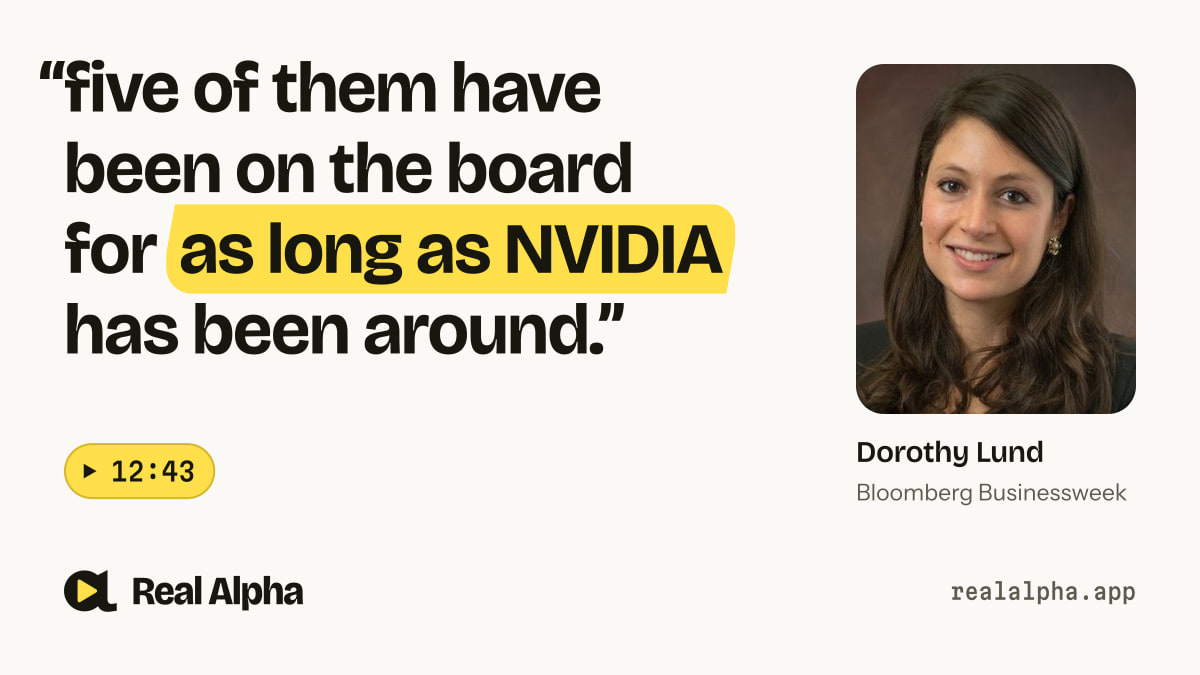
“five of them have been on the board for as long as NVIDIA has been around.”
 Dorothy Lundat 12:43 · Bloomberg Businessweek
Takeaways
- Long board tenure can weaken practical independence.
- Lund says the board lacked guardrails and succession planning.
- A CEO’s influence can make compliance oversight harder.
About this segment
Dorothy Lund says long-standing ties to Jensen Huang left Nvidia’s board weak on guardrails, succession planning and compliance. The episode raises questions about what board independence means in practice.

Columbia 1982 Alumna Professor of Law & Faculty co-director, Columbia Law School
Studies corporate governance and securities regulation, co-directs Columbia’s Millstein Center, and co-hosts Beyond Unprecedented.
From “Nasdaq 100 Tumbles as Nvidia Euphoria Fades | Bloomberg Businessweek”, Nov 24, 2026. Watch the full episode
Thanks. We'll look at and fix what's off.
Transcript
From the transcript Bloomberg Businessweek publishes with the episode.
- 12:15
She joins us here on this Tuesday. Professor Lunn, good to have you here with us. What's your take on the board? I mean, are they an independent board? Did they really mess up here? I don't know. How do you describe it?
- 12:32
I would say this is a weak board, right? This is a board that is although it's technically independent in that the people who populate the board are not currently working at NVIDIA. This is populated with people who've been, five of them have been on the board for as long as NVIDIA has been around. And so these are people who have close, longstanding relationships with Jensen Huang that have become very wealthy as a result of their board service.
- 12:59
And so it's, you know, I think, they also have a proven track record at this point of, you know, up until this point, I should say of saying yes to Jensen, you know, allowing Jensen to pursue his vision unobstructed. And again, that's worked out pretty well for them until it really didn't. And so I think again, weak board. And I think, you know, the reason I think things have gotten, it is, it is a corporate governance story.
- 13:29
And that I think the reason we are where we are today is because this board is didn't put guardrails on, didn't have a succession plan, didn't have a compliance officer, wasn't taking this job as seriously as they could have. And the job being, as a board of directors, a key role is to monitor management and make sure that they're pursuing the business.
- 13:52
Vision, complying with law, all of that. And I think they were overly caught up in the Jensen magic without necessarily putting the guardrails on that, that were needed.
- 14:07
Well, we know there will be a chief compliance officer, but I'm, I'm wondering Dorothy, what other ways this board can improve? Like how does it become stronger? Do you think the board needs to be wiped clean and there need to be all, all new directors on the board or board members? Do you think that there, there needs to be a complete shift in the way the company is structured? Like what's your view?
- 14:28
I mean, it's hard to know where you can go from here, where you, you know, I think the message that the employees and the public got yesterday is that Jensen can do what he wants without any real consequence, right? And so, you know, I question, you can imagine if we were starting as compliance officers at NVIDIA tomorrow and we discovered all sorts of issues, right? who we're reporting to is Jensen Huang. And Jensen Huang is going to say, well, I learned my lesson, right? I learned my lesson that It doesn't really matter.
- 15:03
And so- Isn't this why, coming off the great financial crisis, in some ways, bank CEOs are removed from the board? We wanted a firewall of sorts between the board and really the CEO. And I think it's even tougher when it's a founder, CEO, and member of the board. It's really hard, especially when the story is going so well for so long. It's hard to come up against that.
- 15:30
Yeah, no, exactly. I think, you know, this company was, you know, Jensen's company.
- 15:34
It has been, you know, governed in the way he would like, right, with this really flat organizational structure, with compliance roles being informal, spread across management, no board chair, no succession plan. And, you know, again, it's like, it's not crazy to say, well, this has really worked for us. Look at the value we've created. Look at the growth that we've had. It's not crazy to not you know, to say, well, this is working, why, you know, we shouldn't mess with it.
- 16:01
Uh, but it's really hard to change that, right. To bring this person back, the founder, the visionary, the person who's used to operating with no guardrails and, and, you know, the rule of Jensen.
- 16:15
So can I ask you, what's the lesson learned here? And I guess, you know, we have a president who intervened and we like, you know, went to this board. I don't know. I mean, is this a message being sent to boards around the country that if you're friendly with the White House, you might get a pass? I mean, I'm not quite sure this was a special, unique relationship. Yeah.
- 16:43
I mean, we're in an era of heightened presidential interference in business. And although this is really accelerated with this administration, I will say some of this was going on in the Biden administration with the CHIPS Act. You know, so I think that.
- 16:57
What do you mean? Like what part of getting involved in board decisions? Because it doesn't seem like there's actually precedent for what happened on Sunday.
- 17:06
Well, as you just mentioned, during the Obama administration... which was, again, a financial crisis, right? So very different scenario.
- 17:14
But there was a governmental effort to, as part of the bailout of these companies, for example, take the GM CEO and force him out, right? So it's not, again, this. Isn't unprecedented in extreme circumstances. I think what's new and different about right now is that this is happening in a non-crisis moment, right? not pursuant to a government bailout, and that the government is proudly advertising. Like, you know, this is not a private, this is not a choice made by private market participants, right?
- 17:49
This is something forced down.