The alpha, twice a week
That was 3 min.
Get the best new moments in your inbox every Wednesday and Saturday. It's free.
Check your inbox
We sent a link to your address. Click it to finish signing up. Not there in a minute? Look in spam.
or
Bloomberg Businessweek · 3 min · Nov 26, 2026
NVIDIA’s China business could turn political access into a liability
 Gautam Mukunda
 argues that export-control scrutiny will force Huang to prioritize compliance over boundary-pushing.
The episode’s best minutes
Full analysis- 20:26Founders need peers and boards prepared to replace themPro pick 4 min
- 26:01NVIDIA’s China business could turn political access into a liability3 min
- 2:56Volatility may persist until implied-volatility sellers return2 min
- 2 more moments in the full episode
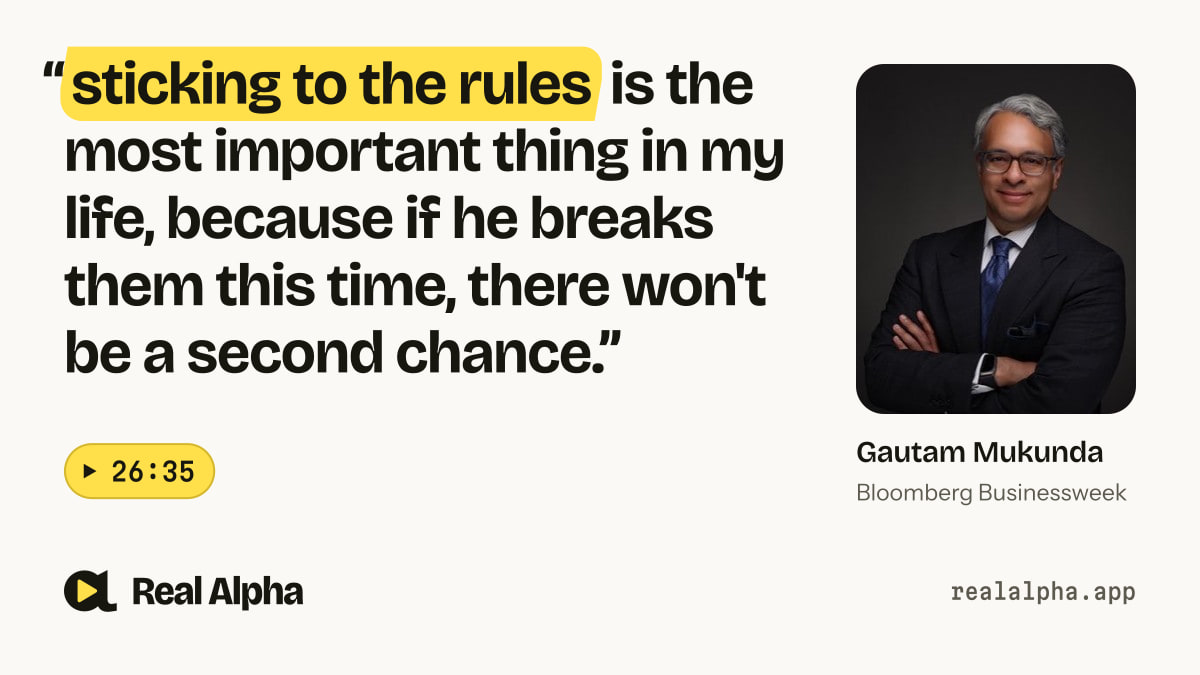
“sticking to the rules is the most important thing in my life, because if he breaks them this time, there won't be a second chance.”
 Gautam Mukundaat 26:35 · Bloomberg Businessweek
Takeaways
- Export controls are a bigger leadership test than personal misconduct.
- Political access can bring short-term benefits and long-term costs.
- Corporate records may remain exposed even if a leader pleads the Fifth.
About this segment
Gautam Mukunda argues that export-control scrutiny will force Huang to prioritize compliance over boundary-pushing. His past access to the Trump administration could become a liability as the company faces investigations and congressional questions.

Opinion Columnist, Bloomberg Opinion
Studies leadership and innovation across public and private sectors, and wrote Indispensable and Picking Presidents.
- CM
Carol Massar, Host

Tim Stenovec, Host · Co-host, Bloomberg
Interviewed leaders including Reed Hastings, Stephen Schwarzman and Mary Barra as a Bloomberg Businessweek co-host.
From “Stocks Pare AI-Driven Losses as Buyers Step In | Bloomberg Businessweek”, Nov 26, 2026. Watch the full episode
Thanks. We'll look at and fix what's off.
Transcript
From the transcript Bloomberg Businessweek publishes with the episode.
- 26:03
I mean, so there are multiple layers of that, right? The first is he has got to accept that whatever his personal relationship with Donald Trump, whatever he's been able to negotiate with Howard Lutnick, whatever he did, that's all over now. Right. That's that's done because the scrutiny is on. The Democrats are on. There will be a law. There's virtually certainty there will be a law saying no more chip exports to China.
- 26:25
That is over. And so he cannot push boundaries. Right. He's going to have to go from someone who is like the rules are a thing that I leave behind me on my way to greatness to someone who's like sticking to the rules is the most important thing in my life, because if he breaks them this time, there won't be a second chance.
- 26:43
Well, and it also speaks to how much of that access to the White House and President Trump has really been a big benefit for NVIDIA overall. If you think about this in what is a really pretty severe AI race here.
- 27:03
Yeah, so it clearly was a big benefit to NVIDIA in the sense of right when they had said, you're not allowed to sell chips anymore, he was essentially able to call Donald Trump reverse the decision, and keep open to Chinese markets. The problem is, I think that what's happening is those short-term benefits are now coming with some pretty gigantic. Long-term costs, right? Because the Trump administration has built its entire industrial policy, its entire global strategy, its entire rhetorical pose on the American economy around this idea that the most important thing in the world is beating China to AI supremacy.
- 27:35
You may think that's right or wrong, but that is their approach. And if you want to do that, the most important thing in the world, the one fundamental, you know, indispensable component is making sure that China does not get top-tier NVIDIA chips, and they seem to have been getting. Them, right? And Jensen Huang has been lobbying to get them. So that is an enormous vulnerability now, and it puts the interests of the Trump administration and the interests of Jensen Huang in direct conflict, which they never had been before, because NVIDIA has to say, right, if there's any evidence that these chips got out past American laws, NVIDIA has to say that the reason this happened is because the Trump administration gave us the okay. And the Trump administration is not going to want to admit that because that
- 28:20
makes them look really bad. So then what's his approach to next week when he heads before Congress? I mean, what is he thinking? What's the best way to handle that as he goes? Is he just going to plead the fifth and not say anything? I highly doubt it.
- 28:31
But what's his approach? I mean, I don't know, right? His lawyers, like it's hard for me to imagine that his lawyers aren't telling him you need to plead the fifth, but that would look extraordinarily bad from a corporate perspective, right? And, you know, and sort. Of Pleading the Fifth, he can do in testimony, but it doesn't protect NVIDIA corporate records, which are going to get subpoenaed. Even if you believe the Trump administration just tries to brush this all under the rug, which they seem to be trying to do, the next administration is going to subpoena them on Inauguration Day. So there– I mean he's– this is the sort of thing– he's really caught in a bind here, and I'm not sure how he gets out of it.