The alpha, twice a week
That was 6 min.
Get the best new moments in your inbox every Wednesday and Saturday. It's free.
Check your inbox
We sent a link to your address. Click it to finish signing up. Not there in a minute? Look in spam.
or
Bloomberg Intelligence · 6 min · Oct 30, 2026
Oil near $100 a barrel may be close to a demand-destruction point
Vincent Piazza weighs record refining results and strong cash generation against peak-cycle risks and geopolitical uncertainty.
The episode’s best minutes
Full analysis- 0:51Memory shortages are deepening Intel’s PC and margin slump3 min
- 4:33Amazon’s spending outlook matters more than its e-commerce slowdownPro pick 2 min
- 10:02Oil near $100 a barrel may be close to a demand-destruction point6 min
- One more moment in the full episode
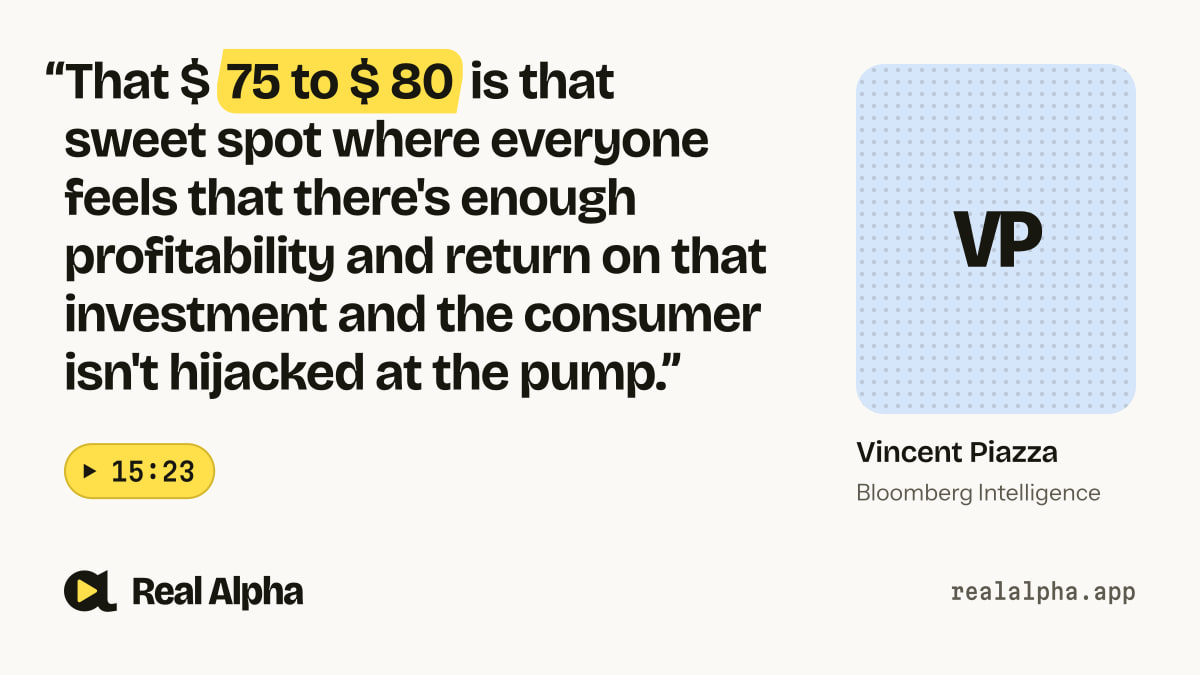
“That $ 75 to $ 80 is that sweet spot where everyone feels that there's enough profitability and return on that investment and the consumer isn't hijacked at the pump.”
Takeaways
- Exxon generated $19 billion in free cash flow in the quarter.
- He is becoming more cautious about earnings beyond 2027.
- He sees $75–$80 oil as a better balance for producers and consumers.
About this segment
Vincent Piazza weighs record refining results and strong cash generation against peak-cycle risks and geopolitical uncertainty. He says $75–$80 oil is a better balance for producer returns and consumers than $100 crude.
Senior Equity Research Analyst, Bloomberg Intelligence
- PS
Paul Sweeney, Host · Bloomberg Intelligence
- SF
Scarlet Fu, Host · Bloomberg Intelligence
From “Intel Shares Plunge After Outlook Hit by PC Slump, Supply | Bloomberg Intelligence”, Oct 30, 2026. Watch the full episode
Thanks. We'll look at and fix what's off.
Transcript
From the transcript Bloomberg Intelligence publishes with the episode.
- 10:04
Yeah, you know, the refining side once again coming through for both Exxon and Chevron for both, you know, utilization very strong, throughput very, very strong, the spreads extremely strong. So we're coming close to that part of the cycle where you ask yourself, how much can things get better? You have WTI 104, Brent 117 today, both Exxon and Chevron. Hitting new highs. Valuations approaching the upper bound of the last five years.
- 10:41
So you ask yourself, does it feel like you're close to a peak? If we have benchmarks that continue down this path over 100 bucks, You could see a lift in 4Q earnings.
- 10:56
But how do things get better from here? Hard to say. So if you're an investor in these names and you're reading the tea leaves aside from war. Where would the benchmark be? So I think as I scrub the models for 2027, I'm starting to get a little bit more cautious with respect to the earnings cadence from here, aside from any kind of benefits of 4Q. The one thing I would say, Paul, is that these guys are throwing off a boatload of free cash flow. $ 19 billion this quarter alone for Exxon.
- 11:36
Net debt is down significantly. The cash is up. So you wonder what happens for 2027 if share buybacks are going to be held relatively flat. That's a lot of firepower to go into a year of uncertainty.
- 11:50
So that brings me to my next question. What do they do with all that cash? I mean, share buybacks is kind of an obvious answer. Of course, these are dividend paying companies, but how else do they deploy it?
- 12:03
So Exxon and Chevron have acquired in the past. You know, Chevron is digesting Hess after a bruising battle with Exxon. Exxon, of course, bought Pioneer in the Permian. As you think about the next growth cycle, what happens as you push past 2027 and 2028? Is there more LNG to invest in?
- 12:26
Are there other companies here in the U.S. to a purchase, just given that the relative multiple advantage and the cash hoard that they have. You mentioned the dividends. Yes, they do pay modest dividends, so you could see some upside there if trends do continue. Again, Exxon held its share of purchases relatively flat for 2027, so there's a lot of firepower there for both not only inorganic growth, via M & A, but also organic growth as well, as it has other projects it can invest in in Guyana and elsewhere.
- 13:02
Hey, Vince, we're hearing from over the last month or two from the Trump administration and from some third party observers that, you know, quite a lot of oil is getting through this trade of Hormuz here. If so, why is Brent at $ 117 a barrel?
- 13:18
Yeah, that's what I'm questioning as well, right? Because the reality on the ground is things are getting closer to a more normal cadence through the Hormuz.
- 13:31
But there's also the geopolitical risk of collapse. Potential strikes after the midterms and what that could mean for global balances as well. So I think there's a lot of uncertainty there. And that's why you're seeing the geopolitical risk premium remain in WTI and also Brent. And that's why you're seeing these names still have some life to them as we get closer to the end of this cycle.
- 13:58
How do you think about the midterm elections and the risks of a Democratic controlled Congress? What does that mean for?
- 14:06
Well, yeah, I guess it's more of a drumbeat with respect to a windfall profits and the the excess cost at the pump for a lot of consumers with these high prices. The only thing is the refiners are really going full out. It's not like they're holding back utilization on the refining side. So they are maxing out. So that's not the issue. And I think there's going to be a little bit of uncertainty post and midterms, but a lot of it is wait and see. And that's why there is a great deal of uncertainty and volatility in the overall commodity space for the energy markets.
- 14:43
So as you well know, Vince, I'm an astute viewer of Landman. I know all things about the energy business, the oil and gas business here. West Texas doesn't necessarily like WTI over $ 100 a barrel because that might be some demand destruction here. Are we seeing that at all? Well, you know what?
- 15:02
I think comments from, I think it was BP or Shell earlier said they are seeing some demand destruction. Look, $ 100 crude does no one any good because it does reduce demand. As I think we've talked about in the past, Paul, you know, $ 100 is right at that level of demand destruction. $ 60 is no good for the industry. That $ 75 to $ 80 is that sweet spot where everyone feels that there's enough profitability and return on that investment and the consumer isn't hijacked at the pump. We're not there yet. And, you know, quite frankly, I thought we were going to get there with tensions being ratcheted down some. But in the last month or so, we've seen these marks scream off the terminal here. And that's really a function of the ratcheted up of tensions as we get closer to the midterms and after the midterms as well.