The alpha, twice a week
That was 4 min.
Get the best new moments in your inbox every Wednesday and Saturday. It's free.
Check your inbox
We sent a link to your address. Click it to finish signing up. Not there in a minute? Look in spam.
or
a16z Podcast · 4 min · Nov 20, 2026
One $200 AI subscription is enough for most of DHH’s work
 David Heinemeier Hansson
DHH says one $200 subscription usually gives him enough agent capacity, despite having access to more.
In this episode
Full analysis- 4:03Linux’s old usability problems become advantages for agents4 min
- 17:04Agents make the last 2% of software more rewarding to perfectPro pick 4 min
- 25:39Open-weight models keep frontier AI competition honest6 min
- 21:02One $200 AI subscription is enough for most of DHH’s work4 min
- 32:13Omarchy could overtake macOS within three years4 min
- 44:20AI is bringing pseudonymous hackers back into computing7 min
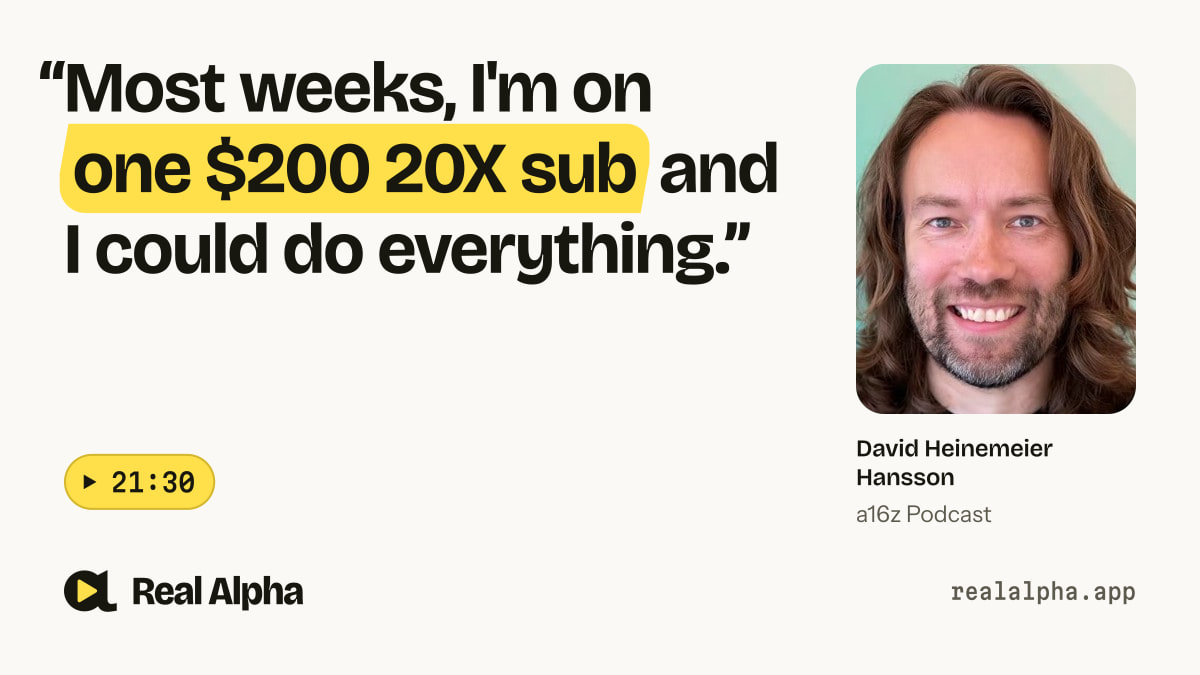
“Most weeks, I'm on one $200 20X sub and I could do everything.”
 David Heinemeier Hanssonat 21:30 · a16z Podcast
Takeaways
- He keeps three Claude subscriptions but rarely hits their limits.
- Most weeks, one $200 20X subscription is enough for his work.
- He sees AI far ahead in software compared with robotics.
About this segment
DHH says one $200 subscription usually gives him enough agent capacity, despite having access to more. He sees coding agents as far ahead of robotics.

David Heinemeier Hansson is a software developer and creator of Omarchy.
Created Ruby on Rails and Omarchy Linux; CTO of 37signals, maker of Basecamp and HEY.

Erik Torenberg, Host · General partner, Andreessen Horowitz
Helped build Product Hunt; founded On Deck, Village Global and Turpentine.
From “Why AI Has DHH Working 16-Hour Days”, Nov 20, 2026. Watch the full episode
Thanks. We'll look at and fix what's off.
Transcript
Transcribed by machine (Whisper) from the episode’s audio, so a word may be off here and there.
- 21:13
Even more so is this fact of just how cheap it is. I mean, I made the quip on X, I don't know, a month ago. I have unlimited tokens, right? Because, okay, I've been working for 20 years. I'm rich at this point. I could buy as many tokens as I want. Do you know how many tokens I buy? I got three clawed subscriptions. That's it. And I can remember two weeks out of the last three months where I actually maxed or got close to maxing those out.
- 21:42
Most weeks, I'm on one $200 20X sub and I could do everything. So don't tell me that this moment is just reserved for people who literally have unlimited money. It totally is not. And this is frontier stuff. We're not even talking about open weight models or any of the cheaper models or running things with Luna or optimizing any of those things. I'm just fucking Opus 5.5, fix everything. And there we go, right?
- 22:07
Like I am saturated in terms of what I can move forward and we can move forward at this lightning pace. So yeah, I think there's still room for humans, but I'm also not so vain to believe that that's necessarily going to last forever. I think it's entirely possible that by next year we will have true super intelligence that's just better at humans at everything. And they will be better even than me at polishing the perfect computer and you could just say to me, make me a great computer.
- 22:32
Whoopity-doop-doop. It does a Linux kernel bespoke for you and everything else. And there we go. So I'm savoring this moment where the human for maybe a blink of an eye is still extra, is still additive to the process while having this amazing capacity. And then, I don't know, maybe we're all dead at the end of next year. So enjoy it. I have to ask, So do you have in your head your, like, David superintelligence test that you, like, test every...
- 23:04
So I'll give you an example. So here's my superintelligence test is every time there's a new model, I ask it to, like, go buy all of the stuff it needs to embody itself. Like, my house constantly has, like, robotics partners. I'm not kidding. so I gave it I give it like a twenty thousand dollar budget and I'm like just go build your robot you know and then so things show up and like you know OLED displays show up and you know whatever and like we're just not at the point where it's even close to being able to do that but that's like my ASI test as soon as I have like a walkable autonomous, robot, that it built itself by ordering parts.
- 23:43
I'm just wondering if you have like a similar, like now you know it's arrived. I don't, I probably should, but what I have is this sensation that for software development, we already have super intelligence. Oh, for sure, yeah. The AI is better than any programmer I've ever known when you consider the breadth of its ability. There are individual parts where individual super programmers I know are still able to one-up the agents in very narrow fields, but you take the whole thing together and you take the pace by which they do it, we already have super intelligence, right?
- 24:18
So I can build anything, literally anything that I want just by prompting and sort of steering a little bit, right? But what's interesting about your example with the robots was I was just in China, whatever, two weeks ago, and we went to see Unitree and we went to see the other one. Talking to the guys at Unitree, they have a very different perspective of this from what I hear from Silicon Valley, which is, I was just watching this Dorquette's interview.
- 24:43
He was talking to someone who's saying like, by next year, maybe we're going to have this super intelligence is going to have rapid takeoff. Uniture guys are like, ah, I don't know, four years, five years, maybe 10. So there's a weird mix here where the folks working on the software side of things are like, oh my God, this is just about to happen. And the people working on actuators and mechanics and whatever are like, ah, I don't know.
- 25:05
Maybe it's actually quite hard to peel an onion or whatever.