The alpha, twice a week
That was 4 min.
Get the best new moments in your inbox every Wednesday and Saturday. It's free.
Check your inbox
We sent a link to your address. Click it to finish signing up. Not there in a minute? Look in spam.
or
Big Technology Podcast · 4 min · Jan 16, 2026
Open models give enterprises control over critical AI
 Arthur Mensch
 says open models let enterprises control deployment and customize systems around proprietary knowledge.
The episode’s best minutes
Full analysis- 1:39Model commoditization shifts value downstream4 min
- 15:55Open models give enterprises control over critical AI4 min
- 39:57AI can automate complex shipping and factory workflows6 min
- 5 more moments in the full episode
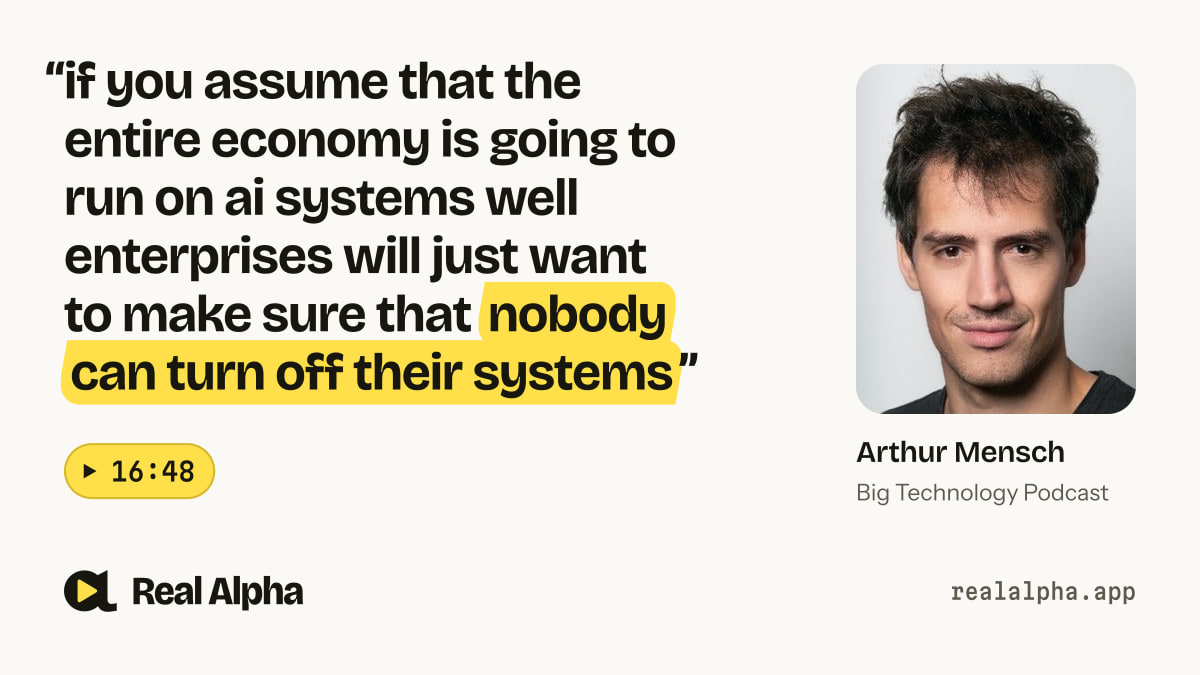
“if you assume that the entire economy is going to run on ai systems well enterprises will just want to make sure that nobody can turn off their systems”
 Arthur Menschat 16:48 · Big Technology Podcast
Takeaways
- Open models can keep essential AI systems running on a company's terms.
- Customization can turn employee knowledge into a proprietary asset.
- Control and portability reduce dependence on a single vendor.
About this segment
Arthur Mensch says open models let enterprises control deployment and customize systems around proprietary knowledge. That matters when AI becomes critical infrastructure and vendor dependence is risky.

Arthur Mensch is CEO and co-founder of Mistral.
Co-founded and leads Paris-based Mistral AI as CEO; named to Time's 100 Most Influential People in AI.

Alex Kantrowitz, Host · Founder, Big Technology
Former BuzzFeed News senior tech reporter and author of Always Day One.
From “Who Wins if AI Models Commoditize? — With Mistral CEO Arthur Mensch”, Jan 16, 2026. Watch the full episode
Thanks. We'll look at and fix what's off.
Transcript
Transcribed by machine (Whisper) from the episode’s audio, so a word may be off here and there.
- 15:59
Okay, so let me see if I can sort of game this out here a little bit. So if that is going to be the key driver of value in the AI world, there's two ways to do it. One is to build a model that's better than everybody else and sell it for a premium. But we've already talked about the fact that that doesn't seem like it's going to be a moat forever. and the other way is you know the model is actually not the value it's the know-how of and and the implementation side of things so you can make the model open source but then provide a service to businesses to be able to figure out how to take that model and put it into action and actually get results are those the two choices uh yeah that's uh it's kind of the fork that we see in the industry uh and uh our view there has been to be at on the second one uh to really the open
- 16:45
source implementation which brings customization but it also brings decentralization in that if you assume that the entire economy is going to run on ai systems well enterprises will just want to make sure that nobody can turn off their systems so the same way if you have a factory you connect it to to the grid you want to make sure that nobody's going to turn off the grid because they don't like you if ai effectively becomes a community which is what's happening and if you treat intelligence as electricity then you just want to make sure that your your access to intelligence cannot be throttled and so that's also one of the things that open source technology can bring and if you're using open source you don't have to worry about like going astray of i'm just saying like anthropics you know user terms and so then pausing your ability to do
- 17:33
what you do if you use open open source you can basically run it on your own terms yeah you run it on your own terms. You create the redundancy you need. You can serve with higher quality of service. You can make sure that whatever the geopolitical situation may be, you can still run the systems if you want. And then, so that's really on the IT side. So if I'm a CIO, I really look at open source as a way to create leverage and independence. But more on the scientific side, it's also the only way in which you can create systems that are effectively using the folklore knowledge of your employees, that's the knowledge that you've accrued for decades.
- 18:13
The only way in which to turn it into an asset that nobody gets access to is to create your own models based on those open source models. And so that's, but it's hard. It's hard to actually build those. And so that's where you need the right tools. You need the right expertise. And that's like the complement business model to building open source models. But even the closed source model providers, companies like Anthropic, will say they'll be able to customize their models with your data.
- 18:36
You don't believe that? they will say that but then they will put some guardrails on top of it so you're basically trusting that their engineers are going to give you enough access to the depth of the system and can you trust that for for for eternity i'm not sure The issue there is as much a question of control as a question of customization. A vendor is going to try to lock you in. If you get access and if you build on top of open source models, like our open source models or anyone, you're basically less locked into the vendor. This is a technology which is so important that you don't want to be locked into a single vendor. That's also the opportunity we bring.
- 19:19
You know what's stunning to me? We're three years past ChatGPT, which basically brought this into a lot of people's consciousness, although I think big technology listeners would have known about it a little bit beforehand,