The alpha, twice a week
That was 6 min.
Get the best new moments in your inbox every Wednesday and Saturday. It's free.
Check your inbox
We sent a link to your address. Click it to finish signing up. Not there in a minute? Look in spam.
or
Core Memory · 6 min · Dec 1, 2025
OpenAI funds exploration to find the next research paradigm
 Mark Chen
 explains how OpenAI ranks hundreds of projects and why it backs exploratory research over chasing competitors’ benchmarks.
The episode’s best minutes
Full analysis- 8:16OpenAI funds exploration to find the next research paradigm6 min
- 59:58Pre-training still has room to scalePro pick 4 min
- 1:09:16OpenAI wants AI to conduct research end to endPro pick 6 min
- 5 more moments in the full episode
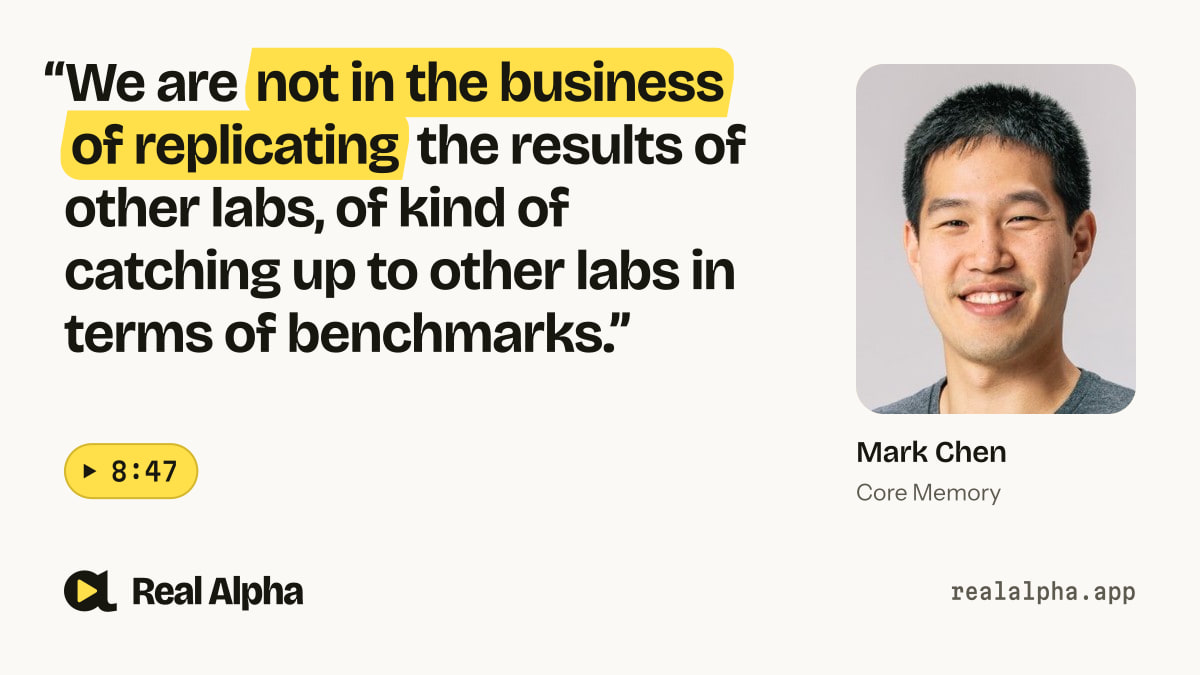
“We are not in the business of replicating the results of other labs, of kind of catching up to other labs in terms of benchmarks.”
 Mark Chenat 8:47 · Core Memory
Takeaways
- The research team ranks roughly 300 projects every one to two months.
- More compute goes to exploration than to training the final model.
- OpenAI backed reasoning before it was a popular direction.
About this segment
Mark Chen explains how OpenAI ranks hundreds of projects and why it backs exploratory research over chasing competitors’ benchmarks. He points to an early bet on reasoning as an example of why that approach can pay off.

Mark Chen is chief research officer at OpenAI.
Led the teams behind DALL-E and Codex and visual perception in GPT-4, now oversees OpenAI's research.

Ashlee Vance, Host · CEO, Core Memory
Wrote the best-selling biography Elon Musk; covered tech for Bloomberg Businessweek, The Economist and The New York Times.
From “How OpenAI Shapes Its Research And What's Next - EP 46 Mark Chen”, Dec 1, 2025. Watch the full episode
Thanks. We'll look at and fix what's off.
Transcript
Transcribed by machine (Whisper) from the episode’s audio, so a word may be off here and there.
- 8:28
keep track of all that and then come to some sort of conclusion about what merits GPUs and what doesn't. Absolutely. So I think it is very important when doing this exercise to keep the core roadmap in focus. And one thing that differentiates, I think, OpenAI with other big labs out there is OpenAI has always had core exploratory research at its core. We are not in the business of replicating the results of other labs, of kind of catching up to other labs in terms of benchmarks.
- 9:07
That isn't really our bread and butter. We're always trying to figure out what that next paradigm is. And we're willing to invest the resources to make sure that, you know, we find that, right? And I think most people might be surprised at this, but more compute goes into that endeavor of doing exploration than it is to training the actual artifact. it must be it's still got to be how do you stop yourself from being persuaded by someone because everybody's going to put i you know like when i think about this sometimes i picture when i was at the new york times you have this page one meeting where everybody wants to be on page one everybody thinks their story is the most important story they're all doing their very best job to tell you why this thing is so important everybody in that room has worked weeks months on whatever
- 9:55
they're pitching. And so it feels like life and death. And that, yeah, I mean, it just seems so difficult for me. Yeah, no, it is also a difficult process. And I think the hardest calls you have to make are, you know, this is a project that we just can't fund right now. But I also think that's good leadership. You need to clearly communicate that, hey, these are the priorities. This is what we're going to talk about. These are the types of results that we think move the research program.
- 10:22
and you know there can be other things but those have to be clearly number two and when you like you were talking about um not being reactive to your competitors yeah when i was looking through my notes i don't know if i could go to the line quick enough but i mean this this was like a point of pride that i saw that you feel like um some of the other companies are well you know you guys were in this position where you were ahead um and and setting the bar for others and so so they were reactive right to what you had coming out we happen to be doing this interview a few days after Gemini 3 came out and you know there is a degree to which your rivals um at times like yeah I mean there's this back and forth going on and and I know the benchmarks are sort of controversial how valuable they are, but people go ahead on these things. So how do you also, as time has
- 11:19
gone on, maintain that luxury or that intellectual position where you feel like we're just going to do what we're going to do? Yeah. I think AI research today, the landscape is just much more competitive than it's ever been. And the important thing is to not get caught up in that competitive dynamic, because you can always say, hey, you know, I'm going to ship an incremental update that puts me in front of my competitor for, you know, a couple of weeks or a couple of months.
- 11:47
And I don't think that's the long-term sustainable way to do research, because if you crack that next paradigm, that's just going to matter so much more, right? You're going to shape the evolution of it. You're going to understand kind of all the side research directions around that sphere of ideas. And so when you think about kind of our RO program, as an example, of this, right? We bet more than two years ago that we're really going to crack RL on language models. And this was a very unpopular bet at the time. You know, right now it seems obvious, but back then the environment was, hey, you know, there's this pre-training machine that's working great. There's this post-training machine that's working great. Why invest in something else? And I think today everyone would tell you, you know, thinking in language models,
- 12:29
it's just a primitive you can't have uh can't live without and um so we're we're really there to make these bold bets and to figure out how we can scale and build the algorithms to really scale to orders of magnitude more compute than we have today this is you know i mean and i get that intellectually in my you know it gets harder as you guys started as a like basically a pure research company when you look at open ai today i mean you have product lines there's parts of open ai that look much more familiar to a mature microsoft or a google where you have product lines you've got all these different things that you have to serve typically i feel like you guys are still young enough so maybe you don't have these exact pressures yet but you know as those companies go on it always becomes well we're more focused on the things that are serving the bottom line
- 13:21
than spending a ton of money on research always seems to get like dwindled down over time. Yeah. And I think that's really one of the most special things about OpenAI. At its core, we're a pure AI research company. And I don't think you can say that of many other companies out there. And, you know, we were founded as a nonprofit and I joined during that era. And I think the spirit is, you know, build AGI, advance AGI research at all costs and do it in a safe way, of course. But yeah, I actually do think that's the best head fake to really creating value, right? If you focus and you win at the research, the value is easy to create. So I think there's a trap of getting too lost into like, oh, you know, let's drive up the bottom line. When in reality if you do the best research that part of the picture is very easy and you you started in