The alpha, twice a week
That was 4 min.
Get the best new moments in your inbox every Wednesday and Saturday. It's free.
Check your inbox
We sent a link to your address. Click it to finish signing up. Not there in a minute? Look in spam.
or
The Real Eisman Playbook · 4 min · Nov 16, 2026
Oracle's OpenAI bet leaves it with a high-wire business
 Dan Ives
 says Oracle has cut staff and repeatedly raised capital to fund its OpenAI bet while its core business is under pressure.
In this episode
Full analysis- 7:56Google search faces a slow shift in advertising dollarsPro pick 6 min
- 37:21CoreWeave’s debt costs put equity holders at risk5 min
- 47:15Slower AI capex could extend the data-center cycle4 min
- 13:57Oracle's OpenAI bet leaves it with a high-wire business4 min
- 17:24Intel's margins point to execution problems, not just a weak PC market3 min
- 30:29AI's impact on software depends on the product category6 min
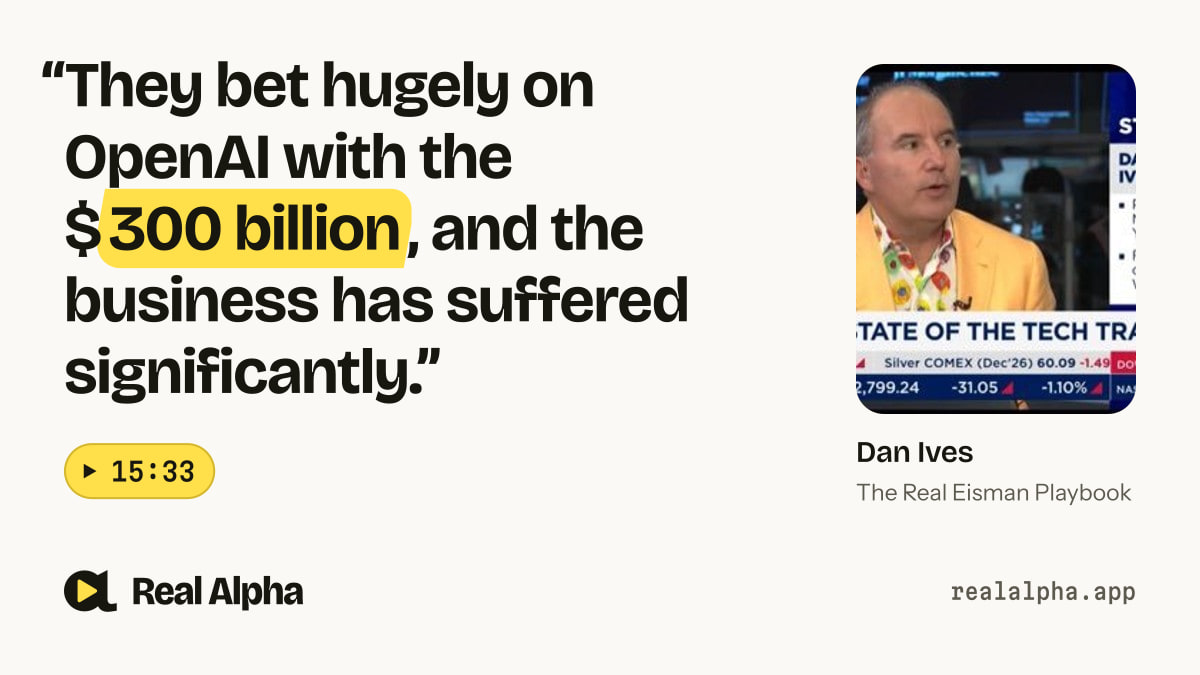
“They bet hugely on OpenAI with the $300 billion, and the business has suffered significantly.”
 Dan Ivesat 15:33 · The Real Eisman Playbook
Takeaways
- Oracle's database business generates cash to help cover interest costs.
- Its financing needs and strained core business create risk.
- The upside depends on execution and OpenAI delivering.
About this segment
Dan Ives says Oracle has cut staff and repeatedly raised capital to fund its OpenAI bet while its core business is under pressure. Luria says database cash flow helps, but execution failures or OpenAI disappointment leave substantial downside.

Partner & senior managing director, tech analyst, Yorkville Ives
Built a globally recognized technology research franchise, covering software and broader technology markets for over 25 years.

Steve Eisman, Host
From “The Blue Wave Meets AI: What the Midterms Mean for Data Centers | The Real Eisman Playbook Ep 84”, Nov 16, 2026. Watch the full episode
Thanks. We'll look at and fix what's off.
Transcript
Transcribed by machine (Whisper) from the episode’s audio, so a word may be off here and there.
- 14:09
I'll take you first. I mean, that's the one that we're most cautious on because my view is like, I know so many people at Oracle over the years, the gold standard. I mean, if I look at like software tech, I could go through every company and like a handful of people starred at one point at Oracle. So many of those people have either been cut or left because of all the layoffs that they've done. They've cut into the muscles, the bone, in order for this data center build out to happen. And that to me is the issue is like the capital raises never stop. The debt raises never stop. Just a secondary this week. And yet the core business is suffering. The hyperscalers are able to raise money, and there's cuts around, you know, across the board, but they're able to continue to sort of build out their business. Oracle is trying to be a hyperscower. The open
- 15:07
AI revenue, I get it. It's just in this market right now, they just, I think they just made the wrong bet. I mean, that's sort of my view. What do you mean they made the wrong bet? They bet the whole, it's no different than like in baseball, when a company spends so much of their salary cap or whatever. On one guy. On one guy. And then after four years and that guy's not like Stanton or whatever, but he's played like 40 games in four years.
- 15:37
You're like, we should have just went the way of Tampa and Kansas City and others that have built the farm system. Oracle is a good example. They bet hugely on OpenAI with the $300 billion, and the business has suffered significantly. And investors are basically like, how could you own the stock knowing every week there's just going to be another debt raise, another equity... Gil. It's a high wire act. Same question. Yeah, it's a high wire act. Here's the thing. We're going to agree that hyperscaler is very good business. Right. Neocloud's probably bad business. We'll get to that. Guess what's right in the middle of that? Oracle. Oracle.
- 16:18
Okay. Right. Because they do have a core business that's very cash generative, right? Oracle databases are not going away. It's a 50% margin business. It's paying the interest on the loans that we're taking to build data centers. Which is a little bit of what the hyperscalers are doing. It's just that the hyperscalers have such better balance sheets, and Oracle already had a challenge balance sheet because of Cerner and other acquisitions they made.
- 16:42
So it's a high wire act. If they execute perfectly, the stock is a multiple of where it is today, but it's a high wire act, because if they don't execute well, if OpenAI doesn't materialize, there's a lot of downside. And also, you don't come off those conference calls Like, those calls don't instill confidence. No. Why? No. Why? Why? Because it just feels like there's pilots in the plane. You're not sure.
- 17:07
Just so you understand, we're talking about the quarterly conference calls when they give you an update. Why does that not give you confidence? Because you don't understand the direction of the business. Some of the stuff is sort of like long-hand, like word salad-ish. You feel like, is Ted Stryker flying the plane? The reference is to a movie called Airplane. But go ahead. And I think that, I think that's part of it. It's part of like the Intel, that like that last Intel call, you came off.
- 17:33
I'd be like, I got to go to the bar or something like that.